
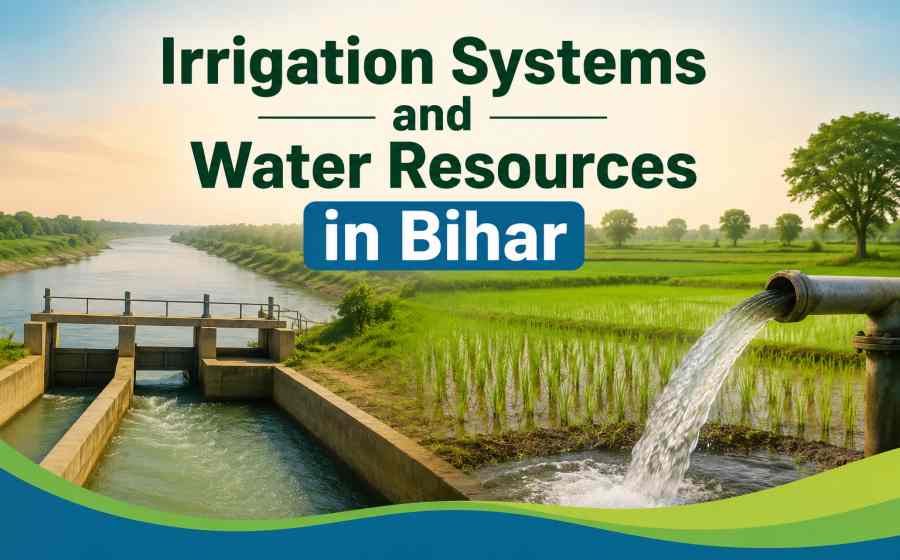
Irrigation Systems and Water Resources in Bihar – Lifelines of Agriculture
Discover the importance of Irrigation Systems and Water Resources in Bihar, including canals, rivers, tube wells and their role in agriculture.
Irrigation Systems and Water Resources in Bihar
Bihar is one of India’s most fertile states, with agriculture serving as the backbone of its economy. A large portion of the state’s population depends directly or indirectly on farming for their livelihood. Since agriculture relies heavily on an adequate water supply, irrigation systems and water resources play a vital role in ensuring successful crop production. Although Bihar receives considerable rainfall during the monsoon season, its uneven distribution often creates challenges for farmers. Therefore, effective irrigation infrastructure is essential for maintaining agricultural productivity throughout the year.
Table of Contents
Importance of Irrigation in Bihar
Irrigation refers to the artificial application of water to agricultural fields to support crop growth when natural rainfall is insufficient. In Bihar, irrigation is particularly important because agriculture is practiced across different seasons, including Kharif, Rabi, and Zaid crops.
Reliable irrigation helps farmers in several ways:
- Ensures a steady water supply during dry periods.
- Increases crop yields and productivity.
- Supports multiple cropping practices.
- Reduces dependence on unpredictable monsoon rainfall.
- Improves food security and rural incomes.
With a growing population and increasing demand for food, efficient irrigation has become a necessity rather than a choice.
Major Water Resources in Bihar
Bihar is naturally blessed with abundant water resources. The state has an extensive river network, groundwater reserves, ponds, and reservoirs that contribute significantly to irrigation.
1. Rivers
Rivers are the primary source of water in Bihar. The state is traversed by several perennial and seasonal rivers originating mainly from the Himalayan region.
Some important rivers include:
- Ganga: The lifeline of Bihar, flowing from west to east through the state.
- Kosi: Often called the “Sorrow of Bihar” due to its frequent floods.
- Gandak: An important source of canal irrigation.
- Bagmati: Supports agriculture in northern Bihar.
- Kamla: Provides water to many districts.
- Mahananda: Beneficial for eastern Bihar.
These rivers provide irrigation water directly and also feed major canal systems.
Groundwater Resources
Groundwater is another crucial source of irrigation in Bihar. The fertile alluvial plains possess rich underground water reserves, making groundwater extraction highly feasible.
Farmers commonly use:
- Tube wells
- Bore wells
- Dug wells
- Pump sets
Private tube wells have become increasingly popular because they provide immediate access to water and are suitable for small and medium farmers. In many regions, groundwater accounts for a significant share of total irrigation.
Major Irrigation Systems in Bihar
Bihar uses both traditional and modern irrigation methods. The major irrigation systems include the following:
Canal Irrigation
Canal irrigation is one of the oldest and most important irrigation methods in the state. Water from rivers is diverted through an extensive network of canals to agricultural fields.
Major canal projects include:
Sone Canal System
The Sone Canal System is among the oldest irrigation projects in Bihar. It derives water from the Sone River and irrigates districts such as:
- Bhojpur
- Buxar
- Rohtas
- Patna
- Aurangabad
This canal system has played a significant role in boosting agricultural production in southern Bihar.
Gandak Irrigation Project
The Gandak Project utilizes water from the Gandak River. It benefits several districts in north Bihar and also extends into neighboring states.
Its objectives include:
- Irrigation development.
- Flood control.
- Improved agricultural output.
Kosi Project
The Kosi Project was developed to manage floods and provide irrigation facilities. It includes embankments, barrages, and canal networks that support farming activities in flood-prone areas.
Tube Well Irrigation
Tube wells have emerged as the most widely used irrigation source in Bihar. They can be categorized into:
Government Tube Wells
These are installed and maintained by government agencies to provide affordable irrigation facilities to farmers.
Private Tube Wells
Individual farmers or groups invest in private tube wells. Their popularity has increased due to:
- Quick water availability.
- Greater control over irrigation schedules.
- Flexibility in crop planning.
However, excessive dependence on groundwater requires careful management to prevent depletion.
Traditional Water Sources
Before the expansion of modern irrigation systems, rural communities depended on traditional water structures.
These include:
- Village ponds
- Ahars (water storage reservoirs)
- Pynes (traditional channels)
- Small tanks
The Ahar-Pyne system, particularly prevalent in southern Bihar, is a unique indigenous irrigation practice that stores rainwater and distributes it to fields. Reviving such traditional systems can contribute to sustainable water management.
Challenges Facing Irrigation in Bihar
Despite having abundant water resources, Bihar faces several irrigation-related challenges.
Floods and Waterlogging
Northern Bihar experiences frequent floods due to rivers originating in the Himalayas. Floods damage crops and irrigation infrastructure.
Uneven Distribution of Water
While some regions receive excess water, others struggle with inadequate irrigation facilities.
Poor Maintenance
Many canal systems suffer from siltation, leakage, and inadequate maintenance, reducing their efficiency.
Groundwater Exploitation
Increasing dependence on tube wells may lead to declining groundwater levels if extraction exceeds recharge rates.
Climate Change
Changing rainfall patterns and rising temperatures can adversely affect water availability and agricultural planning.
Government Initiatives
The Bihar government has introduced several measures to improve irrigation facilities and water management.
Important initiatives include:
- Expansion and modernization of canal networks.
- Renovation of traditional Ahar-Pyne systems.
- Promotion of micro-irrigation techniques.
- Subsidies for irrigation equipment.
- Programs encouraging efficient water use.
- Groundwater conservation efforts.
These initiatives aim to increase irrigation coverage and strengthen the agricultural sector.
Summary
Irrigation systems and water resources form the foundation of Bihar’s agricultural economy. The state’s rivers, groundwater reserves, canals, tube wells, and traditional water structures collectively support millions of farmers. While Bihar possesses significant water potential, effective management and modernization are essential to address challenges such as floods, uneven distribution, and groundwater depletion. By combining traditional wisdom with modern technology and sustainable practices, Bihar can ensure water security, enhance agricultural productivity, and contribute to long-term rural prosperity.
Also Check: Bihar GK