San Marino – History, Culture, Sports, Attractions and Fascinating Facts
San Marino – Explore its rich history, unique culture, sports, landmarks, traditions, geography and fascinating facts about this historic republic.
San Marino
San Marino is one of Europe’s most fascinating microstates. Completely surrounded by Italy, this small republic stands on the slopes of Mount Titano and is famous for its extraordinary history, medieval architecture, strong traditions and independent identity. Despite its tiny size, San Marino has preserved centuries of political and cultural heritage and remains one of the world’s oldest republics. UNESCO describes its historic centre and Mount Titano as an exceptional testimony to the continuity of a free republic since the Middle Ages.
The country attracts visitors with its fortified towers, historic streets, churches, museums, panoramic landscapes and cultural events. Sports also have an important place in modern Sammarinese life, with the country participating in Olympic and international competitions across several disciplines.
Table of Contents
Where Is San Marino?
San Marino is a small landlocked country in southern Europe. It is entirely surrounded by Italy and lies close to the Italian Adriatic coast. The country covers only about 61 square kilometres, making it one of the smallest independent states in Europe. A government report gives the country’s area as approximately 61 km².
The capital is City of San Marino, located high on Mount Titano. The historic centre sits around 750 metres above sea level and is enclosed by medieval walls.
Because of its elevated position, the capital offers impressive views over the surrounding Italian landscape and towards the Adriatic region.
History of San Marino
The history of San Marino combines legend, medieval traditions and a remarkable record of political independence.
According to tradition, the country was founded by Saint Marinus, a Christian stonemason from the island of Rab in Dalmatia. The traditional story says that Marinus arrived on Mount Titano and established a Christian community. San Marino’s tourism authority associates the foundation tradition with the year 301 AD.
While the traditional founding story is an important part of national identity, archaeological evidence shows that Mount Titano was inhabited much earlier. One of the earliest documentary references to an organized community in the area is the Placito Feretrano, dated to 885 AD.
Over the centuries, the community developed its own institutions. The Arengo, an assembly of heads of families, played an important role in early government. By 1243, two consuls were appointed, and this tradition eventually developed into the institution of the Captains Regent, who continue to serve as the country’s heads of state for six-month terms.
San Marino faced several challenges to its independence, including occupations in 1503 and 1739. Nevertheless, the republic preserved its independent political identity.
Its long history of self-government is one of the reasons San Marino has become internationally known as one of the world’s oldest surviving republics.
San Marino and UNESCO
The Historic Centre of San Marino and Mount Titano was added to the UNESCO World Heritage List in 2008. The site covers the historic centre and Mount Titano and includes fortifications, towers, walls, gates, religious buildings and important civic structures.
UNESCO recognizes San Marino for its exceptional continuity as an independent republic and its importance in the development of representative government and civic self-governance.
The historic centre remains a living part of the country rather than simply an archaeological site.
Culture and Traditions
San Marino’s culture has developed in close connection with the traditions of the Italian peninsula while maintaining its own national identity. Italian is the country’s official language, and Catholic traditions have historically played an important role in society.
The country’s historic centre is filled with stone buildings, narrow streets, churches, museums and medieval defensive structures. The Basilica of Saint Marinus is one of the most important religious landmarks and is associated with the country’s patron saint.
Another important building is the Palazzo Pubblico, located in Piazza della Libertà. It serves as a major symbol of San Marino’s political institutions.
Traditional ceremonies also remain an important part of the country’s cultural life. Visitors can experience events such as the Changing of the Guard, festivals, exhibitions and other cultural activities throughout the year.
The Three Towers of San Marino
One of the most recognizable symbols of San Marino is its three medieval towers:
- Guaita
- Cesta
- Montale
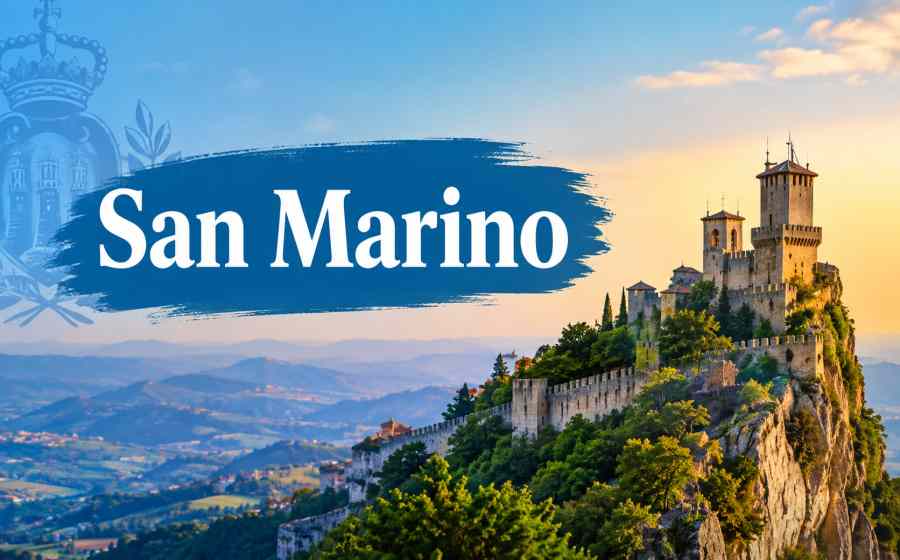
They stand on Mount Titano and form a distinctive part of the country’s landscape. The towers were originally connected with the defensive history of the republic and are now among its most famous attractions. The tourism authority describes the three towers as the most recognizable image of the state.
Guaita is the oldest and most famous of the three, while Cesta stands on another summit of Mount Titano and houses historical collections. Montale is the smallest of the three towers.
Food and Local Life
Sammarinese cuisine reflects the country’s close geographical and cultural relationship with Italy while retaining local specialties.
Traditional food includes handmade pasta, soups, breads, meats, cheeses and desserts. One well-known sweet associated with San Marino is Torta Tre Monti, a layered wafer and chocolate dessert inspired by the country’s three towers.
Food is an important part of festivals and everyday social life, and visitors can find restaurants and cafés throughout the historic centre and other parts of the country. Tourism authorities also highlight local cuisine as an important part of the visitor experience.
Sports in San Marino
Although San Marino has a very small population, sports play an important role in national life. The San Marino National Olympic Committee (CONS) coordinates the country’s participation in international sporting competitions. Its sports federations cover disciplines including athletics, cycling, football, gymnastics, golf, swimming, judo, basketball, volleyball, tennis, shooting, archery and several others.
Football
Football is one of the best-known sports associated with San Marino. The San Marino national football team competes internationally under UEFA. Because of its small population and limited player pool, the national side faces significant challenges against larger European nations.
San Marino achieved its first senior international victory in 2004, defeating Liechtenstein 1–0 in a friendly match. In 2024, the team recorded its first competitive victory by defeating Liechtenstein in the UEFA Nations League.
Olympic Sports
San Marino has also produced notable results in Olympic shooting and wrestling. At the Tokyo 2020 Olympics, Alessandra Perilli won an individual bronze medal in shooting, while Myles Amine Mularoni won bronze in wrestling. Perilli and Gian Marco Berti also won a silver medal in the mixed team trap event.
These achievements have been particularly significant for such a small nation and have helped raise San Marino’s profile in international sport.
Tourism and Famous Attractions
Tourism is an important part of San Marino’s modern identity. Visitors commonly explore the historic capital, Mount Titano, the three towers, museums, churches and public squares.
Some notable attractions include:
- Guaita Tower
- Cesta Tower
- Montale Tower
- Basilica of Saint Marinus
- Palazzo Pubblico
- Piazza della Libertà
- State Museum
- San Francesco Museum and Art Gallery
The official tourism authority also promotes nature trails, cycling, cultural events, museums, shopping and sporting activities.
Economy and Modern San Marino
Despite its small territory, San Marino has developed a diversified economy. Tourism, services, commerce, manufacturing and financial activities contribute to economic life.
Its location within Italy makes the country closely connected to the surrounding European economy. Tourism remains particularly visible because visitors come to experience the historic centre, medieval architecture, cultural heritage and mountain scenery.
San Marino’s small population is another distinctive characteristic. A San Marino government country report recorded 33,812 inhabitants at the end of 2022.
Interesting Facts About San Marino
Here are some interesting facts about the country:
- San Marino is a landlocked microstate completely surrounded by Italy.
- It is one of the world’s oldest republics.
- Its traditional foundation date is 301 AD.
- Mount Titano is the country’s most famous natural landmark.
- The historic centre and Mount Titano are a UNESCO World Heritage Site.
- The country is famous for its three towers: Guaita, Cesta and Montale.
- The Captains Regent serve as the country’s heads of state and traditionally hold office for six months.
- San Marino has its own national football team and participates in UEFA competitions.
- San Marino has won Olympic medals in disciplines including shooting and wrestling.
- Its historic capital is built around the upper slopes of Mount Titano.
- The country maintains a distinctive identity despite its very small size.
Summary
San Marino is a remarkable example of how a small country can preserve a powerful historical and cultural identity. From the traditional story of Saint Marinus and the development of its medieval institutions to the preservation of Mount Titano and its historic centre, the republic has maintained an extraordinary connection with its past.
Its three towers, ancient streets, churches, museums and government institutions make it interesting for everyone. At the same time, modern San Marino continues to participate in international sports, cultural events and tourism.
Also Check: General Knowledge