
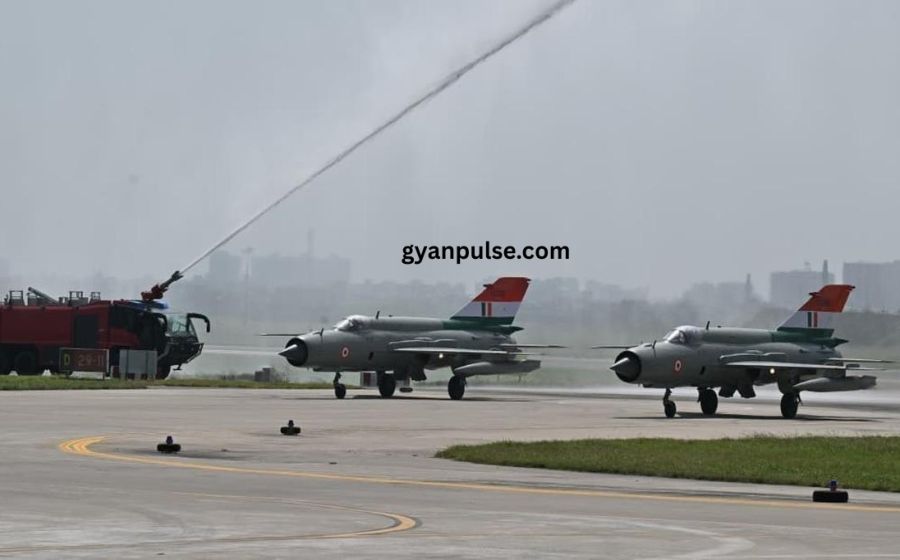
Iconic MiG21 Fighter Jets Retires by Indian AirForce After 62 years
Iconic MiG21 Fighter Jets Retires by Indian AirForce marks the end of a six-decade legacy, highlighting its history, service and future IAF modernization plans.
Iconic MiG21 Fighter Jets Retires by Indian AirForce
In September 2025, the Indian Air Force (IAF) retired its final MiG21 fighter jets, ending a remarkable six-decade legacy. The No. 23 “Panthers” and No. 3 “Cobras” squadrons, which operated a total of 36 aircraft, were decommissioned in Chandigarh.
The move highlights the challenges the IAF faces in keeping its fighter squadrons fully operational, especially due to delays in introducing new aircraft.
Table of Contents
The MiG21: A Legendary Chapter in the History of the Indian Air Force
Introduced in 1963, the MiG-21 became the Indian Air Force’s main fighter jet and interceptor. It played a crucial role in the 1965 and 1971 wars with Pakistan, as well as in the 1999 Kargil conflict. Over 700 jets of different versions were acquired from the Soviet Union.
The MiG21 Bison, the most advanced upgrade, came with modern avionics and weapon systems. Despite these improvements, engine issues remained a concern, leading to several accidents.
In its 60-year service, the aircraft was involved in over 500 crashes, resulting in around 170 pilot deaths. Still, many pilots feel this is a reasonable record considering how extensively the MiG-21 was used.
Fighter Squadron Strength Today and Key Strategic Challenges
With the retirement of the MiG-21, the Indian Air Force now has 29 fighter squadrons, falling short of the sanctioned 42. This shortfall could be critical in the event of a two-front conflict with Pakistan and China.
For comparison, Pakistan operates 20–25 squadrons, while China has more than 60. Older aircraft such as the MiG-29, Jaguar, and Mirage 2000 are also expected to retire by 2035.
This decline in fighter strength presents a significant challenge to India’s air defense preparedness.
Upgrading India’s Air Power
India is actively enhancing its air defence with advanced surface-to-air missile systems. The country inducted the Russian S-400 missile system, even amid US objections.
At the same time, homegrown systems like Akashteer have been developed and successfully tested in military exercises. These missile systems offer vital air defence support while the Air Force works on rebuilding its fighter fleet.
Homegrown Fighter Jets and India’s Future Air Power Plans
The Indian Air Force currently flies two squadrons of the homegrown Light Combat Aircraft (LCA) Tejas Mk1. Recently, an order was placed for 180 Tejas Mk1A jets, equipped with advanced radars and missile systems.
The next-generation Tejas Mk2 and the fifth-generation stealth fighter, Advanced Medium Combat Aircraft (AMCA), are under development and expected to join the fleet within the next decade.
Acquiring and Upgrading Foreign Fighter Jets for India’s Air Force
The Indian Air Force is in talks to acquire 114 fighter jets from international manufacturers, with the Dassault Rafale being a top contender.
Some jets will be delivered fully ready-to-fly, while others will be assembled in India through joint ventures. Meanwhile, 84 Su-30MKI aircraft are set to receive upgrades under the Super-30 program to extend their operational life.
Challenges Facing India’s Air Force Modernisation
The Indian Air Force has struggled with long delays in aircraft development and procurement. The MiG-21 stayed in service far beyond its planned retirement due to a shortage of replacements. The LCA Tejas program, which started in the 1980s, has seen slow deliveries.
Delays in engine supplies from GE Aerospace have further pushed back timelines. HAL plans to produce 16 Tejas jets per year, but full delivery may stretch into the mid-2030s. Negotiations for co-producing F414 engines are moving slowly, the AMCA prototype is still several years away, and the foreign fighter jet deal has yet to be finalized.
The End of an Era: MiG-21’s Last Flight and Its Lasting Legacy
The retirement of the MiG-21 marks the conclusion of one of the most influential chapters in Indian military aviation history. For more than six decades, the aircraft served as a symbol of speed, strength, and national defence, participating in major conflicts and shaping the Indian Air Force’s combat capabilities.
While its service record included operational challenges and safety concerns, the MiG-21 played a significant role in protecting India’s airspace. Its retirement now represents a transition toward a modern era focused on advanced technology, indigenous fighter development, and stronger air power preparedness for future security needs.
Summary
The retirement of the MiG-21 fighter jets marks the end of a historic six-decade journey in the Indian Air Force. While the aircraft played a crucial role in major military operations, its exit also highlights the need for faster modernization. India is now focusing on advanced defence systems, indigenous fighter programs like Tejas and AMCA, and future-ready technologies to strengthen its air power capabilities.
Also Check: Current Affairs