
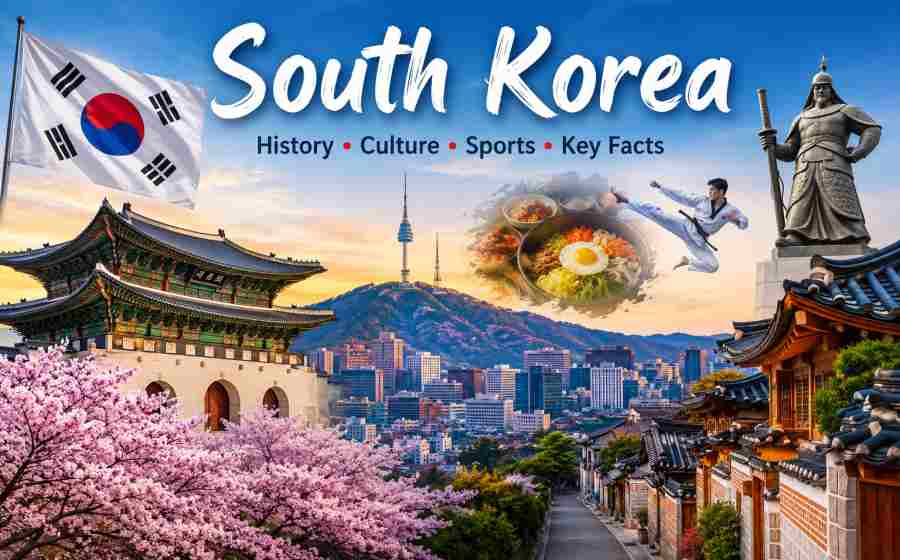
South Korea – History, Tourism, Culture, Sports and Key Facts
Discover South Korea’s history, culture, world-famous sports, economy, traditions, festivals and key facts that make it one of Asia’s most influential nation.
South Korea
South Korea, officially known as the Republic of Korea (ROK), is one of the most technologically advanced and culturally influential countries in the world. Located on the southern part of the Korean Peninsula in East Asia, it shares a border with North Korea while being surrounded by the Yellow Sea, East Sea (Sea of Japan), and the Korea Strait. Over the past few decades, South Korea has transformed from a war-torn nation into a global leader in technology, entertainment, education, and manufacturing.
The country is widely recognized for its rich historical heritage, vibrant traditions, K-pop music, Korean dramas, delicious cuisine, and globally successful companies. South Korea successfully blends ancient customs with modern innovation, making it one of the most fascinating countries to study.
Table of Contents
History of South Korea
The history of Korea dates back thousands of years. According to Korean tradition, the first Korean kingdom, Gojoseon, was established in 2333 BCE by the legendary founder Dangun.
Over time, Korea developed through several important historical periods:
- Three Kingdoms Period (57 BCE–668 CE): Goguryeo, Baekje, and Silla competed for control of the peninsula.
- Unified Silla Dynasty (668–935): Silla united most of the Korean Peninsula and promoted Buddhism.
- Goryeo Dynasty (918–1392): The name “Korea” originates from Goryeo. This period saw advances in printing, ceramics, and culture.
- Joseon Dynasty (1392–1897): Confucianism became the guiding philosophy, and the Korean alphabet Hangul was created by King Sejong the Great in the 15th century.
- Japanese Rule (1910–1945): Korea was occupied by Japan until the end of World War II.
- Division of Korea (1945): After World War II, Korea was divided into North and South.
- Korean War (1950–1953): The war caused widespread destruction but ended with an armistice rather than a peace treaty.
- Economic Miracle: From the 1960s onward, South Korea experienced rapid industrialization, often called the “Miracle on the Han River,” becoming one of the world’s largest economies.
Today, South Korea is a democratic nation with a highly developed economy and global influence.
Geography
South Korea covers approximately 100,363 square kilometers and consists mainly of mountains, hills, and coastal plains.
Some geographical highlights include:
- Capital: Seoul
- Highest Mountain: Hallasan (1,947 meters) on Jeju Island
- Longest River: Nakdong River
- Famous Island: Jeju Island
- Climate: Four distinct seasons with warm summers and cold winters
The country has beautiful coastlines, national parks, forests, and volcanic landscapes.
Culture of South Korea
South Korean culture combines centuries-old traditions with modern lifestyles.
Hangul
Hangul, the Korean writing system, is considered one of the world’s most scientific alphabets. It was invented in 1443 under King Sejong to improve literacy.
Respect and Family Values
Confucian traditions continue to influence Korean society. Respect for elders, family loyalty, education, and discipline remain highly valued.
Traditional Clothing
The traditional Korean dress is called the Hanbok. It is worn during festivals, weddings, and cultural ceremonies.
Korean Cuisine
South Korean food is famous worldwide for its unique flavors.
Popular dishes include:
- Kimchi
- Bibimbap
- Bulgogi
- Japchae
- Tteokbokki
- Samgyeopsal
- Korean Fried Chicken
Rice, vegetables, seafood, fermented foods, and spicy sauces are common ingredients.
Festivals
Major celebrations include:
- Seollal (Lunar New Year)
- Chuseok (Harvest Festival)
- Lotus Lantern Festival
- Boryeong Mud Festival
- Jeju Fire Festival
These festivals reflect both traditional heritage and modern entertainment.
Education System
South Korea has one of the world’s strongest education systems.
Students focus heavily on academics, and universities such as Seoul National University, KAIST, and Yonsei University are internationally respected.
Education plays a major role in the country’s economic success and technological development.
Economy
South Korea has the fourth-largest economy in Asia and is among the world’s leading exporters.
Major industries include:
- Electronics
- Automobiles
- Shipbuilding
- Steel
- Robotics
- Artificial Intelligence
- Biotechnology
- Semiconductors
Globally recognized companies such as Samsung, Hyundai, LG, SK, and Kia originated in South Korea. The nation is also one of the world’s leading producers of memory chips and consumer electronics.
Technology and Innovation
South Korea ranks among the world’s most innovative countries. Key achievements include:
- High-speed internet infrastructure
- Advanced 5G networks
- Smart cities
- Robotics
- Electric vehicles
- Artificial intelligence
- Semiconductor manufacturing
Seoul is considered one of the smartest and most connected cities globally.
Sports in South Korea
Sports are an important part of South Korean society.
Popular Sports
- Football (Soccer)
- Baseball
- Taekwondo
- Golf
- Volleyball
- Basketball
- Speed Skating
- Archery
Taekwondo
Taekwondo originated in Korea and became an official Olympic sport in 2000. It is practiced in more than 200 countries.
International Sporting Events
South Korea has successfully hosted several major sporting events:
- 1988 Seoul Summer Olympics
- 2002 FIFA World Cup (co-hosted with Japan)
- 2018 PyeongChang Winter Olympics
South Korean athletes regularly win medals in archery, taekwondo, fencing, shooting, and skating.
Entertainment and Global Influence
South Korea has become a global cultural powerhouse through the Korean Wave (Hallyu).
Popular aspects include:
- K-pop music
- Korean dramas
- Korean films
- Fashion
- Beauty products (K-Beauty)
- Online gaming
Globally famous entertainment exports have introduced millions of people to Korean language and culture.
Tourism
South Korea attracts millions of tourists every year. Popular tourist destinations include:
- Seoul
- Jeju Island
- Busan
- Gyeongju
- Incheon
- Nami Island
- Seoraksan National Park
Visitors enjoy historic palaces, temples, shopping districts, beaches, mountain hiking, and modern city life.
Government
South Korea is a democratic republic. Key features include:
- President as Head of State and Government
- National Assembly (unicameral legislature)
- Independent judiciary
- Multi-party political system
The country maintains strong diplomatic and economic relations with nations around the world.
Key Facts About South Korea
- Official Name: Republic of Korea
- Capital: Seoul
- Largest City: Seoul
- Continent: Asia
- Population: About 52 million
- Official Language: Korean
- Currency: South Korean Won (KRW)
- National Flower: Mugunghwa (Rose of Sharon)
- National Animal: Siberian Tiger (symbolic)
- Highest Peak: Hallasan
- Government: Democratic Republic
- Time Zone: Korea Standard Time (UTC+9)
Interesting Facts
- South Korea has one of the fastest internet speeds in the world.
- Hangul has its own national celebration called Hangul Day.
- Jeju Island is a UNESCO World Heritage Site.
- Korean skincare products are popular worldwide.
- The country has one of the world’s largest subway systems.
- South Korea is among the leading exporters of semiconductors.
- Convenience stores operate 24 hours in many cities.
- Recycling and public transportation are highly developed.
- Seoul is home to numerous historic palaces alongside modern skyscrapers.
- South Korea consistently ranks among the world’s most innovative economies.
Summary
South Korea is a remarkable example of how determination, innovation, and respect for tradition can shape a nation’s future. From its ancient kingdoms and unique cultural heritage to its cutting-edge technology and worldwide influence in entertainment, South Korea has become one of the most admired countries in the world. Its strong economy, excellent education system, successful sports achievements, and rich traditions continue to inspire people across the globe. Whether explored through its history, cuisine, festivals, or modern achievements, South Korea offers a fascinating blend of the past and the future.
Also Check: General Knowledge