
Vatican City – History, Culture, Famous Places and Key Facts
Discover Vatican City, the world’s smallest independent state, including its history, culture, landmarks, art, government, religion and interesting facts.
Vatican City
Vatican City is one of the most remarkable places in the world. Located entirely within the city of Rome, Italy, it is the smallest independent state in the world by territory and population. Despite its tiny size, Vatican City has enormous religious, historical, artistic and cultural importance. It is the spiritual and administrative centre of the Roman Catholic Church and the residence of the Pope.
The modern Vatican City State was established through the Lateran Treaty of 11 February 1929, an agreement between the Holy See and Italy. The treaty recognized Vatican City as a sovereign state and provided the territorial independence necessary for the Holy See to carry out its functions. Today, millions of pilgrims, tourists, art lovers and history enthusiasts visit Vatican City to see its extraordinary churches, museums, paintings, sculptures, gardens and historic buildings.
Table of Contents
History of Vatican City
The history of the Vatican area goes back many centuries. In ancient Roman times, the region on the western side of the Tiber River was known as the Ager Vaticanus. During the Roman period, the area contained gardens, villas and a large circus associated with Emperor Caligula and later Nero. The Vatican State’s historical records connect this area with the martyrdom and burial tradition of Saint Peter.
After Christianity gained legal recognition in the Roman Empire, Emperor Constantine began the construction of a large basilica around the traditional site of Saint Peter’s tomb in the 4th century. This church became an important centre of Christianity and helped establish the Vatican area as a major religious destination.
During the Middle Ages, defensive walls and other structures were developed around the Vatican. Later, especially during the Renaissance, successive popes supported major architectural and artistic projects. Artists such as Michelangelo, Raphael, Bernini, Bramante and Maderno contributed to the development of the Vatican’s famous artistic heritage.
A major turning point came in the 19th century. Following the end of the Papal States and the incorporation of Rome into the Kingdom of Italy in 1870, the relationship between the Italian state and the papacy remained unsettled for decades. The issue was resolved in 1929 through the Lateran Pacts.
The Lateran Treaty established the present Vatican City State as a sovereign entity. It was ratified on 7 June 1929.
Location and Size
Vatican City is an enclave within Rome, Italy. Its territory covers approximately 44 hectares, or 0.44 square kilometres. UNESCO describes it as a 44-hectare territory in the centre of Rome.
Its small area makes it unique among the world’s sovereign states. The territory includes important religious and cultural sites such as St. Peter’s Basilica, St. Peter’s Square, the Vatican Museums, the Sistine Chapel and the Vatican Gardens.
Although Vatican City and the Holy See are closely connected, they are not exactly the same thing. Vatican City is the sovereign territorial state, while the Holy See refers to the central governing authority of the Catholic Church.
Government of Vatican City
Vatican City has a distinctive political and administrative structure. Its form of government is an absolute monarchy, with the Pope serving as the head of state. According to the Vatican’s official information, the Supreme Pontiff holds legislative, executive and judicial authority.
The Pope governs the state through various institutions, including the Pontifical Commission for Vatican City State and the Governorate. The state also has its own judicial system and security organizations.
The Pontifical Swiss Guard, founded in 1506, is one of the best-known security forces associated with Vatican City. The Vatican Gendarmerie also provides security and police services within the state.
Culture and Religion
Religion is at the heart of Vatican City’s identity. The state serves as the central institutional base of the Roman Catholic Church and is an important destination for Catholic pilgrims from around the world.
The Vatican’s culture is strongly connected with Christian traditions, religious ceremonies, sacred architecture and centuries of artistic patronage. Religious celebrations involving the Pope can attract large numbers of visitors.
At the same time, Vatican City has significance beyond religion. Its buildings, manuscripts, paintings, sculptures and historical collections make it an important centre of global cultural heritage.
St. Peter’s Basilica
St. Peter’s Basilica is one of the most famous landmarks in Vatican City. It stands at the centre of St. Peter’s Square and is traditionally associated with the tomb of Saint Peter, one of the apostles of Jesus and a central figure in Christian history.
The present basilica was developed over a long period during the Renaissance and early modern era. Several major artists and architects contributed to the project, including Bramante, Michelangelo, Maderno and Bernini. UNESCO identifies the basilica and its surrounding ensemble as outstanding examples of Renaissance and Baroque art and architecture.
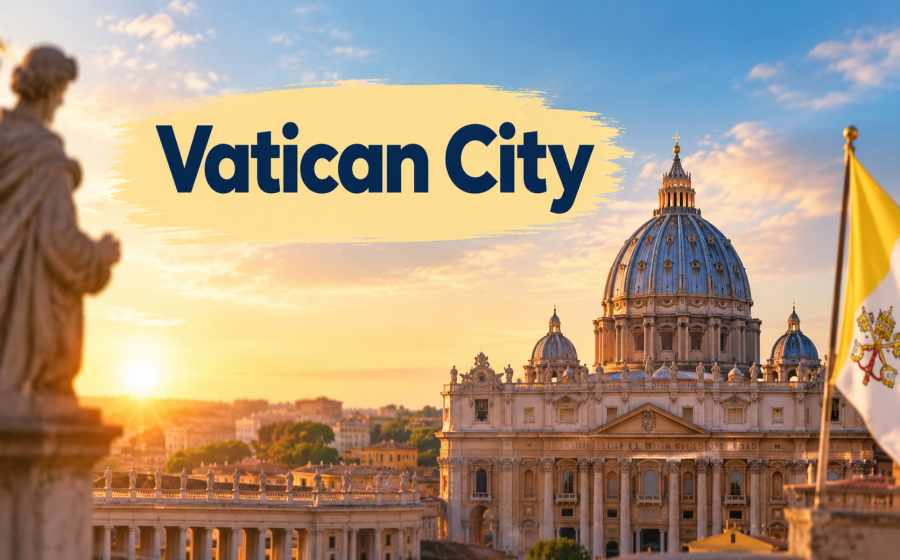
The enormous dome designed under Michelangelo’s influence is one of the most recognizable features of the Vatican skyline.
Sistine Chapel
The Sistine Chapel is another world-famous Vatican landmark. It is particularly famous for the magnificent frescoes painted by Michelangelo.
Michelangelo decorated the ceiling of the chapel with scenes from the Book of Genesis, while his monumental Last Judgment covers the altar wall. The chapel is also traditionally used for the conclave in which cardinals gather to elect a new Pope.
The Sistine Chapel forms part of the Vatican’s extraordinary artistic heritage, which also includes works associated with Raphael, Botticelli, Perugino and other important Renaissance artists.
Vatican Museums
The Vatican Museums contain an enormous collection of art and historical objects accumulated over centuries. Their collections include sculptures, paintings, manuscripts, archaeological objects and decorative works.
The development of the Vatican’s collections is closely linked with centuries of papal patronage. UNESCO notes that the Vatican’s cultural institutions preserve an exceptionally important record of human creativity and history.
Among the best-known attractions are the Raphael Rooms, the Sistine Chapel and collections of ancient Roman and Greek art.
Vatican Library and Archives
Vatican City is also famous for its historical collections of books and manuscripts. The Vatican Library has roots reaching back centuries and preserves important examples of written and printed culture.
The Vatican’s archival collections are valuable resources for researchers studying religion, European history, art, diplomacy and many other subjects. UNESCO highlights the Library’s manuscripts and books as part of the Vatican’s contribution to humanity’s cultural memory.
Economy and Currency
Vatican City’s economy is unusual because it is not based on large-scale industry or natural resources. Its activities are closely connected with the administration of the Catholic Church, tourism, cultural institutions, publications, donations and related services.
The Vatican uses the euro as its currency and has the right to mint its own euro coins. It also issues its own postage stamps, which are popular among collectors.
The state also operates media organizations. For example, L’Osservatore Romano, the Vatican’s daily newspaper, was founded in 1861, while Vatican Radio began broadcasting in 1931.
UNESCO World Heritage Status
Vatican City is recognized as a UNESCO World Heritage Site. It was inscribed on the World Heritage List in 1984.
UNESCO considers Vatican City important because of its exceptional artistic, architectural, historical and religious significance. Its heritage includes St. Peter’s Basilica, the Vatican Palace, the Sistine Chapel, Renaissance and Baroque works, and archaeological remains connected with ancient Rome and early Christianity.
Key Facts About Vatican City
- Vatican City is the smallest independent state in the world by territory and population.
- It is completely surrounded by Rome, Italy.
- The modern state was created through the Lateran Treaty of 1929.
- The Pope is the head of Vatican City State.
- The euro is the official currency used by Vatican City.
- Vatican City issues its own postage stamps and mints its own euro coins.
- The Swiss Guard has protected the Pope since its foundation in 1506.
- St. Peter’s Basilica is one of the world’s most famous religious buildings.
- The Sistine Chapel is renowned for Michelangelo’s ceiling and The Last Judgment.
- Vatican City became a UNESCO World Heritage Site in 1984.
- The Vatican has its own newspaper and international broadcasting services.
- Vatican City and the Holy See are distinct entities, although they are closely connected.
Summary
Vatican City may be one of the world’s smallest countries, but its historical and cultural importance is immense. From the ancient history of the Vatican Hill and the traditions surrounding Saint Peter to the creation of the modern state in 1929, its story spans nearly two thousand years.
Its magnificent basilica, Sistine Chapel, museums, libraries, gardens and Renaissance and Baroque masterpieces have made Vatican City an extraordinary centre of art, religion and history. Vatican City is an especially interesting country because its tiny territory combines unique political institutions, remarkable cultural heritage and global religious significance in one extraordinary place.
Also Check: General Knowledge