
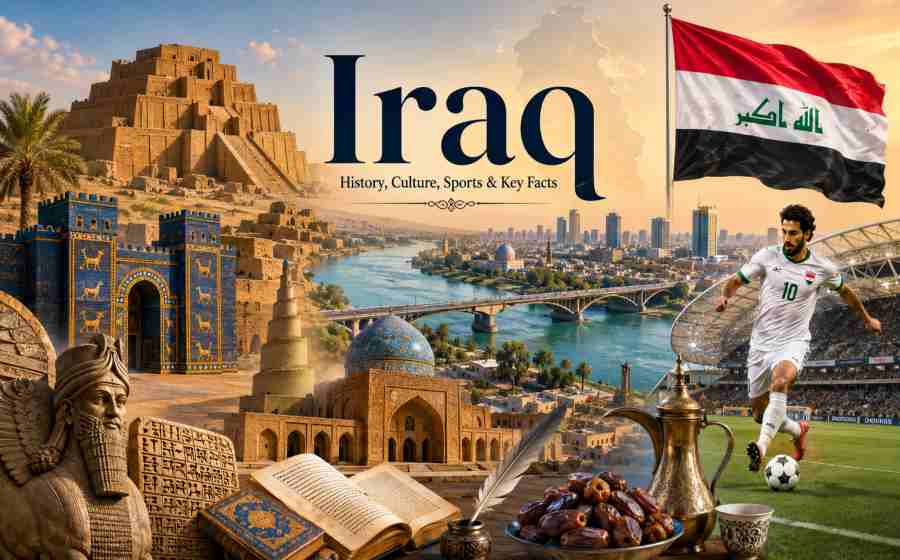
Iraq – The Cradle of Civilization, History, Culture, Sports and Fascinating Facts
Explore Iraq’s history, culture, sports, geography, economy and key facts. Learn why Iraq is known as the cradle of civilization, Tourism and Famous Places.
Iraq
Iraq is one of the world’s oldest civilizations and holds a special place in human history. Located in Western Asia, Iraq is often called the “Cradle of Civilization” because some of the earliest human societies developed in this region. The country is rich in history, culture, traditions, and natural resources. From the ancient civilizations of Mesopotamia to its modern cities, Iraq continues to play an important role in the Middle East.
The capital city of Iraq is Baghdad, which has been a center of learning, trade, and culture for centuries. Iraq shares borders with Iran, Turkey, Syria, Jordan, Saudi Arabia, and Kuwait.
Table of Contents
Historical Background
Iraq is home to the ancient region of Mesopotamia, which means “land between rivers.” The fertile lands between the Tigris and Euphrates rivers gave rise to some of the earliest civilizations in human history.
Ancient civilizations such as the Sumerians, Akkadians, Babylonians, and Assyrians flourished here thousands of years ago. The Sumerians are credited with developing one of the first writing systems known as cuneiform. The Babylonians, under King Hammurabi, introduced one of the earliest written legal codes.
In the 7th century, Iraq became part of the Islamic world. Baghdad later emerged as a major center of science, mathematics, literature, and philosophy during the Abbasid Caliphate. Scholars from around the world visited the city, making it one of the most influential intellectual centers of its time.
Modern Iraq gained independence from British control in 1932 and became a republic in 1958. Since then, the country has experienced political changes, conflicts, and reconstruction efforts.
Geography and Climate
Iraq covers an area of approximately 438,000 square kilometers. The country consists of plains, deserts, mountains, and river valleys.
The two major rivers, the Tigris and Euphrates, are vital for agriculture and daily life. These rivers have supported human settlements for thousands of years.
Iraq experiences a hot desert climate in most regions. Summers are extremely hot, with temperatures often exceeding 45°C. Winters are generally mild, though northern mountainous areas can receive snowfall.
Culture and Traditions
Iraqi culture reflects a blend of ancient Mesopotamian heritage and Islamic traditions. Family values, hospitality, and respect for elders are central aspects of Iraqi society.
Traditional music plays an important role in cultural celebrations. Iraqi musicians often use instruments such as the oud, qanun, and ney. Poetry is also highly respected and has been an important part of Iraqi cultural expression for centuries.
Traditional clothing varies by region. Men may wear long robes called dishdashas, while women often wear modest and colorful attire reflecting local customs.
Religious festivals, weddings, and family gatherings are celebrated with enthusiasm and community participation.
Language and Religion
The official languages of Iraq are Arabic and Kurdish. Arabic is widely spoken throughout the country, while Kurdish is primarily spoken in the northern regions.
Islam is the dominant religion in Iraq, with both Shia and Sunni Muslim communities. The country is also home to smaller religious groups, including Christians, Yazidis, and others, contributing to Iraq’s cultural diversity.
Economy
Iraq possesses some of the world’s largest oil reserves. Petroleum exports form the backbone of the country’s economy and contribute significantly to government revenue.
Apart from oil, agriculture remains important. Farmers cultivate wheat, barley, rice, dates, and vegetables. Iraq is particularly famous for its high-quality dates, which are exported to many countries.
The government continues to invest in infrastructure, industry, education, and economic development to diversify beyond oil dependence.
Sports in Iraq
Sports are an important part of Iraqi society, with football being the most popular game in the country. The Iraq national football team has achieved notable success on the international stage. One of its greatest achievements came when Iraq won the AFC Asian Cup in 2007, a victory celebrated across the nation.
Besides football, Iraq also participates in basketball, wrestling, weightlifting, martial arts, and athletics. Young athletes continue to represent the country in regional and international competitions. Sports play an important role in promoting unity, national pride, and youth development throughout Iraq.
Education and Literature
Iraq has a long tradition of scholarship dating back to ancient times. During the Islamic Golden Age, Baghdad became one of the world’s greatest centers of learning.
The famous House of Wisdom attracted scholars who translated and preserved knowledge from different civilizations.
Today, Iraq has numerous universities and educational institutions that contribute to research and higher education. Efforts continue to improve educational opportunities for future generations.
Tourism and Famous Places
Despite challenges, Iraq contains many historical and archaeological treasures.
Some notable attractions include:
- Ancient City of Babylon
- Ziggurat of Ur
- Al-Mustansiriya School
- Mosul
- Basra
These sites provide valuable insights into thousands of years of human civilization and cultural development.
Interesting Facts About Iraq
- Iraq is often called the “Cradle of Civilization.”
- The world’s earliest known writing system developed in Mesopotamia.
- Baghdad was once among the most advanced cities in the world.
- The Tigris and Euphrates rivers have supported civilizations for over 5,000 years.
- Iraq possesses some of the largest proven oil reserves globally.
- The ancient city of Babylon was located in present-day Iraq.
- Iraq won the AFC Asian Cup football championship in 2007.
- Date palm cultivation has been an important part of Iraqi agriculture for centuries.
- The country has a rich tradition of poetry and literature.
- Iraq connects the cultural heritage of ancient and modern Middle Eastern civilizations.
Summary
Iraq is a nation with a remarkable historical legacy, diverse culture, and significant contributions to human civilization. From the ancient achievements of Mesopotamia to the modern aspirations of its people, Iraq remains a country of great importance. Its rich heritage, sporting achievements, cultural traditions, and historical landmarks make it a fascinating subject for students, travelers, and general knowledge enthusiasts alike. Understanding Iraq helps us appreciate the origins of many developments that shaped the modern world.
Also Check: General Knowledge