
Malaysia – History, Culture, Sports, Tourist Attractions, Geography and Key Facts
Discover Malaysia’s history, culture, sports, geography, economy, famous landmarks, festivals, wildlife and key facts in this informative overview.
Malaysia
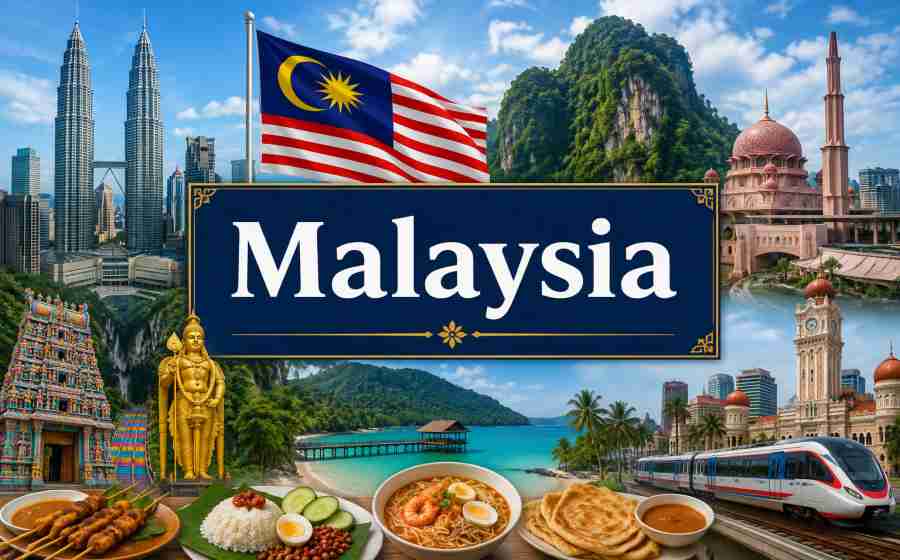
Malaysia is a beautiful Southeast Asian country known for its cultural diversity, modern cities, tropical rainforests, delicious food, and breathtaking islands. It is one of Asia’s most attractive tourist destinations, offering a unique blend of Malay, Chinese, Indian, and indigenous traditions. From the iconic Petronas Twin Towers in Kuala Lumpur to ancient rainforests and vibrant festivals, Malaysia has something for everyone.
Today, Malaysia is recognized as one of Southeast Asia’s fastest-growing economies, with strengths in tourism, manufacturing, agriculture, and technology. Its peaceful multicultural society makes it an interesting country to study in general knowledge.
Table of Contents
Location and Geography
Malaysia is located in Southeast Asia and consists of two main regions:
- Peninsular Malaysia (West Malaysia)
- East Malaysia on the island of Borneo
These two regions are separated by the South China Sea.
Neighboring Countries
- Thailand (north)
- Indonesia
- Brunei
- Singapore (connected by causeways)
Malaysia has a tropical climate throughout the year, with warm temperatures, high humidity, and abundant rainfall. Dense rainforests cover much of the country and are home to many rare species of plants and animals.
Brief History of Malaysia
Malaysia has a long and fascinating history dating back thousands of years.
Ancient Period
Early kingdoms in the region prospered through maritime trade between China, India, and the Middle East. The strategic location made Malaysia an important trading hub.
Colonial Rule
Over the centuries, different European powers ruled parts of Malaysia:
- Portuguese (1511)
- Dutch (1641)
- British (18th–20th century)
The British developed plantations, railways, and ports while bringing workers from China and India, shaping Malaysia’s multicultural society.
Independence
Malaysia gained independence from Britain on 31 August 1957.
In 1963, the Federation of Malaysia was formed by joining Malaya, Sabah, Sarawak, and Singapore. Singapore became an independent nation in 1965.
Today, Malaysia is a stable constitutional monarchy with democratic governance.
Capital and Major Cities
Capital: Kuala Lumpur
Important cities include:
- Kuala Lumpur
- George Town
- Johor Bahru
- Kota Kinabalu
- Kuching
- Ipoh
Kuala Lumpur is famous for its skyscrapers, shopping malls, cultural attractions, and modern infrastructure.
Government and Political System
Malaysia is a Federal Constitutional Monarchy.
Key features include:
- Head of State: King (Yang di-Pertuan Agong)
- Head of Government: Prime Minister
- Bicameral Parliament
- 13 states and 3 federal territories
The unique monarchy rotates among the rulers of nine royal states every five years.
People and Culture
Malaysia is one of the world’s most multicultural countries.
Major ethnic groups include:
- Malays
- Chinese Malaysians
- Indian Malaysians
- Indigenous communities
This diversity is reflected in daily life, traditions, clothing, architecture, languages, and food.
Languages
- Malay (Bahasa Malaysia) – Official language
- English
- Mandarin
- Tamil
- Various indigenous languages
English is widely spoken, especially in business, education, and tourism.
Religion
Malaysia practices religious freedom.
Major religions include:
- Islam (official religion)
- Buddhism
- Christianity
- Hinduism
- Traditional beliefs
Mosques, temples, churches, and shrines can often be found in the same cities, showcasing peaceful coexistence.
Traditional Food
Malaysia is considered a paradise for food lovers.
Popular dishes include:
- Nasi Lemak
- Satay
- Roti Canai
- Laksa
- Char Kway Teow
- Rendang
Its cuisine combines Malay, Chinese, Indian, and local influences, creating rich flavors.
Festivals Celebrated
Malaysia celebrates festivals from many cultures.
Major festivals include:
- Hari Raya Aidilfitri
- Chinese New Year
- Deepavali
- Christmas
- Wesak Day
- Thaipusam
- Harvest Festival (Kaamatan)
These celebrations highlight Malaysia’s multicultural harmony.
Sports in Malaysia
Sports are an important part of Malaysian life.
Popular sports include:
- Badminton
- Football
- Field Hockey
- Sepak Takraw
- Squash
- Motorsports
- Diving
Malaysia has produced world-class badminton players and regularly hosts international sporting events.
Economy
Malaysia has one of Southeast Asia’s strongest economies.
Major industries include:
- Electronics manufacturing
- Palm oil production
- Petroleum and natural gas
- Tourism
- Rubber
- Finance
- Information Technology
The country is one of the world’s largest exporters of palm oil and electronic products.
Education
Malaysia has made significant investments in education.
The country offers:
- Public schools
- Private schools
- International schools
- Universities with global recognition
Many international students choose Malaysia due to affordable education and English-medium programs.
Tourist Attractions
Malaysia offers a wide variety of natural and urban attractions.
Popular places include:
- Petronas Twin Towers
- Langkawi Islands
- Batu Caves
- Mount Kinabalu
- Cameron Highlands
- Taman Negara National Park
- George Town
- Perhentian Islands
Tourism contributes significantly to the national economy.
Wildlife and Nature
Malaysia is one of the world’s biodiversity hotspots.
Wildlife includes:
- Orangutans
- Malayan Tigers
- Asian Elephants
- Sun Bears
- Hornbills
- Proboscis Monkeys
Its rainforests are among the oldest tropical forests on Earth.
Climate
Malaysia experiences:
- Tropical climate
- High humidity
- Heavy rainfall
- Average temperatures between 25°C and 32°C
There are no traditional summer or winter seasons.
Interesting Facts About Malaysia
- Malaysia consists of two separate land regions.
- Kuala Lumpur is home to the famous Petronas Twin Towers.
- The country has one of the oldest rainforests in the world.
- More than 130 languages are spoken across Malaysia.
- It is among the world’s leading producers of palm oil.
- Malaysia celebrates festivals from many different religions.
- The national flower is the Hibiscus.
- The national animal is the Malayan Tiger.
- The country has thousands of islands.
- It is one of Southeast Asia’s most popular tourist destinations.
Importance of Malaysia
Malaysia plays a vital role in Southeast Asia through trade, tourism, education, manufacturing, and environmental conservation. As a founding member of ASEAN, it contributes to regional cooperation and economic development. Its multicultural society serves as an example of peaceful coexistence among different communities.
Summary
Malaysia is a nation where modern development and rich traditions exist side by side. From ancient trading kingdoms to a thriving modern economy, the country has grown into one of Southeast Asia’s most influential nations. Its diverse culture, stunning natural beauty, excellent infrastructure, famous cuisine, and sporting achievements make it an important topic for students and general knowledge enthusiasts. Understanding Malaysia provides valuable insight into the cultural richness and economic importance of Southeast Asia.
Also Check: General Knowledge