
Ivory Coast – History, Culture, Sports, Wildlife and Essential Facts
Discover Ivory Coast, its rich history, culture, sports, geography, economy and interesting facts. Explore everything about this vibrant West African nation.
Ivory Coast
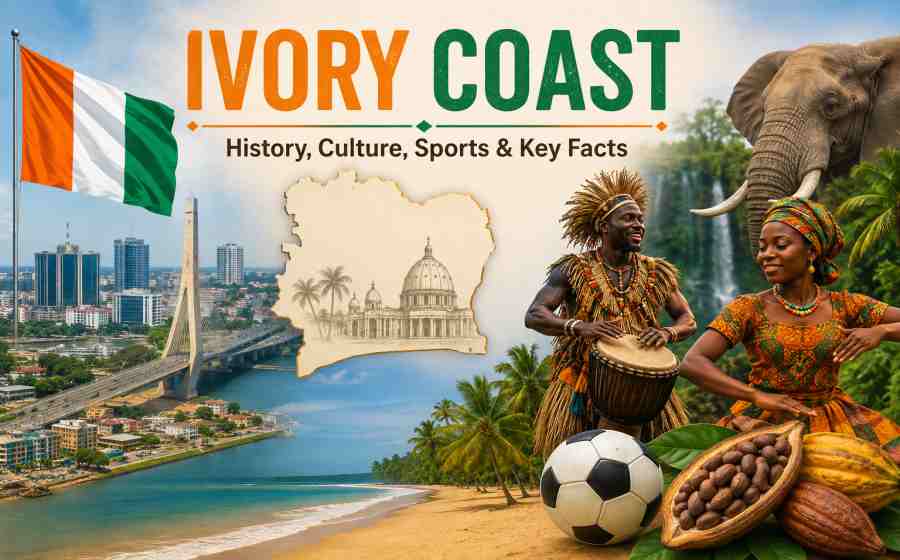
Ivory Coast, officially known as the Republic of Côte d’Ivoire, is one of the most important countries in West Africa. Famous for its cocoa production, cultural diversity, beautiful beaches, and growing economy, Ivory Coast plays a significant role in Africa’s development. The country is home to more than 60 ethnic groups, each with its own traditions, languages, and customs, making it one of the continent’s richest cultural destinations.
From ancient kingdoms and colonial history to modern sports achievements and economic progress, Ivory Coast offers countless interesting facts for students, travelers, and general knowledge enthusiasts.
Table of Contents
History of Ivory Coast
The history of Ivory Coast dates back centuries when various indigenous kingdoms and communities settled across the region. Before European contact, several ethnic groups such as the Baoulé, Sénoufo, and Agni established organized societies with thriving trade networks.
Portuguese explorers arrived in the 15th century and named the region “Ivory Coast” because of its abundant elephant ivory trade. Later, French influence increased, and by 1893, Ivory Coast officially became a French colony.
The country remained under French rule until 7 August 1960, when it gained independence. Félix Houphouët-Boigny became its first president and led the nation for more than three decades, bringing political stability and economic growth.
Although the country experienced political unrest and civil conflicts during the early 2000s, Ivory Coast has since made remarkable progress in rebuilding its economy and strengthening democratic institutions.
Geography of Ivory Coast
Ivory Coast is located along the Gulf of Guinea in West Africa.
Bordering Countries:
- Liberia
- Guinea
- Mali
- Burkina Faso
- Ghana
Key Geographical Features:
- Capital: Yamoussoukro
- Largest city: Abidjan
- Area: Approximately 322,463 square kilometres
- Coastline: Around 515 kilometres
- Highest Peak: Mount Nimba
The country’s landscape includes tropical forests, rolling hills, fertile plains, rivers, lagoons, and coastal beaches. The southern region receives heavy rainfall, while the northern region has a tropical savanna climate.
People and Culture
Ivory Coast is one of Africa’s most culturally diverse nations.
More than 60 ethnic groups live peacefully across the country. The largest communities include:
- Baoulé
- Bété
- Sénoufo
- Dioula
- Agni
Although French is the official language, many local languages are widely spoken in daily life.
Religion is also diverse:
- Islam
- Christianity
- Traditional African religions
Respect for elders, strong family values, colorful festivals, traditional dances, and storytelling remain important parts of Ivorian society.
Music is deeply rooted in the country’s culture. Popular styles include Coupé-Décalé, which originated in Ivory Coast and has gained international recognition.
Traditional Food
Ivorian cuisine is flavorful and influenced by local agriculture.
Popular dishes include:
- Attiéké (fermented cassava)
- Kedjenou (slow-cooked chicken stew)
- Foutou (mashed yam or plantain)
- Alloco (fried plantains)
- Grilled fish
- Peanut sauces
- Rice with spicy stews
Fresh tropical fruits such as mangoes, pineapples, bananas, and papayas are also widely enjoyed.
Economy
Ivory Coast has one of the strongest economies in West Africa.
The country is the world’s largest producer of cocoa beans, supplying nearly 40% of global cocoa production.
Major industries include:
- Cocoa production
- Coffee farming
- Rubber
- Palm oil
- Cashew nuts
- Gold mining
- Oil and natural gas
- Manufacturing
- Banking
- Telecommunications
Abidjan serves as one of Africa’s major financial and commercial centers.
Education
Education continues to improve across Ivory Coast.
The government has invested in:
- Primary education
- Secondary schools
- Universities
- Technical education
- Digital learning
Major universities attract students from different parts of West Africa.
Although literacy rates continue to rise, efforts are ongoing to improve access to quality education, particularly in rural areas.
Sports in Ivory Coast
Football (soccer) is by far the most popular sport in Ivory Coast.
The national football team is known as The Elephants and has achieved remarkable success in African football.
Legendary Ivorian footballers include:
- Didier Drogba
- Yaya Touré
- Kolo Touré
- Gervinho
- Salomon Kalou
The country has won the Africa Cup of Nations (AFCON) multiple times and regularly qualifies for major international tournaments.
Besides football, people also enjoy:
- Basketball
- Athletics
- Rugby
- Handball
- Taekwondo
Sports continue to inspire millions of young Ivorians.
Wildlife and Natural Beauty
Ivory Coast possesses remarkable biodiversity.
The country is home to:
- Forest elephants
- Chimpanzees
- Hippopotamuses
- Crocodiles
- Antelopes
- Hundreds of bird species
Important national parks include:
- Taï National Park
- Comoé National Park
- Mount Nimba Nature Reserve
These protected areas help preserve endangered wildlife and unique ecosystems.
Government
Ivory Coast follows a presidential system.
Key facts:
- Official name: Republic of Côte d’Ivoire
- President serves as Head of State
- Multi-party democratic system
- National Assembly forms the legislative branch
The government continues to focus on economic development, infrastructure, education, and regional cooperation.
Major Cities
Abidjan
The country’s largest city and economic capital, known for skyscrapers, ports, universities, and vibrant nightlife.
Yamoussoukro
The political capital famous for the magnificent Basilica of Our Lady of Peace, one of the world’s largest churches.
Bouaké
An important commercial and educational center.
San-Pédro
Known for its major seaport and cocoa exports.
Korhogo
Famous for traditional crafts and Sénoufo culture.
Interesting Facts About Ivory Coast
- Ivory Coast officially prefers the French name Côte d’Ivoire in international usage.
- It is the world’s leading cocoa producer.
- Abidjan is often called the “Paris of West Africa.”
- More than 60 ethnic groups contribute to the country’s cultural richness.
- The Basilica of Our Lady of Peace in Yamoussoukro is among the largest churches on Earth.
- The country celebrates Independence Day every year on 7 August.
- French is the official language despite numerous local languages.
- Ivory Coast has one of Africa’s busiest ports.
- Traditional masks and wood carvings are famous worldwide.
- The nation is an important economic hub within West Africa.
Key Facts at a Glance
| Feature | Details |
|---|---|
| Official Name | Republic of Côte d’Ivoire |
| Capital | Yamoussoukro |
| Largest City | Abidjan |
| Continent | Africa |
| Region | West Africa |
| Official Language | French |
| Currency | West African CFA Franc (XOF) |
| Independence | 7 August 1960 |
| Area | 322,463 sq km |
| Population | Approximately 32 million |
| Main Export | Cocoa |
| National Sport | Football (Soccer) |
| Time Zone | GMT (UTC+0) |
Summary
Ivory Coast is a nation that combines rich history, cultural diversity, economic strength, and sporting excellence. As the world’s leading cocoa producer and one of West Africa’s fastest-growing economies, it continues to play a vital role in the African continent. Its colorful traditions, welcoming people, thriving cities, abundant wildlife, and passion for football make Ivory Coast a fascinating country to study and explore. Whether viewed from a historical, cultural, or economic perspective, Ivory Coast remains an important and inspiring nation with a promising future.
Also Check: General Knowledge


Great content! Keep up the good work!