Poland – History, Culture, Sports, Tourism and Key Facts
Discover Poland’s rich history, vibrant culture, famous sports, geography, traditions, landmarks and fascinating facts in this informative overview.
Poland
Poland is one of Central Europe’s most historically significant countries, known for its rich cultural heritage, resilient people, beautiful medieval cities, and remarkable contributions to science, literature, and music. Despite facing numerous invasions and partitions throughout history, Poland has preserved its unique identity and traditions. Today, it is a modern European nation with a growing economy, vibrant tourism industry, and strong cultural values.
From the majestic Tatra Mountains to the sandy beaches of the Baltic Sea, Poland offers diverse landscapes, historical landmarks, and colorful festivals that attract millions of visitors every year.
Table of Contents
Basic Facts About Poland
- Official Name: Republic of Poland
- Capital: Warsaw
- Continent: Europe
- Region: Central Europe
- Population: Around 38 million
- Official Language: Polish
- Currency: Polish Złoty (PLN)
- Government: Parliamentary Republic
- National Day: Independence Day – 11 November
- Time Zone: Central European Time (CET)
Poland shares borders with Germany, the Czech Republic, Slovakia, Ukraine, Belarus, Lithuania, and Russia’s Kaliningrad region.
History of Poland
Poland’s history dates back over a thousand years. The Polish state officially began in 966 AD when Duke Mieszko I accepted Christianity, marking an important turning point in the country’s development.
During the Middle Ages, Poland became one of Europe’s strongest kingdoms. In the 16th century, the Polish-Lithuanian Commonwealth was among the largest and most powerful states in Europe.
However, in the late 18th century, Poland was partitioned by Russia, Prussia, and Austria, disappearing from the map for over 120 years.
After World War I, Poland regained its independence in 1918. During World War II, the country suffered enormous destruction under Nazi Germany and later came under Soviet influence. Poland eventually became a democratic republic in 1989 following the fall of communism.
Today, Poland is a member of the European Union and NATO and continues to play an important role in European affairs.
Geography and Climate
Poland covers an area of approximately 312,696 square kilometers, making it one of Europe’s larger countries.
Its geography includes:
- Baltic Sea coastline in the north
- Large plains and fertile farmland
- Beautiful lakes in the northeast
- Forests covering nearly one-third of the country
- Tatra Mountains in the south
Poland experiences a temperate climate with four distinct seasons:
- Warm summers
- Cold winters with snowfall
- Pleasant spring
- Colorful autumn
Culture and Traditions
Polish culture is deeply influenced by history, Christianity, family values, literature, and traditional customs.
Important cultural features include:
- Strong respect for family
- Traditional folk music and dances
- Rich literary heritage
- Beautiful handicrafts
- Religious festivals and celebrations
Popular traditional dances include:
- Polonaise
- Mazurka
- Krakowiak
Polish hospitality is famous across Europe, with guests often welcomed warmly and offered traditional homemade meals.
Traditional Polish Food
Polish cuisine is hearty, flavorful, and influenced by neighboring countries.
Popular dishes include:
- Pierogi (dumplings)
- Bigos (hunter’s stew)
- Żurek (sour rye soup)
- Kielbasa (Polish sausage)
- Gołąbki (stuffed cabbage rolls)
- Potato pancakes
- Cheesecake and poppy seed cake
Bread and potatoes are common staples in Polish households.
Sports in Poland
Sports are an important part of Polish life.
The most popular sports include:
- Football (Soccer)
- Volleyball
- Athletics
- Ski Jumping
- Tennis
- Basketball
- Handball
Poland has achieved international success in volleyball and athletics. The country has also produced world-famous athletes in tennis, football, and ski jumping.
Major sporting events regularly attract enthusiastic crowds across the country.
Economy
Poland has one of Europe’s fastest-growing economies.
Major industries include:
- Manufacturing
- Automobile production
- Information Technology
- Agriculture
- Mining
- Food processing
- Tourism
- Financial services
The country exports machinery, electronics, furniture, vehicles, and agricultural products worldwide.
Education
Education is highly valued in Poland.
The education system includes:
- Primary education
- Secondary education
- Higher education
Poland has several internationally recognized universities and attracts thousands of international students every year.
The literacy rate is very high, reflecting the country’s strong emphasis on education.
Tourism in Poland
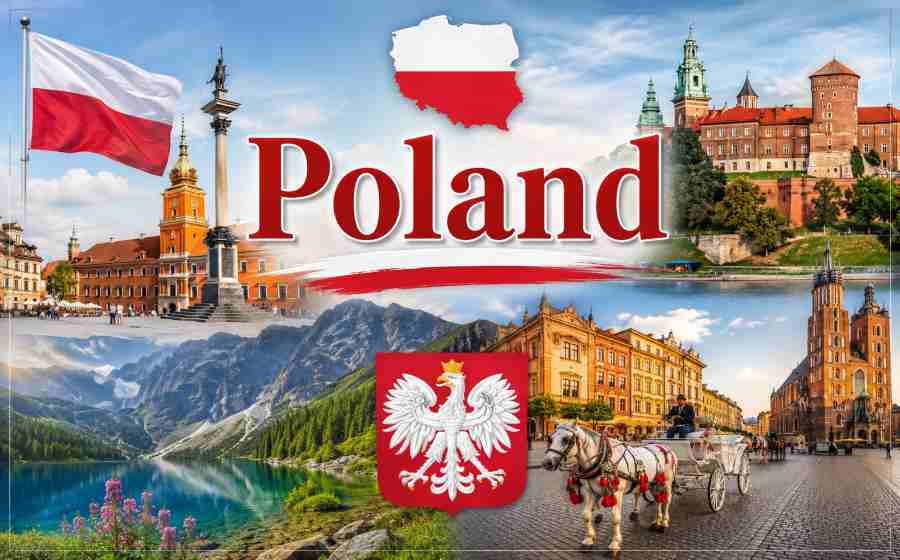
Poland is famous for its historical cities, castles, mountains, and national parks.
Popular tourist attractions include:
- Warsaw Old Town
- Kraków Historic Centre
- Wawel Castle
- Auschwitz-Birkenau Memorial
- Wieliczka Salt Mine
- Tatra Mountains
- Baltic Sea beaches
- Masurian Lake District
Many of these sites are recognized as UNESCO World Heritage Sites.
National Symbols
Every country has symbols representing its identity.
Poland’s national symbols include:
- National Flag: White and Red
- National Emblem: White Eagle
- National Anthem: “Mazurek Dąbrowskiego”
- National Flower: Red Poppy (commonly associated)
- National Animal: White-tailed Eagle
These symbols represent Poland’s independence, courage, and national pride.
Famous Polish Personalities
Poland has produced many globally respected individuals.
Some notable personalities include:
- Nicolaus Copernicus – Astronomer
- Marie Curie – Scientist and Nobel Prize winner
- Frédéric Chopin – Composer and pianist
- Pope John Paul II – Religious leader
- Robert Lewandowski – Footballer
- Iga Świątek – Tennis player
Their achievements continue to inspire people around the world.
Interesting Facts About Poland
- Poland is home to one of the world’s oldest salt mines.
- The country’s constitution of 1791 was Europe’s first modern constitution.
- Warsaw was almost completely rebuilt after World War II.
- Poland has over 1,000 years of recorded history.
- It has numerous castles and medieval towns.
- The European bison has been successfully protected in Poland.
- Polish scientists have made important contributions to astronomy, physics, and chemistry.
- Poland celebrates many colorful cultural and religious festivals throughout the year.
Importance of Poland
Poland serves as a cultural and economic bridge between Eastern and Western Europe. Its strategic location, skilled workforce, historical significance, and growing economy have made it an influential member of the European Union. The country continues to preserve its traditions while embracing innovation, education, and sustainable development.
Summary
Poland is a nation where ancient history meets modern progress. From its resilient past and vibrant cultural traditions to its thriving economy and sporting achievements, the country offers countless reasons to admire and explore it. Whether through its historic cities, delicious cuisine, breathtaking natural landscapes, or remarkable contributions to science and culture, Poland remains one of Europe’s most fascinating and influential countries. Learning about Poland helps us better understand Europe’s rich history and the enduring spirit of its people.
Also Check: General Knowledge