Democratic Republic of the Congo – A Land of Rich History, Culture, Sports and Geography
Discover the Democratic Republic of the Congo, its history, culture, wildlife, sports, geography and key facts in this informative overview.
Democratic Republic of the Congo
The Democratic Republic of the Congo (DRC) is one of Africa’s largest and most fascinating countries. Located in Central Africa, it is known for its vast rainforests, rich mineral resources, diverse cultures, and remarkable wildlife. Despite facing political and economic challenges throughout its history, the DRC remains a nation of great importance due to its natural wealth and cultural heritage. This article explores the history, culture, sports, geography, and key facts about the Democratic Republic of the Congo.
Table of Contents
Introduction to the Democratic Republic of the Congo
The Democratic Republic of the Congo is the second-largest country in Africa by land area and is home to more than 100 million people. Its capital city is Kinshasa, one of Africa’s largest and most vibrant cities. The country shares borders with nine nations, making it a significant geographical and economic hub in Central Africa.
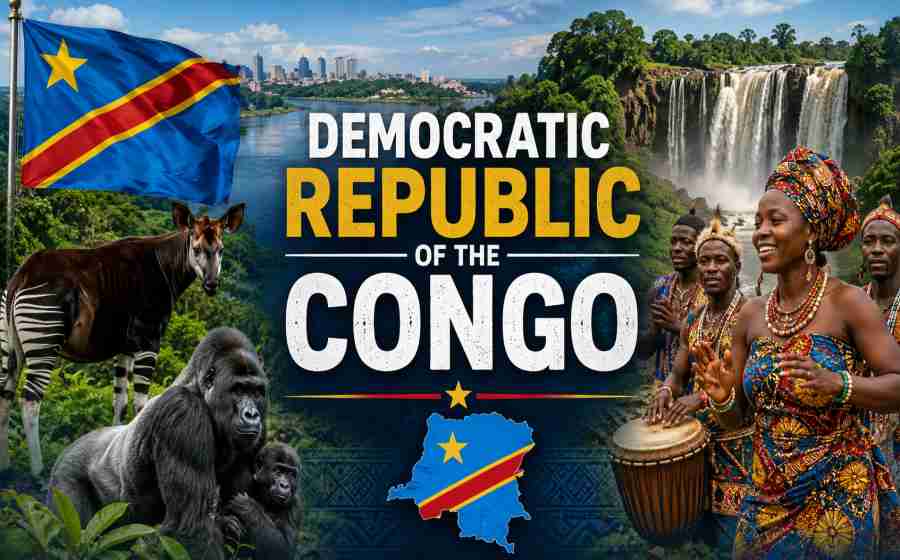
The DRC is often called the “heart of Africa” because of its central location and the immense Congo Basin rainforest, which is the second-largest tropical rainforest in the world after the Amazon.
History of the Democratic Republic of the Congo
The region now known as the Democratic Republic of the Congo has a long and complex history. Before European colonization, powerful kingdoms such as the Kingdom of Kongo and the Luba Kingdom flourished in the area. In the late 19th century, the territory became the personal possession of King Leopold II of Belgium. During this period, known as the Congo Free State, millions of Congolese suffered under harsh colonial policies. International criticism eventually forced Belgium to take control of the territory in 1908.
The country gained independence from Belgium on June 30, 1960. Shortly afterward, political instability and conflicts emerged. In 1971, President Mobutu Sese Seko renamed the country Zaire. Following years of unrest, it was renamed the Democratic Republic of the Congo in 1997. The nation has experienced civil wars and political challenges, but efforts toward stability, development, and democratic governance continue today.
Geography and Natural Resources
The Democratic Republic of the Congo covers approximately 2.3 million square kilometers, making it one of the largest countries in Africa.
The country features:
- Dense tropical rainforests
- Large rivers and lakes
- Mountain ranges
- Savannah grasslands
- Active volcanoes
The Congo River is Africa’s second-longest river and one of the world’s most powerful waterways. It serves as a vital transportation route and supports millions of people.
The DRC possesses some of the world’s most valuable natural resources, including:
- Cobalt
- Copper
- Gold
- Diamonds
- Coltan
- Tin
These resources play a crucial role in global industries, especially the production of electronics and rechargeable batteries.
Culture of the Democratic Republic of the Congo
The DRC is among the most culturally diverse countries in Africa. More than 200 ethnic groups live within its borders, each contributing unique traditions, languages, and customs.
Languages
French is the official language of the country. In addition, four national languages are widely spoken:
- Lingala
- Swahili
- Kikongo
- Tshiluba
This linguistic diversity reflects the country’s rich cultural heritage.
Music and Dance
Congolese music has gained international recognition. Genres such as Soukous and Congolese Rumba have influenced music across Africa and beyond.
Music and dance play an important role in social gatherings, celebrations, and cultural events. Traditional drums, guitars, and vibrant dance styles are key elements of Congolese artistic expression.
Traditional Clothing and Cuisine
Traditional attire often features colorful fabrics and patterns. Clothing styles vary among ethnic groups and regions.
Popular Congolese dishes include:
- Fufu (a starchy staple food)
- Cassava leaves
- Grilled fish
- Plantains
- Rice-based meals
Food is an essential part of family gatherings and cultural celebrations.
Wildlife and Biodiversity
The Democratic Republic of the Congo is one of the world’s most biodiverse countries. Its forests provide habitats for many rare and endangered species.
Notable wildlife includes:
- Mountain gorillas
- Bonobos
- Forest elephants
- Okapis
- Chimpanzees
The Okapi, often called the “forest giraffe,” is native to the DRC and serves as a national symbol.
Several national parks help protect wildlife and ecosystems, including Virunga National Park, one of Africa’s oldest and most famous protected areas.
Sports in the Democratic Republic of the Congo
Sports are an important part of life in the DRC, with football being the most popular sport.
Football
The national football team, known as the Leopards, has achieved success in African competitions. The team won the Africa Cup of Nations in 1968 and 1974 and has represented the country in international tournaments.
Many Congolese footballers have played professionally in Europe and other parts of the world, helping raise the country’s sporting profile.
Basketball and Other Sports
Basketball continues to grow in popularity, especially among young people. Athletics, boxing, and martial arts also attract participants and fans.
Community sports programs provide opportunities for youth development and social engagement across the country.
Economy and Development
The Democratic Republic of the Congo has enormous economic potential due to its natural resources. Mining remains a major contributor to the national economy.
Agriculture is another important sector, employing a significant portion of the population. Key agricultural products include:
- Coffee
- Cocoa
- Palm oil
- Cassava
- Maize
Despite its wealth in resources, the country faces challenges such as infrastructure development, poverty reduction, and access to education and healthcare. Continued investment and governance reforms are seen as important steps toward long-term growth.
Interesting Facts About the DR Congo
- It is the second-largest country in Africa.
- The Congo Basin rainforest is the world’s second-largest tropical rainforest.
- The Congo River is one of the deepest rivers on Earth.
- The DRC is home to the rare bonobo, a close relative of humans.
- It has more than 200 ethnic groups.
- French is the official language.
- The country contains some of the world’s largest reserves of cobalt.
- Kinshasa is among Africa’s largest cities.
- The okapi is found only in the DRC.
- The nation possesses immense hydroelectric power potential.
Summary
The Democratic Republic of the Congo is a country of extraordinary diversity, natural beauty, and cultural richness. From its ancient kingdoms and vibrant musical traditions to its vast rainforests and abundant wildlife, the DRC holds a unique place in Africa and the world. Although it continues to face development challenges, its people, resources, and cultural heritage provide a strong foundation for future progress. Understanding the Democratic Republic of the Congo offers valuable insight into one of the most significant and resource-rich nations on the African continent.
Also Check: General Knowledge