
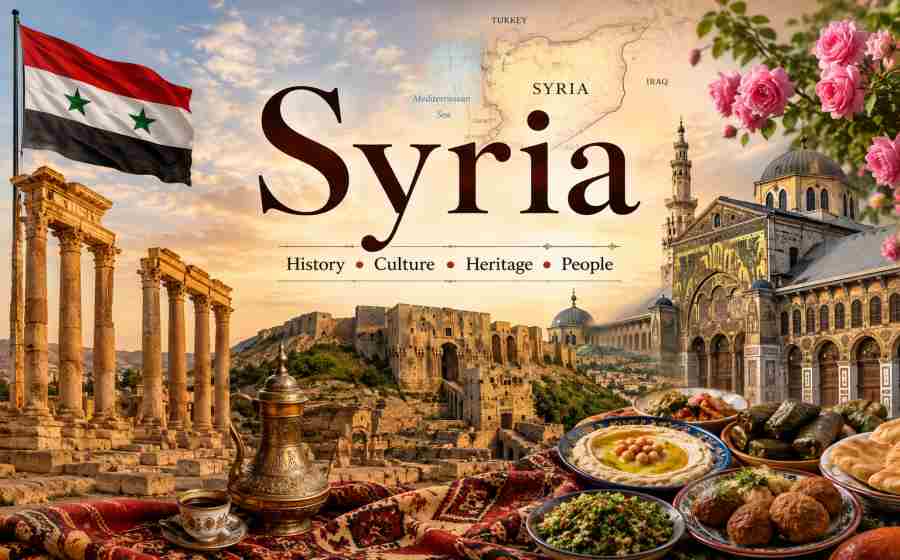
Syria – A Land of Ancient Civilizations, Rich Culture, History, Sports and Fascinating Facts
Discover Syria through its rich history, culture, famous landmarks, sports, traditions, geography, economy and important facts in one informative overview.
Syria
Syria is one of the world’s oldest inhabited countries and has played a vital role in the development of human civilization. Located in Western Asia, Syria has been home to ancient kingdoms, major trade routes, and influential empires for thousands of years. Despite facing years of conflict in recent history, the country remains known for its deep historical roots, remarkable cultural heritage, traditional arts, and archaeological treasures.
From ancient cities and magnificent castles to delicious cuisine and vibrant traditions, Syria continues to hold an important place in world history. Understanding Syria provides valuable insights into the origins of civilization, religion, architecture, and cultural exchange across continents.
Table of Contents
Location and Geography
Syria is situated in the Middle East and shares borders with Turkey to the north, Iraq to the east, Jordan to the south, Israel and Lebanon to the southwest, and the Mediterranean Sea to the west. Its strategic location has made it an important crossroads connecting Asia, Europe, and Africa throughout history.
The country’s geography includes fertile plains, mountain ranges, deserts, and a Mediterranean coastline. The Euphrates River, one of the most significant rivers in the region, flows through eastern Syria and has supported agriculture and settlements for thousands of years.
Capital: Damascus
Official Language: Arabic
Currency: Syrian Pound (SYP)
Government: Republic
History of Syria
Syria has a history stretching back over 10,000 years, making it one of the cradles of civilization. Ancient settlements flourished in the region during the Neolithic period, while powerful civilizations such as the Eblaites, Arameans, Assyrians, Babylonians, Persians, Greeks, Romans, and Byzantines ruled different parts of the country.
Damascus is widely regarded as one of the world’s oldest continuously inhabited cities. Throughout history, it served as a center for trade, culture, and learning.
During the 7th century, Syria became an important part of the Islamic world. Damascus later became the capital of the Umayyad Caliphate, one of the largest empires in history, which greatly influenced architecture, science, education, and administration.
After centuries under Ottoman rule, Syria came under French administration following World War I. It gained independence in 1946 and became a sovereign nation. In the 21st century, Syria experienced a prolonged civil conflict that significantly affected its people, economy, and infrastructure.
Culture and Traditions
Syrian culture reflects thousands of years of interaction among different civilizations, religions, and ethnic communities. Hospitality remains one of the country’s most respected traditions, with guests often welcomed warmly and offered generous meals.
Family plays a central role in Syrian society. Festivals, weddings, and religious celebrations bring relatives together and preserve traditional customs that have been passed down for generations.
Traditional Syrian clothing varies by region, although modern attire is common in urban areas. Music, storytelling, poetry, and folk dances continue to be valued cultural expressions.
Languages and Religion
Arabic is the official language and is spoken throughout the country. Kurdish, Armenian, Syriac, and several other minority languages are also spoken by different communities.
Islam is the majority religion, while Christianity has deep historical roots in Syria. Various religious communities have contributed to the country’s diverse cultural landscape over many centuries.
Syrian Cuisine
Syrian cuisine is among the richest in the Middle East and emphasizes fresh vegetables, grains, olive oil, herbs, and spices.
Popular Syrian dishes include:
- Kibbeh
- Shawarma
- Hummus
- Falafel
- Fattoush
- Tabbouleh
- Muhammara
- Baklava
Tea and Arabic coffee are commonly served during family gatherings and social visits.
Art and Architecture
Syria possesses some of the world’s most remarkable historical architecture. Ancient temples, mosques, churches, castles, and marketplaces showcase influences from Roman, Byzantine, Islamic, and Ottoman civilizations.
Traditional Syrian craftsmanship includes:
- Wood carving
- Mosaic art
- Glass making
- Textile weaving
- Metalwork
- Handcrafted jewelry
Historic marketplaces, known as souks, have long served as centers of commerce and artisan culture.
Sports in Syria
Football is the most popular sport in Syria. The national football team regularly participates in regional and international competitions. Basketball is also widely played, particularly in urban areas.
Other sports enjoyed in Syria include:
- Volleyball
- Athletics
- Wrestling
- Martial arts
- Table tennis
- Swimming
Young athletes continue to participate in sports despite various challenges, demonstrating resilience and determination.
Economy
Before years of conflict, Syria’s economy relied heavily on agriculture, manufacturing, tourism, and oil production.
Major agricultural products include:
- Wheat
- Cotton
- Olives
- Barley
- Fruits
- Vegetables
Small industries produce textiles, food products, pharmaceuticals, cement, and handicrafts. Reconstruction and economic recovery remain important priorities for the country’s future.
Education
Education has traditionally been valued in Syrian society. The country established universities and educational institutions that have contributed to scientific and cultural development.
Many students pursue higher education in fields such as medicine, engineering, science, literature, and business. Although recent conflicts have disrupted educational systems in some areas, efforts continue to improve access to learning.
Tourism and Famous Places
Syria is home to numerous historical and archaeological sites recognized for their cultural significance.
Some famous attractions include:
- Ancient City of Damascus
- Ancient City of Aleppo
- Palmyra
- Krak des Chevaliers
- Bosra
- Umayyad Mosque
- Citadel of Aleppo
These landmarks reflect thousands of years of architectural achievement and cultural heritage.
Wildlife and Climate
Syria experiences a Mediterranean climate along the coast, with hot, dry summers and mild, rainy winters. Inland regions are generally more arid, while desert areas experience extreme temperatures.
Wildlife found in Syria includes:
- Gazelles
- Foxes
- Wolves
- Hyenas
- Eagles
- Falcons
- Various migratory birds
Conservation efforts seek to protect natural habitats and biodiversity.
Interesting Facts About Syria
- Syria is among the oldest continuously inhabited regions on Earth.
- Damascus is considered one of the oldest continuously inhabited cities in the world.
- The ancient city of Palmyra was once a major trading center connecting East and West.
- Syria played an important role in the spread of science, mathematics, medicine, and philosophy during the Islamic Golden Age.
- The country contains numerous archaeological sites dating back thousands of years.
- Syrian cuisine is widely appreciated across the Middle East and beyond.
- Traditional Syrian handicrafts remain highly valued for their craftsmanship.
- The Euphrates River has supported civilization in the region since ancient times.
- Syria’s cultural heritage reflects influences from many ancient empires.
- Despite modern challenges, Syrians continue to preserve their rich traditions, language, arts, and historical legacy.
National Symbols
National Flag: Red, white, and black horizontal stripes with two green stars.
National Animal: Syrian Brown Bear (historically associated)
National Tree: Olive Tree
National Flower: Damask Rose
The olive tree symbolizes peace, endurance, and prosperity, while the Damask rose is internationally famous for its fragrance and historical significance.
Summary
Syria stands as one of humanity’s oldest cultural and historical centers. Its ancient cities, remarkable architecture, diverse traditions, flavorful cuisine, and significant contributions to civilization make it an important country in world history. Although recent decades have brought considerable challenges, Syria’s enduring heritage continues to inspire scholars, historians, and travelers alike. Learning about Syria offers a deeper appreciation of the civilizations that helped shape the modern world and highlights the resilience of a nation with an extraordinary past.
Also Check: General Knowledge