
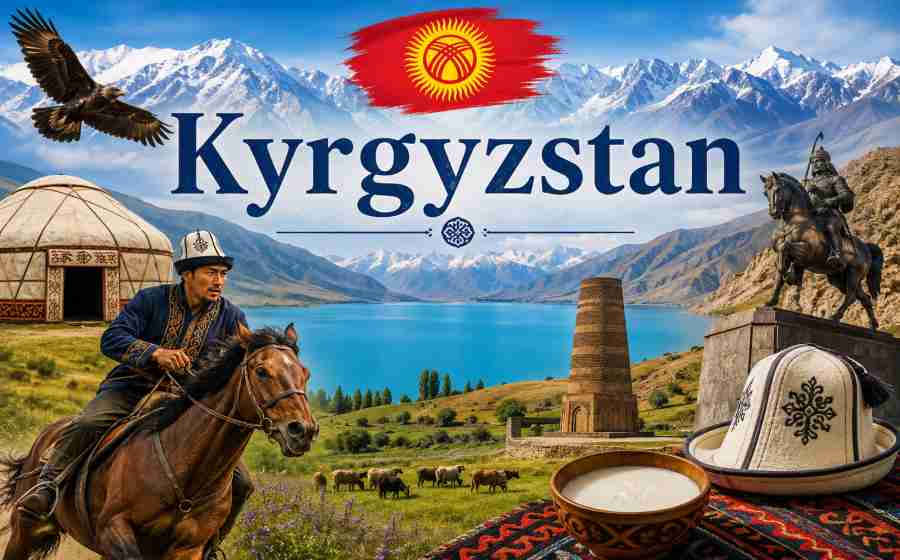
Kyrgyzstan – History, Culture, Tourism, Sports and Fascinating Key Facts
Discover Kyrgyzstan’s history, culture, sports, geography, economy, traditions, famous landmarks and fascinating facts about this Central Asian nation.
Kyrgyzstan
Kyrgyzstan is a beautiful landlocked country located in Central Asia. Known for its breathtaking mountains, crystal-clear lakes, and centuries-old nomadic traditions, it is often called the “Switzerland of Central Asia.” The country is famous for its natural beauty, warm hospitality, traditional horse culture, and rich historical heritage. Although it is one of the smaller countries in Central Asia, Kyrgyzstan has a unique identity shaped by ancient civilizations, the Silk Road, and its independent spirit.
Table of Contents
Location and Geography
Kyrgyzstan is situated in the heart of Central Asia and shares borders with Kazakhstan, Uzbekistan, Tajikistan, and China. It covers an area of approximately 199,951 square kilometers.
Nearly 90% of the country is covered by mountains, mainly the Tian Shan mountain range. These mountains make Kyrgyzstan one of the most mountainous countries in the world. The country’s natural landscape includes glaciers, valleys, rivers, alpine meadows, and beautiful lakes.
One of its greatest natural attractions is Issyk-Kul Lake, one of the world’s largest alpine lakes that never freezes despite its high altitude.
Quick Facts
- Capital: Bishkek
- Largest City: Bishkek
- Official Language: Kyrgyz
- Official Language (also): Russian
- Currency: Kyrgyzstani Som (KGS)
- Population: Around 7 million
- Time Zone: UTC +6
History of Kyrgyzstan
The history of Kyrgyzstan dates back thousands of years. Ancient nomadic tribes inhabited the region long before recorded history. Due to its strategic location, Kyrgyzstan became an important part of the historic Silk Road, connecting East Asia with Europe and the Middle East.
During different periods, the territory was ruled by various empires, including the Turkic Khaganate, Mongol Empire, and Kokand Khanate. In the 19th century, the Russian Empire gradually took control of the region.
Following the Russian Revolution, Kyrgyzstan became part of the Soviet Union as the Kyrgyz Soviet Socialist Republic. During Soviet rule, agriculture, education, and infrastructure developed significantly.
On 31 August 1991, Kyrgyzstan declared independence after the collapse of the Soviet Union. Since then, the country has developed as a democratic republic while facing political and economic challenges.
Government and Economy
Kyrgyzstan is a democratic republic with a presidential system. The President serves as the head of state, while the Prime Minister manages the government.
The country’s economy depends on several important sectors:
- Agriculture
- Gold mining
- Hydroelectric power
- Tourism
- Livestock farming
- Trade and small businesses
Gold remains one of Kyrgyzstan’s biggest exports. The country’s abundant rivers also provide significant opportunities for hydroelectric energy production. Although the economy continues to grow, Kyrgyzstan is still considered a developing nation.
Culture of Kyrgyzstan
Kyrgyz culture is deeply influenced by its nomadic heritage. Hospitality is one of the country’s strongest traditions, and guests are treated with great respect. Traditional music, storytelling, handicrafts, and horse riding remain important aspects of everyday life.
The traditional portable home called the yurt continues to symbolize Kyrgyz identity. Even today, many families use yurts during summer festivals and while grazing livestock in mountain pastures.
The country’s most celebrated literary work is the Epic of Manas, one of the longest epic poems in the world. It tells the heroic story of the legendary warrior Manas and remains an important part of Kyrgyz national identity.
Traditional Food
Kyrgyz cuisine reflects its nomadic lifestyle and relies heavily on meat and dairy products.
Popular traditional dishes include:
- Beshbarmak (boiled meat with noodles)
- Lagman (hand-pulled noodle soup)
- Manti (steamed dumplings)
- Samsa (baked pastry filled with meat)
- Shashlik (grilled meat skewers)
- Kymyz (fermented mare’s milk)
Tea is commonly served during meals and social gatherings.
Festivals and Celebrations
Several cultural festivals are celebrated throughout Kyrgyzstan.
Some important occasions include:
- Independence Day (31 August)
- Nooruz (Persian New Year celebrated in March)
- Traditional Horse Games Festivals
- National Folklore Festivals
These celebrations feature traditional music, folk dances, horse competitions, and local cuisine.
Sports in Kyrgyzstan
Sports are an important part of Kyrgyz culture, especially those involving horses.
Popular sports include:
- Football
- Wrestling
- Boxing
- Weightlifting
- Judo
- Horse racing
One of the country’s most unique sporting traditions is Kok Boru, a fast-paced horseback game where teams compete to place a goat carcass into the opponent’s goal. It is considered the national sport and reflects Kyrgyzstan’s nomadic heritage.
Kyrgyz athletes have also won medals in wrestling, boxing, and weightlifting at international competitions.
Wildlife and Natural Beauty
Kyrgyzstan is rich in biodiversity due to its mountainous terrain.
Wildlife includes:
- Snow leopard
- Ibex
- Brown bear
- Wolf
- Golden eagle
- Marmot
The country has several protected national parks and nature reserves dedicated to conserving its unique ecosystems.
Adventure tourism has become increasingly popular, attracting visitors for trekking, hiking, skiing, horseback riding, and mountaineering.
Education
Education is highly valued in Kyrgyzstan. Primary and secondary education are widely available, and literacy rates remain relatively high.
Major universities are located in Bishkek and other cities, offering programs in science, engineering, medicine, business, and humanities. International educational partnerships have also expanded higher education opportunities.
Tourism in Kyrgyzstan
Tourism has become one of the country’s fastest-growing industries.
Popular attractions include:
- Issyk-Kul Lake
- Ala Archa National Park
- Song-Kul Lake
- Tash Rabat Caravanserai
- Jeti-Ögüz Rocks
- Sary-Chelek Biosphere Reserve
Visitors come to experience mountain trekking, camping in yurts, cultural festivals, horseback adventures, and breathtaking landscapes.
Interesting Facts About Kyrgyzstan
- Kyrgyzstan is one of the most mountainous countries in the world.
- Nearly 90% of its territory lies above 1,500 meters.
- The country was an important stop along the ancient Silk Road.
- The Epic of Manas contains over half a million lines, making it one of the world’s longest epic poems.
- Issyk-Kul Lake never completely freezes despite harsh winters.
- Snow leopards inhabit the country’s remote mountain regions.
- Traditional yurts remain an important cultural symbol.
- Kok Boru is one of the oldest horseback sports still played today.
- The country has abundant freshwater resources and hydroelectric potential.
- Kyrgyzstan gained independence from the Soviet Union in 1991.
Summary
Kyrgyzstan is a nation where majestic mountains, ancient traditions, and nomadic culture come together to create a unique identity. From the legendary Epic of Manas and the scenic beauty of Issyk-Kul Lake to thrilling horse sports and warm hospitality, the country offers a remarkable blend of history and modern development. As tourism, education, and economic opportunities continue to expand, Kyrgyzstan is steadily gaining recognition on the global stage while preserving its rich cultural heritage. For students, travelers, and general knowledge enthusiasts alike, Kyrgyzstan remains a fascinating country with countless stories, traditions, and natural wonders to explore.
Also Check: General Knowledge