Belarus – Traditions, History, Culture, Sports and Fascinating Facts
Discover Belarus through its rich history, culture, popular sports, geography, economy, traditions and fascinating facts about this Eastern European nation.
Belarus
Belarus is a landlocked country in Eastern Europe known for its rich history, beautiful forests, peaceful countryside, and unique cultural traditions. Often called the “Lungs of Europe” because of its vast forests, Belarus has preserved much of its natural beauty while maintaining a strong cultural identity. Although it is less visited than many European countries, Belarus offers impressive architecture, historical landmarks, and a deep connection to its traditions.
The country shares borders with Russia, Ukraine, Poland, Lithuania, and Latvia, making it an important crossroads between Eastern and Central Europe. Belarus has experienced centuries of changing rulers, wars, and political transformations, all of which have shaped its identity. Today, it remains an important nation with a growing focus on education, technology, and industrial development.
Table of Contents
Location and Geography
Belarus covers an area of approximately 207,600 square kilometers, making it one of the larger countries in Europe. It is characterized by flat plains, rolling hills, lakes, rivers, and dense forests. Nearly 40% of the country is covered by forests, providing habitats for diverse wildlife.
The country experiences a temperate continental climate with warm summers and cold winters. Several major rivers, including the Dnieper, Pripyat, and Neman, flow through Belarus, supporting agriculture and transportation.
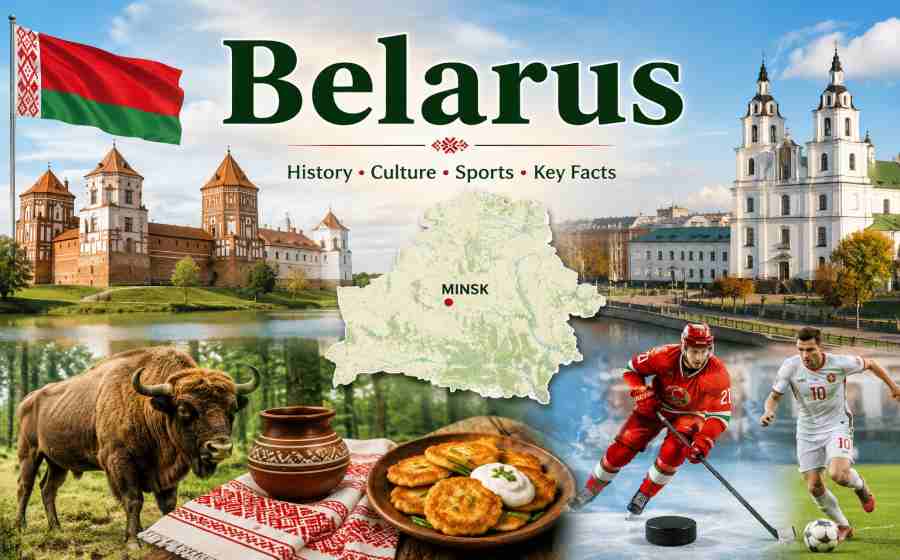
The capital city, Minsk, is also the largest city and serves as the country’s political, cultural, and economic center.
History of Belarus
The history of Belarus dates back over a thousand years. Early settlements were established by Slavic tribes, and during the medieval period, the territory became part of the Kievan Rus’, one of Eastern Europe’s earliest states.
Later, Belarus became an important region within the Grand Duchy of Lithuania, followed by the Polish–Lithuanian Commonwealth. During these periods, the country experienced significant cultural and economic development.
In the late 18th century, Belarus was incorporated into the Russian Empire after the partitions of Poland. During the 20th century, Belarus suffered enormous destruction during both World Wars, especially World War II, where many cities and villages were devastated.
Following the war, Belarus became one of the republics of the Soviet Union. After the dissolution of the Soviet Union in 1991, Belarus declared independence and became a sovereign nation.
Government and Economy
Belarus operates as a presidential republic. The government plays a significant role in managing the country’s economy, with many industries remaining under state control.
The country’s economy is based on:
- Manufacturing
- Agriculture
- Information technology
- Machinery production
- Chemical industries
- Food processing
Belarus is well known for producing tractors, heavy vehicles, fertilizers, and industrial machinery. Agriculture also remains important, with wheat, potatoes, dairy products, and livestock contributing significantly to the economy.
In recent years, Belarus has also developed a growing IT sector, attracting software developers and technology companies.
Culture and Traditions
Belarusian culture reflects influences from Slavic, Baltic, and European civilizations. Folk traditions continue to play an important role in everyday life, especially in rural communities.
Traditional Belarusian music features folk songs, string instruments, and dance performances during festivals and celebrations. Handmade embroidery, wood carving, pottery, and weaving remain respected forms of craftsmanship.
Family values and hospitality are central to Belarusian society. Visitors are often welcomed warmly and treated with generosity.
National celebrations include Independence Day, Victory Day, and traditional seasonal festivals that celebrate harvests and local customs.
Language and Religion
The official languages of Belarus are Belarusian and Russian. While Russian is widely spoken in cities, Belarusian remains an important symbol of national identity and cultural heritage.
Religion also plays an important role in society. The majority of the population follows Eastern Orthodox Christianity, while Roman Catholicism is also practiced by many communities. Other religious groups coexist peacefully across the country.
Famous Food of Belarus
Belarusian cuisine is simple, hearty, and influenced by local agriculture.
Some popular dishes include:
- Draniki (potato pancakes)
- Potato casseroles
- Beetroot soup
- Dumplings
- Rye bread
- Mushroom dishes
- Smoked meats
- Dairy products
Potatoes are considered one of the country’s staple foods and appear in numerous traditional recipes.
Education in Belarus
Belarus has a well-developed education system with high literacy rates. Education is compulsory for children, and the country has many universities and research institutions.
Higher education attracts both local and international students, particularly in fields such as engineering, medicine, computer science, and natural sciences. Scientific research and technical education continue to receive government support.
Sports in Belarus
Sports are highly popular in Belarus, and the country has produced many internationally successful athletes.
Popular sports include:
- Ice hockey
- Football
- Athletics
- Wrestling
- Gymnastics
- Tennis
- Biathlon
Ice hockey enjoys exceptional popularity and has become one of the country’s national sports. Belarusian athletes have won numerous medals at Olympic Games, World Championships, and European competitions.
Wildlife and Natural Beauty
Belarus is famous for its rich biodiversity and protected forests. One of its greatest natural treasures is Belovezhskaya Forest, one of Europe’s oldest forests and home to the European bison, the continent’s largest land mammal.
The country also features:
- Thousands of lakes
- Wetlands
- National parks
- Bird sanctuaries
- Nature reserves
These natural areas make Belarus an attractive destination for eco-tourism and wildlife observation.
Tourism in Belarus
Although tourism is still developing, Belarus offers several attractions for visitors.
Popular destinations include:
- Minsk’s modern city center
- Historic castles
- Ancient churches
- Museums
- National parks
- Forest reserves
Visitors appreciate the country’s clean cities, peaceful atmosphere, and well-preserved historical architecture.
Interesting Facts About Belarus
- Belarus is one of Europe’s most forested countries.
- Nearly 40% of its land area is covered by forests.
- Minsk was almost completely rebuilt after World War II.
- Belarus has one of the highest literacy rates in Europe.
- Potatoes are a major part of Belarusian cuisine.
- The European bison is one of the country’s national symbols.
- Belarus has thousands of lakes spread across the country.
- It is known for manufacturing heavy machinery and tractors.
- The country has a strong tradition of folk music and dance.
- Belarus lies at the crossroads of Eastern and Central Europe.
Importance of Belarus
Belarus occupies a strategic location between Europe and Russia, making it significant for trade and transportation. Its strong manufacturing sector, skilled workforce, agricultural production, and growing technology industry contribute to its economic importance.
The country’s commitment to preserving forests, wildlife, and cultural traditions also makes it unique among European nations.
Summary
Belarus is a country where history, nature, and tradition come together to create a unique national identity. From ancient forests and medieval influences to modern industries and educational achievements, Belarus offers much more than many people realize. Its rich cultural heritage, strong sporting tradition, beautiful landscapes, and resilient people continue to shape the country’s future. Whether exploring its historical landmarks, enjoying traditional cuisine, or learning about its remarkable past, Belarus stands as an important and fascinating nation in Eastern Europe.
Also Check: General Knowledge