Important Historical Monuments of Bihar – Bihar’s Heritage Sites and Architectural Wonders
Discover the important historical monuments of Bihar, ancient stupas, forts, temples, mosques and archaeological sites that showcase the state’s heritage
Important Historical Monuments of Bihar
Bihar is one of the oldest inhabited regions of India and has played a significant role in shaping the country’s history, religion, education, and culture. From the rise of the powerful Magadha Empire to the spread of Buddhism and Jainism, Bihar has witnessed several remarkable events that influenced not only India but also the world. Today, the state is home to numerous historical monuments that reflect its glorious past. These monuments include ancient stupas, temples, forts, monasteries, mosques, tombs, and archaeological ruins that attract historians, researchers, pilgrims, and tourists alike.
The historical monuments of Bihar stand as symbols of its rich cultural heritage and architectural excellence. Many of these sites are associated with Lord Buddha, Lord Mahavira, Emperor Ashoka, the Gupta Empire, and the Mauryan dynasty. Several monuments are recognized as nationally protected sites, while some have also received international recognition.
Table of Contents
Importance of Historical Monuments
Historical monuments are valuable because they:
- Preserve the history and culture of a region.
- Showcase ancient architectural styles and engineering skills.
- Promote tourism and economic development.
- Help students and researchers understand India’s past.
- Preserve the legacy of ancient civilizations for future generations.
Bihar’s monuments represent over 2,500 years of history, making the state one of India’s most historically significant regions.
Major Historical Monuments of Bihar
1. Mahabodhi Temple, Bodh Gaya
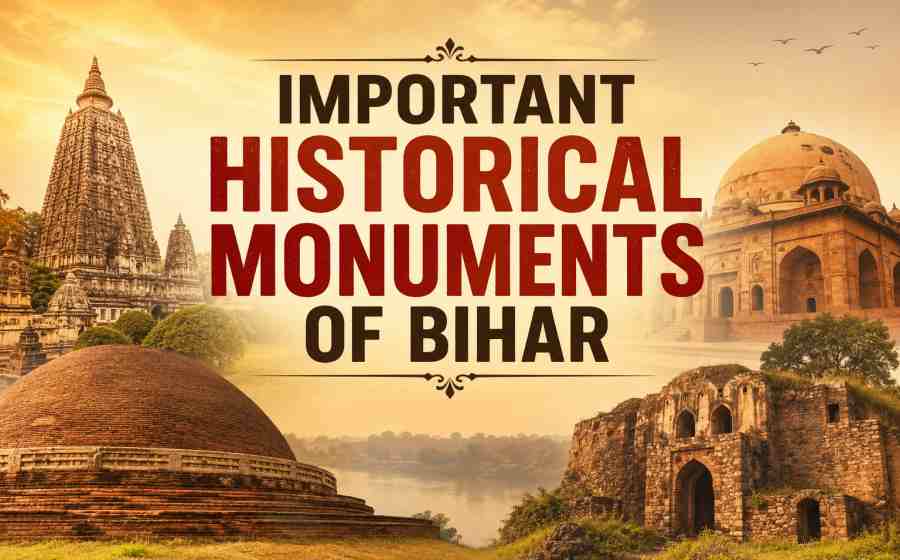
The Mahabodhi Temple is the most famous monument in Bihar and one of the holiest Buddhist pilgrimage sites in the world. It marks the place where Gautama Buddha attained enlightenment under the Bodhi Tree around the 6th century BCE.
The present temple was built in the Gupta period and later restored several times. Its towering pyramidal structure, intricate carvings, and peaceful surroundings attract millions of visitors every year.
Highlights:
- UNESCO World Heritage Site
- Sacred Bodhi Tree
- Vajrasana (Diamond Throne)
- International Buddhist monasteries nearby
2. Nalanda Mahavihara (Nalanda University Ruins)
Nalanda was one of the world’s first residential universities and flourished between the 5th and 12th centuries CE. Scholars from India, China, Korea, Tibet, and Southeast Asia came here to study philosophy, astronomy, medicine, mathematics, and Buddhist teachings.
The archaeological remains include monasteries, temples, classrooms, libraries, and meditation halls.
Highlights:
- UNESCO World Heritage Site
- Ancient learning centre
- Red-brick architecture
- Important archaeological site
3. Vikramshila University Ruins
Established by King Dharmapala of the Pala Dynasty during the 8th century CE, Vikramshila University became another great centre of Buddhist education after Nalanda.
The ruins reveal an impressive central monastery, prayer halls, temples, and residential complexes.
Location: Bhagalpur District
4. Kesaria Stupa
Kesaria Stupa is believed to be one of the tallest Buddhist stupas in the world. According to Buddhist tradition, Lord Buddha gave his begging bowl to the Licchavis at this place before proceeding towards Kushinagar.
The massive circular structure demonstrates advanced ancient engineering.
Location: East Champaran
5. Barabar Caves
The Barabar Caves are the oldest surviving rock-cut caves in India. Built during the reign of Emperor Ashoka and his grandson Dasharatha in the 3rd century BCE, these caves were dedicated to the Ajivika sect.
Their highly polished granite interiors remain an architectural marvel.
Famous Caves:
- Sudama Cave
- Lomas Rishi Cave
- Karan Chaupar Cave
- Visvakarma Cave
6. Rohtasgarh Fort
Situated atop the Kaimur Hills, Rohtasgarh Fort is one of Bihar’s largest and strongest hill forts. It has witnessed the rule of various dynasties, including the Mughals and Sher Shah Suri.
The fort contains temples, gateways, reservoirs, palaces, and defensive walls spread across a vast area.
7. Sher Shah Suri’s Tomb
Located in Sasaram, this magnificent sandstone mausoleum was built in memory of Sher Shah Suri, the founder of the Sur Empire.
Constructed in Indo-Islamic architectural style, the tomb stands in the middle of an artificial lake, creating a spectacular view.
Architectural Features:
- Octagonal structure
- Massive dome
- Beautiful sandstone carvings
- Surrounded by water
8. Golghar
Golghar is one of Patna’s most recognizable landmarks. Built in 1786 by Captain John Garstin after the Great Bengal Famine, it served as a granary for storing food grains.
The structure features a unique beehive shape with spiral staircases leading to the top, offering panoramic views of Patna.
9. Agam Kuan
Agam Kuan, meaning “Unfathomable Well,” is associated with Emperor Ashoka. According to historical accounts, it was part of Ashoka’s palace complex before he embraced Buddhism.
The mysterious well continues to attract historians and visitors.
10. Kumhrar Archaeological Site
Kumhrar represents the remains of ancient Pataliputra, the capital of the Mauryan Empire.
Excavations have revealed the famous eighty-pillared hall believed to have belonged to Emperor Ashoka’s palace complex.
The site provides valuable insights into one of the greatest empires in Indian history.
11. Jalmandir, Pawapuri
Pawapuri is the place where Lord Mahavira, the 24th Tirthankara of Jainism, attained Nirvana.
The beautiful white marble Jalmandir stands in the middle of a lotus-filled lake and is one of the holiest Jain pilgrimage sites.
12. Pathar Ki Masjid
Built in the early 17th century during the Mughal period, Pathar Ki Masjid is one of Patna’s oldest mosques.
Constructed entirely of stone, it showcases elegant Mughal architecture.
13. Navlakha Palace
Located in Rajnagar near Madhubani, Navlakha Palace was constructed by Maharaja Rameshwar Singh.
Although partially damaged by earthquakes, it remains an important example of Rajput and Mughal architectural influence.
14. Tomb of Malik Ibrahim Bayu
Situated in Bihar Sharif, this medieval monument is dedicated to the Sufi saint Malik Ibrahim Bayu and reflects the spread of Islamic architecture in Bihar.
15. Ancient Ruins of Vaishali
Vaishali was one of the world’s earliest republics and an important centre for both Buddhism and Jainism.
The archaeological remains include:
- Ashokan Pillar
- Buddha Stupa
- Relic Stupa
- Ancient monasteries
- Raja Vishal Ka Garh
These monuments collectively highlight Vaishali’s historical and religious importance.
Architectural Diversity of Bihar
Historical monuments in Bihar represent various architectural traditions, including:
- Mauryan Architecture
- Gupta Architecture
- Buddhist Architecture
- Jain Architecture
- Mughal Architecture
- Indo-Islamic Architecture
- Colonial Architecture
This diversity reflects Bihar’s long and multicultural history.
Tourism and Heritage Conservation
The Government of India and the Government of Bihar have undertaken several initiatives to preserve these monuments through conservation, restoration, and tourism development. Improved infrastructure, museums, guided tours, and heritage circuits have increased visitor interest.
Responsible tourism, proper maintenance, and public awareness are essential to ensure these monuments remain preserved for future generations.
Summary
The historical monuments of Bihar are living reminders of India’s ancient civilization, religious traditions, and architectural brilliance. From the sacred Mahabodhi Temple and the ruins of Nalanda University to the mighty Rohtasgarh Fort and the magnificent Sher Shah Suri’s Tomb, each monument tells a unique story of power, knowledge, faith, and culture. These priceless heritage sites not only preserve Bihar’s glorious past but also inspire future generations to appreciate and protect India’s rich historical legacy. Exploring these monuments offers an unforgettable journey through thousands of years of history, making Bihar one of the most important heritage destinations in the country.
Also Check: Bihar GK