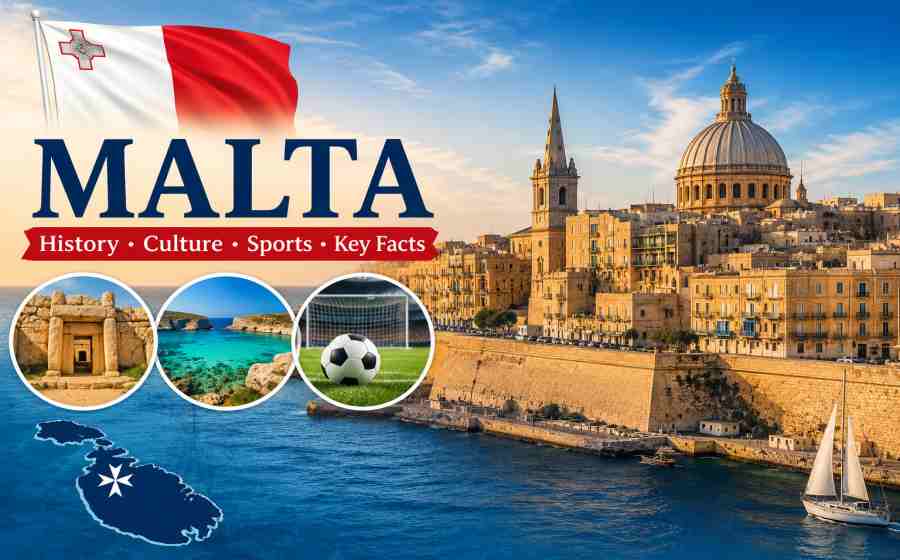
Malta – History, Tourism, Culture, Sports, Geography and Key Facts
Discover Malta, explore its rich history, vibrant culture, popular sports, geography, traditions and fascinating key facts about this Mediterranean nation.
Malta
Malta is a small island country in the central Mediterranean Sea, known for its ancient history, impressive fortifications, beautiful coastline and distinctive culture. Despite its compact size, Malta has played an important role in Mediterranean history because of its strategic location between Europe and North Africa. The Maltese archipelago has a history stretching back thousands of years and has been influenced by numerous civilizations.
The Republic of Malta consists primarily of the inhabited islands of Malta, Gozo and Comino. Malta is the largest island and serves as the country’s political, commercial and cultural centre. The capital city, Valletta, is famous for its historic architecture and UNESCO World Heritage significance. The country covers only about 316 square kilometres, making it one of the world’s smallest countries.
Table of Contents
Geography of Malta
Malta is situated in the Mediterranean Sea, approximately 93 kilometres south of Sicily and around 288 kilometres north of Libya. Its geographical position has made it an important crossroads between Europe, North Africa and the wider Mediterranean region.
The three main inhabited islands have different characteristics. Malta is the most developed and densely populated, Gozo is greener and more rural, while Comino is famous for its natural beauty and the popular Blue Lagoon. The islands enjoy a typical Mediterranean climate, with hot, dry summers and relatively mild winters.
History of Malta
Malta has one of the most fascinating histories in the Mediterranean. Evidence of human settlement goes back thousands of years, while the islands are home to remarkable prehistoric structures. The Megalithic Temples of Malta are among the world’s oldest free-standing stone structures.
Over the centuries, Malta came under the influence or control of several civilizations and powers, including the Phoenicians, Carthaginians, Romans, Byzantines, Arabs, Normans and various European rulers. The islands’ strategic position repeatedly attracted competing powers.
One of the most important periods began in 1530, when Malta and Gozo were granted to the Order of Saint John. The Knights transformed the islands through extensive construction, particularly fortifications, churches and public buildings. Their most famous historical challenge was the Great Siege of 1565, when the Knights and Maltese defenders resisted the Ottoman forces.
The Knights later developed Valletta, which became an important example of European Baroque urban planning and architecture. Their influence remains visible throughout the country.
In 1798, Napoleon Bonaparte’s French forces occupied Malta. British rule followed, and Malta became a British colony in the 19th century. Malta eventually achieved independence from Britain in 1964 and became a republic in 1974. It joined the European Union in 2004, later becoming part of the Schengen Area and adopting the euro.
Culture and Traditions of Malta
Maltese culture reflects the country’s long and varied history. It contains Mediterranean, European and Arab influences, creating an identity that is distinctive within Europe. Maltese and English are the country’s official languages, while Italian is also widely understood.
Religion has traditionally played an important role in Maltese society, with Roman Catholicism having a strong influence on festivals, architecture and community life. One of Malta’s best-known traditions is the village festa, held in honour of patron saints. These celebrations can feature processions, music, decorations and fireworks.
Malta also has a strong tradition of music, crafts, theatre and artistic expression. The country’s cultural institutions work to preserve its heritage while encouraging contemporary creativity.
Maltese cuisine is another important part of the national identity. Traditional food reflects Mediterranean ingredients and the islands’ historical connections with neighbouring cultures. Popular dishes include pastizzi, a flaky pastry usually filled with ricotta or peas, and fenek, a traditional rabbit dish. Fresh seafood, vegetables, bread and olive oil are also important parts of local cuisine.
Famous Historical and Cultural Sites
Malta is sometimes described as an open-air museum because historic structures can be found throughout the islands. Valletta is particularly famous for its fortifications, churches, palaces and streets.
Among Malta’s major heritage attractions are the Megalithic Temples, Ħal Saflieni Hypogeum and the City of Valletta, all of which are represented on the UNESCO World Heritage List.
Another notable location is Mdina, a historic fortified city often associated with Malta’s medieval past. The ancient walled character of Mdina, combined with Malta’s numerous churches and fortifications, provides a visual record of the islands’ complex history.
Sports in Malta
Sports are an important part of Maltese society. Football (soccer) is the country’s most popular sport, with clubs and supporters found throughout the islands. Malta has its own national football team and participates in international competitions.
Other popular sporting activities include swimming, water sports, athletics, basketball, tennis and sailing. Malta’s Mediterranean location naturally encourages participation in activities connected with the sea.
Boating and sailing have a particularly strong connection with the islands. The surrounding waters provide opportunities for diving, snorkeling, sailing and other recreational activities. Malta’s clear Mediterranean waters also make it a well-known destination for underwater exploration.
Economy and Modern Malta
Although Malta is small, its economy has developed into a modern, service-oriented economy. Tourism is a major sector, supported by the country’s historical attractions, beaches, climate and cultural heritage. Financial services, digital industries, manufacturing, education and other international services also contribute to economic activity.
Membership in the European Union has strengthened Malta’s connections with the wider European economy. The country’s location and English-language environment have also contributed to its international business links.
Malta and Tourism
Tourism remains one of Malta’s major attractions. Visitors come to explore historic cities, ancient temples, coastal landscapes and traditional villages. Valletta, Mdina, the Three Cities, Gozo and Comino are among the places that attract visitors.
The islands combine historical attractions with Mediterranean beaches and outdoor activities. Malta’s relatively small size means that many cultural and natural attractions can be reached within a short distance of one another.
Important Facts About Malta
- Official Name: Republic of Malta
- Capital: Valletta
- Location: Central Mediterranean Sea
- Main Islands: Malta, Gozo and Comino
- Area: About 316 square kilometres
- Official Languages: Maltese and English
- Currency: Euro (€)
- Government: Republic
- Independence: 1964
- Republic Declared: 1974
- European Union Membership: 2004
- Country Calling Code: +356
- National Anthem: L-Innu Malti
- National Symbol: Maltese Cross
- Major Sport: Football
- Famous Heritage: Megalithic Temples, Ħal Saflieni Hypogeum and Valletta
Summary
Malta may be one of Europe’s smallest countries, but its historical and cultural importance is remarkable. From prehistoric temples and the legacy of the Knights of Saint John to British rule and modern European membership, Malta’s story has been shaped by centuries of interaction between civilizations. Its distinctive language, village festas, architecture, cuisine and sporting traditions add to its unique identity. Today, Malta combines its ancient heritage with a modern economy and an internationally connected society, making it an interesting country to study from historical, geographical, cultural and general-knowledge perspectives.
Also Check: General Knowledge