
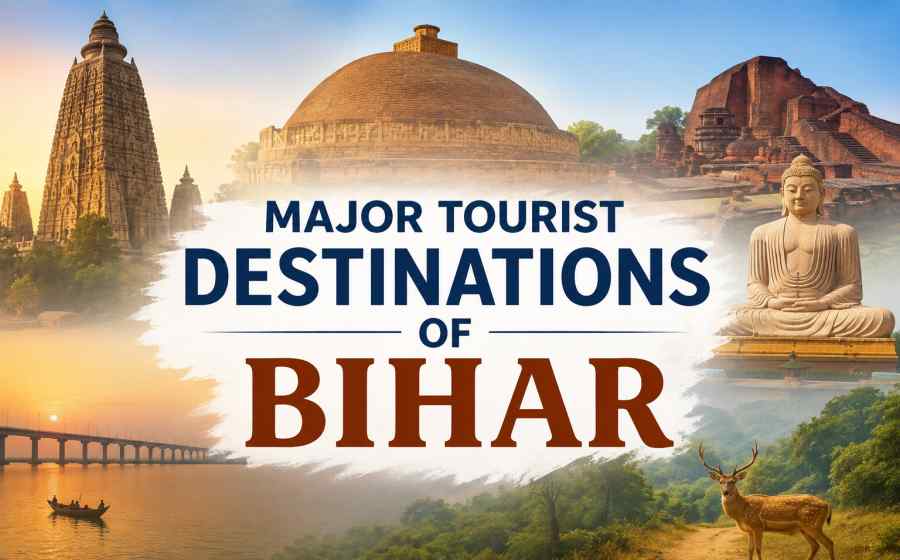
Major Tourist Destinations of Bihar – History, Culture and Natural Beauty
Major Tourist Destinations of Bihar, explore Bodh Gaya, Nalanda, Rajgir, Patna, Pawapuri and other famous historical, religious and natural attractions.
Major Tourist Destinations of Bihar
Bihar is one of India’s most historically and culturally significant states. Located in eastern India, it has a remarkable heritage shaped by ancient kingdoms, Buddhism, Jainism, Hinduism, literature, education and the freedom movement. The state is home to archaeological sites, sacred places, ancient universities, historical monuments, wildlife areas and scenic landscapes. These attractions make Bihar an important destination for history lovers, pilgrims, students and travelers interested in India’s cultural heritage.
From the spiritual importance of Bodh Gaya to the ancient ruins of Nalanda and the natural beauty of Valmiki Tiger Reserve, Bihar offers a wide variety of experiences. Several destinations are also closely connected with important personalities and events that have influenced Indian history.
Table of Contents
Bodh Gaya
Bodh Gaya is among the most important Buddhist pilgrimage destinations in the world. It is believed to be the place where Prince Siddhartha Gautama attained enlightenment under the Bodhi Tree and became the Buddha.
The Mahabodhi Temple is the central attraction of Bodh Gaya. The temple complex is recognized as a UNESCO World Heritage Site and attracts pilgrims and visitors from India and many other countries. The Bodhi Tree, meditation areas and monasteries built by different Buddhist communities add to the spiritual atmosphere of the town.
Bodh Gaya is particularly significant for those interested in Buddhism, meditation and ancient Indian history. The destination also reflects Bihar’s important role in the development and spread of Buddhist traditions.
Nalanda
Nalanda is another major historical destination of Bihar. Ancient Nalanda was one of the world’s great centers of learning and attracted scholars and students from different parts of Asia.
The Nalanda Mahavihara Archaeological Site contains the remains of monasteries, temples, classrooms and other structures associated with the ancient educational institution. Its archaeological remains provide valuable insight into the intellectual and architectural traditions of ancient India.
The modern Nalanda Archaeological Museum also preserves important artifacts discovered in the region. A visit to Nalanda offers an opportunity to understand Bihar’s contribution to education and knowledge in the ancient world.
Rajgir
Rajgir is a historically and religiously important destination surrounded by hills. It has connections with Buddhism, Jainism and ancient Magadha.
The place is associated with Gautama Buddha, who is believed to have spent considerable time in the region. Griddhakuta Hill, also known as Vulture Peak, is an important Buddhist site. Rajgir is also associated with Jain traditions and is believed to have connections with several Jain Tirthankaras.
The city has hot springs, ancient ruins, hills and religious sites. The Rajgir Nature Safari and ropeway have also added modern attractions for visitors. The combination of history, spirituality and natural scenery makes Rajgir one of Bihar’s prominent tourist destinations.
Patna
Patna, the capital of Bihar, combines historical importance with modern urban life. The city was known as Pataliputra in ancient times and served as an important center under several powerful dynasties.
Important attractions include Golghar, Patna Museum, Bihar Museum, Takht Sri Patna Sahib, Gandhi Maidan and Agam Kuan. Patna Sahib is especially significant to Sikh pilgrims because it is the birthplace of Guru Gobind Singh.
Patna is also a useful starting point for exploring other tourist destinations in Bihar. Its museums, historical landmarks and religious sites provide visitors with an introduction to the state’s diverse heritage.
Vaishali
Vaishali is an important ancient city associated with Buddhism, Jainism and the republican traditions of India. It is believed to have been an important center of the ancient Vajji confederacy.
Vaishali has strong connections with Gautama Buddha and is regarded as an important Buddhist pilgrimage site. The Ashokan Pillar, ancient stupas and archaeological remains are among its notable attractions.
The destination is also closely associated with Lord Mahavira, who was born in the Vaishali region. Because of these connections, Vaishali holds special importance for followers of both Buddhism and Jainism.
Pawapuri
Pawapuri is one of the most sacred Jain pilgrimage sites in Bihar. It is traditionally regarded as the place where Lord Mahavira attained nirvana.
The most famous attraction is the Jal Mandir, a beautiful temple situated in the middle of a lotus-filled water body. A marble structure and the surrounding peaceful landscape give the site a distinctive appearance.
Pawapuri attracts Jain pilgrims throughout the year and is an important destination for understanding the religious heritage of Bihar.
Kesaria
Kesaria in East Champaran district is famous for its enormous ancient Buddhist stupa. The Kesaria Stupa is considered one of the important Buddhist archaeological monuments in the region.
The site reflects Bihar’s connection with the Buddhist period and provides visitors with an opportunity to explore ancient architecture and archaeology. Its large structure and historical significance make Kesaria an important stop for travelers interested in Bihar’s Buddhist heritage.
Vikramshila
Vikramshila, located in present-day Bhagalpur district, was another renowned center of Buddhist learning in ancient India. It was established during the Pala period and became an important institution of higher learning.
The archaeological remains include monasteries, a central stupa and other structures. The site demonstrates the advanced educational and architectural traditions that existed in eastern India centuries ago.
Vikramshila is particularly valuable for students and history enthusiasts who want to explore Bihar’s ancient academic heritage beyond Nalanda.
Valmiki Nagar and Valmiki Tiger Reserve
Bihar’s tourism is not limited to historical and religious attractions. Valmiki Nagar, located near the Nepal border, is known for its forests and natural surroundings.
The Valmiki Tiger Reserve is Bihar’s only tiger reserve and is an important wildlife destination. The reserve contains forests, rivers, grasslands and diverse wildlife. Visitors may encounter a variety of animals and birds depending on the season and permitted activities.
The area provides a different side of Bihar, highlighting the state’s biodiversity and natural beauty.
Sonepur
Sonepur is famous for the historic Sonepur Mela, traditionally associated with the Kartik Purnima festival. The fair has long been an important cultural gathering and attracts visitors from different parts of the region.
Apart from the fair, Sonepur is also known for its religious importance and its location near the confluence of the Ganga and Gandak rivers. The annual gathering showcases Bihar’s rural traditions, handicrafts, local culture and religious practices.
Munger
Munger is an important historical city situated along the Ganga. It has a long association with ancient and medieval history and is known for several historical and religious sites.
The Munger Fort is one of the city’s prominent landmarks. Munger is also associated with yoga through the well-known Bihar School of Yoga. The combination of history, spirituality and the riverside setting makes it an interesting destination for visitors.
Summary
Bihar is a state where ancient history, spirituality, education, culture and nature come together. Bodh Gaya represents the global importance of Buddhism, Nalanda highlights the legacy of ancient learning, Rajgir and Vaishali showcase religious and historical traditions, while Patna reflects the state’s continuing cultural importance.
Destinations such as Pawapuri, Kesaria and Vikramshila reveal Bihar’s deep archaeological and religious heritage, while Valmiki Nagar demonstrates its natural wealth. Sonepur and Munger further add cultural and historical diversity to the tourism landscape.
For travelers seeking meaningful experiences connected with India’s past and cultural traditions, Bihar offers a rich collection of destinations. Its tourist places are not only scenic or architecturally significant but also provide valuable insights into the history and civilization of the Indian subcontinent.
Also Check: Bihar GK