
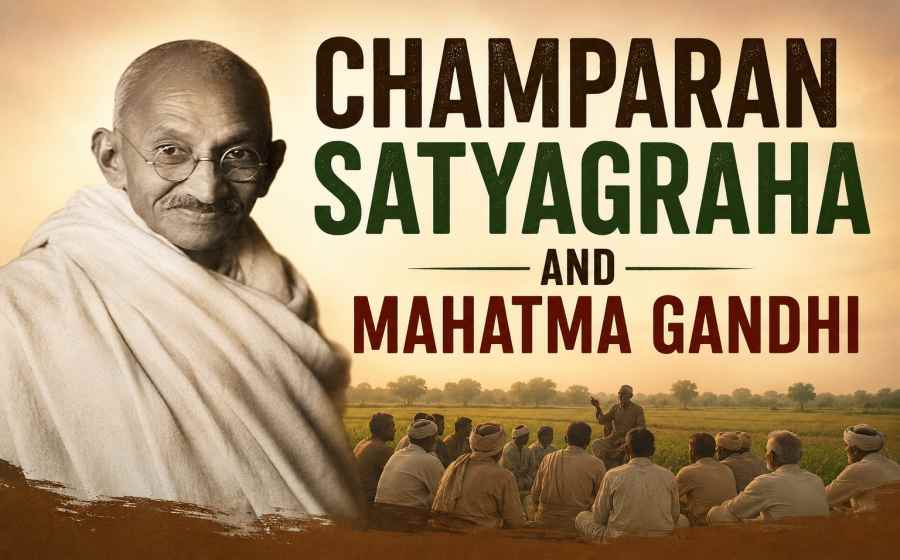
Champaran Satyagraha and Mahatma Gandhi – The Movement That Changed India’s Freedom Struggle
Learn about Champaran Satyagraha and Mahatma Gandhi, the first successful Satyagraha in India that inspired the freedom movement and empowered farmers.
Champaran Satyagraha and Mahatma Gandhi
The Champaran Satyagraha was one of the most significant events in India’s struggle for independence. It marked the beginning of Mahatma Gandhi’s leadership in India’s freedom movement and introduced the powerful method of Satyagraha (non-violent resistance) on Indian soil. The movement took place in 1917 in the Champaran district of present-day Bihar, where thousands of poor farmers were suffering under the oppressive policies of British indigo planters.
The success of the Champaran Satyagraha not only improved the lives of the farmers but also demonstrated that peaceful protest could challenge injustice. It became a turning point in India’s fight against British colonial rule.
Table of Contents
Background of Champaran
Champaran, located in the northern part of Bihar, was a fertile agricultural region. During British rule, European indigo planters forced local farmers to cultivate indigo instead of food crops under a system known as the Tinkathia System.
According to this system, farmers had to dedicate 3 kathas out of every 20 kathas of land (about 15%) to indigo cultivation. They received very little payment while bearing all the risks of cultivation. After the invention of synthetic dyes in Europe, the demand for natural indigo declined, but the British planters continued exploiting Indian farmers by imposing unfair taxes and demanding compensation. As a result, the peasants of Champaran suffered from poverty, debt, and continuous harassment.
Raj Kumar Shukla’s Role
The Champaran movement would not have begun without the determination of Raj Kumar Shukla, a farmer from Champaran.
Shukla repeatedly requested Mahatma Gandhi to visit Champaran and witness the condition of the farmers. He met Gandhi during the Lucknow Session of the Indian National Congress in 1916 and persistently persuaded him until Gandhi agreed to visit Bihar.
Raj Kumar Shukla’s efforts played a crucial role in bringing national attention to the problems faced by Champaran’s farmers.
Arrival of Mahatma Gandhi in Champaran
Mahatma Gandhi reached Champaran in April 1917. Before coming to Champaran, Gandhi had successfully used the method of Satyagraha in South Africa against racial discrimination.
Soon after arriving, British officials ordered Gandhi to leave Champaran. Gandhi refused to obey the order, stating that it was his moral duty to help the suffering farmers. He accepted the possibility of punishment but remained committed to justice.
This act of peaceful defiance won the respect of the local people and marked the beginning of the Champaran Satyagraha.
Investigation into Farmers’ Problems
Instead of launching an immediate protest, Gandhi first conducted a detailed investigation.
He traveled from village to village and recorded the statements of thousands of farmers. He collected evidence regarding:
- Forced indigo cultivation
- Illegal taxes
- Low compensation
- Harassment by British planters
- Poverty and debt among peasants
Many local leaders assisted Gandhi in this work, including:
- Dr. Rajendra Prasad
- Brajkishore Prasad
- Mazharul Haque
- J.B. Kripalani
- Mahadev Desai
Their collective efforts helped present a strong case before the British administration.
The Principle of Satyagraha
The word Satyagraha means “holding firmly to truth.”
Its main principles include:
- Truth
- Non-violence
- Peaceful resistance
- Courage
- Moral strength
Instead of using violence, Gandhi believed that injustice could be defeated through truth, discipline, and peaceful protest. Champaran became the first major experiment of this philosophy in India.
Government’s Response
The British government realized that Gandhi’s movement had gained widespread public support. Instead of suppressing the movement violently, the government appointed a committee to investigate the farmers’ grievances. Gandhi was included as a member of this committee. After examining the evidence, the committee recommended reforms.
Major Outcomes of Champaran Satyagraha
The movement achieved several important victories:
- The oppressive Tinkathia System was abolished.
- Farmers received refunds for illegal collections.
- British planters lost their unchecked authority.
- Farmers gained confidence and awareness of their rights.
- Gandhi emerged as a respected national leader.
Although the monetary compensation was limited, the moral victory was enormous.
Social Reforms Initiated by Gandhi
Gandhi believed that true freedom required social improvement as well as political change.
During his stay in Champaran, he encouraged:
- Cleanliness and sanitation
- Basic education
- Women’s participation
- Better health practices
- Self-reliance
Schools were opened in villages, and volunteers educated local people about hygiene and literacy. These reforms reflected Gandhi’s vision of holistic rural development.
Importance in India’s Freedom Struggle
The Champaran Satyagraha occupies a unique place in Indian history because:
- It was Gandhi’s first Satyagraha in India.
- It proved that non-violent protest could succeed.
- It united ordinary farmers with the national movement.
- It increased public confidence in Gandhi’s leadership.
- It inspired later movements like the Kheda Satyagraha (1918), Ahmedabad Mill Strike (1918), Non-Cooperation Movement (1920), Civil Disobedience Movement (1930), and the Quit India Movement (1942).
Champaran demonstrated that India’s freedom struggle would not be limited to educated elites but would involve ordinary citizens from villages across the country.
Champaran and Bihar’s Contribution
The Champaran Satyagraha highlighted Bihar’s important contribution to India’s independence. The movement showcased the courage of Bihar’s farmers and the dedication of local leaders. It also brought Bihar into the national spotlight as the birthplace of Gandhi’s first successful mass movement in India. Today, Champaran is remembered as a symbol of justice, courage, and peaceful resistance.
Legacy of the Movement
More than a century later, the Champaran Satyagraha continues to inspire movements for justice around the world.
Its lessons remain relevant:
- Peaceful resistance is powerful.
- Truth can overcome oppression.
- Ordinary people can bring extraordinary change.
- Leadership should be based on service and compassion.
The principles established in Champaran influenced not only India’s independence movement but also civil rights campaigns across the world.
Summary
The Champaran Satyagraha and Mahatma Gandhi represent one of the greatest chapters in India’s history. What began as a struggle against the exploitation of indigo farmers became the foundation of India’s mass freedom movement. Gandhi’s commitment to truth, non-violence, and justice transformed the political landscape of India and gave hope to millions of oppressed people.
The success of the Champaran Satyagraha proved that courage combined with peaceful resistance could challenge even the most powerful empire. It remains a timeless example of how determination, unity, and moral strength can bring lasting social and political change.
Also Check: Bihar GK