Austria – History, Tourism, Culture, Sports and Key Facts
Discover Austria’s history, culture, famous landmarks, sports, traditions, geography, economy and key facts in this informative overview of the Alpine nation.
Austria
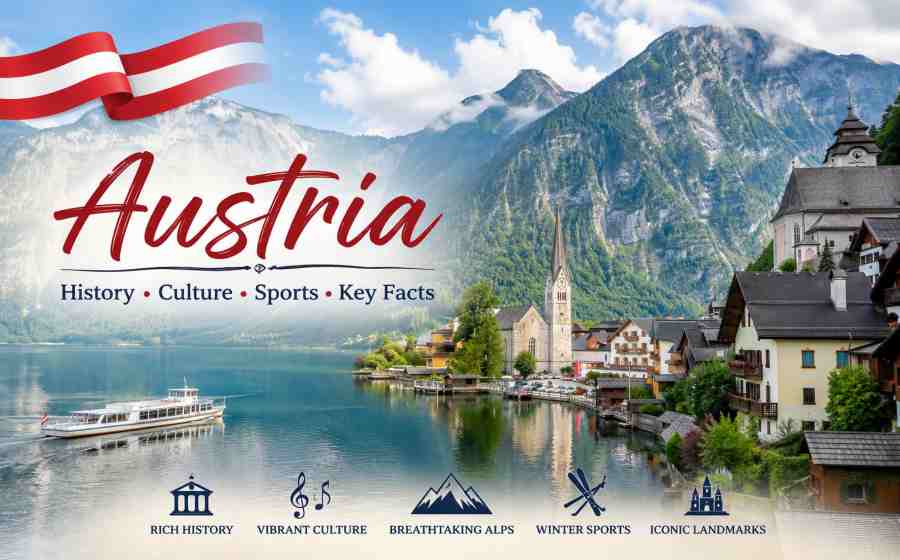
Austria is one of Europe’s most beautiful and historically significant countries. Nestled in the heart of Central Europe, it is renowned for its breathtaking Alpine landscapes, classical music, imperial heritage, and high quality of life. Despite its relatively small size, Austria has played a major role in shaping European politics, art, science, and culture for centuries.
Today, Austria is a modern, prosperous nation known for its excellent education system, advanced economy, environmental sustainability, and vibrant tourism industry. Millions of visitors travel to Austria each year to explore its historic cities, majestic mountains, ski resorts, and cultural festivals.
Table of Contents
Geography of Austria
Austria is a landlocked country in Central Europe bordered by Germany, Czech Republic, Slovakia, Hungary, Slovenia, Italy, Switzerland, and Liechtenstein.
- Capital: Vienna
- Largest City: Vienna
- Continent: Europe
- Area: Approximately 83,879 square kilometres
- Population: Around 9 million
- Official Language: German
- Currency: Euro (€)
- Government: Federal Parliamentary Republic
Nearly two-thirds of Austria is covered by the Alps, making it one of Europe’s most mountainous countries. The Danube River, Europe’s second-longest river, also flows through Austria and plays a significant role in transportation and trade.
History of Austria
Austria’s history dates back thousands of years. During ancient times, Celtic tribes inhabited the region before it became part of the Roman Empire.
In the Middle Ages, Austria emerged as an important duchy ruled by the powerful House of Habsburg. The Habsburg dynasty governed Austria for over six centuries and expanded its influence across much of Europe.
The Austrian Empire was established in 1804 and later transformed into the Austro-Hungarian Empire in 1867. This empire became one of Europe’s most influential powers until its collapse after World War I in 1918.
Following World War II, Austria was occupied by Allied powers until 1955. The Austrian State Treaty restored the country’s independence, and Austria declared permanent neutrality, a policy it continues to maintain today.
Austria joined the European Union in 1995 and has since become an active member of the European community while preserving its neutral foreign policy.
Culture of Austria
Austria possesses one of the richest cultural heritages in the world. The country is widely recognized as the birthplace of legendary composers such as Wolfgang Amadeus Mozart, Franz Schubert, and Johann Strauss II. Classical music remains deeply embedded in Austrian society, with concerts and opera performances attracting visitors from around the globe.
Family values, punctuality, cleanliness, and respect for tradition are highly regarded in Austrian culture. Traditional clothing is still worn during festivals:
- Lederhosen for men
- Dirndl dresses for women
Austria also celebrates numerous cultural events throughout the year, including music festivals, Christmas markets, and local harvest festivals.
Famous Austrian Cuisine
Austrian food combines Central European flavors with regional specialties. Popular dishes include:
- Wiener Schnitzel
- Tafelspitz
- Goulash
- Kaiserschmarrn
- Apple Strudel
- Sachertorte
- Knödel (dumplings)
Coffee houses are an important part of Austrian culture. These cafés have served as gathering places for artists, writers, and intellectuals for centuries.
Economy of Austria
Austria has one of Europe’s strongest and most stable economies. Major industries include:
- Tourism
- Manufacturing
- Engineering
- Automobile components
- Machinery
- Renewable energy
- Banking
- Information Technology
- Agriculture
The country’s well-developed transport network and strategic location make it an important commercial hub in Europe. Austria is also recognized for its environmental protection policies and sustainable development initiatives.
Sports in Austria
Sports play an important role in Austrian life, especially winter sports. Austria is considered one of the world’s strongest nations in Alpine skiing and has produced numerous Olympic and World Championship medalists. Popular sports include:
- Alpine Skiing
- Snowboarding
- Ice Hockey
- Football (Soccer)
- Cycling
- Tennis
- Mountaineering
- Hiking
The country’s mountainous landscape provides ideal conditions for skiing and outdoor adventure sports. One of Austria’s greatest sporting legends is Marcel Hirscher, an eight-time overall Alpine Ski World Cup champion.
In football, Austria regularly competes in UEFA European Championship tournaments and FIFA World Cup qualifiers.
Education in Austria
Austria has an excellent education system supported by the government. Education is compulsory for children between the ages of 6 and 15.
The country is home to prestigious universities including:
- University of Vienna
- Graz University of Technology
- University of Innsbruck
- Vienna University of Technology
Austria is also well known for vocational education and technical training programs.
Tourism in Austria
Tourism contributes significantly to Austria’s economy. Major tourist attractions include:
- Schönbrunn Palace
- Hofburg Palace
- Salzburg Old Town
- Hallstatt
- Innsbruck
- Vienna State Opera
- St. Stephen’s Cathedral
- Grossglockner Alpine Road
Winter tourism is especially popular due to Austria’s world-class ski resorts. Summer visitors enjoy hiking, cycling, lake tourism, and mountain climbing.
Wildlife and Nature
Austria is home to rich biodiversity. Common wildlife includes:
- Red Deer
- Alpine Ibex
- Golden Eagle
- Marmots
- Brown Bears (rare)
- Chamois
- Foxes
The country maintains numerous national parks to preserve its forests, mountains, rivers, and wildlife. The Hohe Tauern National Park is Austria’s largest protected natural area.
Government and Political System
Austria is a federal republic consisting of nine states. The President serves as the Head of State, while the Chancellor heads the government.
Austria is internationally respected for its political stability, democratic institutions, and commitment to human rights. Vienna also hosts several important international organizations, making Austria a center for diplomacy.
Interesting Facts About Austria
- Vienna has repeatedly ranked among the world’s most livable cities.
- Austria has no coastline because it is landlocked.
- About 60% of Austria is covered by mountains.
- Mozart was born in Salzburg in 1756.
- The Austrian Alps attract millions of tourists annually.
- Austria has one of the highest recycling rates in Europe.
- The country is famous for Christmas markets held every winter.
- The Euro has been Austria’s official currency since 2002.
- Austria follows a policy of permanent neutrality.
- Vienna is often called the “City of Music.”
National Symbols
- National Flag: Red–White–Red
- National Animal: Golden Eagle
- National Flower: Edelweiss
- National Anthem: Land der Berge, Land am Strome (“Land of Mountains, Land by the River”)
Key Facts About Austria
| Category | Information |
|---|---|
| Capital | Vienna |
| Official Language | German |
| Currency | Euro (€) |
| Population | Around 9 million |
| Area | 83,879 sq km |
| Continent | Europe |
| Government | Federal Parliamentary Republic |
| Highest Mountain | Grossglockner (3,798 m) |
| Major River | Danube |
| Famous For | Alps, Mozart, Classical Music, Skiing, Palaces |
Summary
Austria is a country where magnificent natural beauty meets centuries of cultural excellence. From the snow-covered Alps and charming villages to the elegant streets of Vienna and Salzburg, Austria offers a unique blend of history, music, architecture, and modern development. Its strong economy, world-class education system, commitment to environmental sustainability, and leadership in winter sports make it one of Europe’s most admired nations. Whether for its imperial heritage, artistic legacy, or stunning landscapes, Austria continues to inspire visitors and learners from around the world.
Also Check: General Knowledge