Tunisia – History, Culture, Sports, Tourism and Amazing Facts
Discover Tunisia through its rich history, vibrant culture, popular sports, geography, economy and fascinating facts that make this North African nation unique.
Tunisia
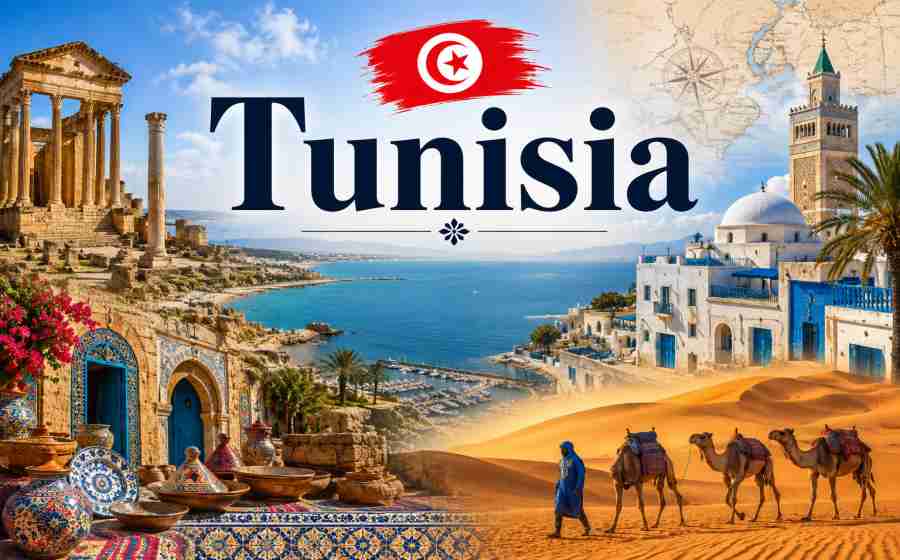
Tunisia is one of North Africa’s most fascinating countries, known for its rich history, Mediterranean coastline, ancient ruins, vibrant culture, and strategic location. Despite being the smallest country in the Maghreb region, Tunisia has played an important role in world history for thousands of years. It has witnessed the rise and fall of powerful civilizations, including the Phoenicians, Romans, Arabs, and Ottomans.
Today, Tunisia is recognized for its cultural heritage, beautiful beaches, archaeological treasures, and growing tourism industry. It is also known as the birthplace of the Arab Spring, a movement that influenced political changes across the Middle East and North Africa.
Table of Contents
Location and Geography
Tunisia is located in North Africa along the Mediterranean Sea. It shares borders with Algeria to the west and Libya to the southeast. The northern region enjoys a Mediterranean climate with fertile land, while the southern part gradually transitions into the vast Sahara Desert.
The country’s diverse landscape includes mountains, coastal plains, deserts, salt lakes, and olive groves. This variety makes Tunisia attractive for agriculture as well as tourism.
Quick Facts
- Capital: Tunis
- Continent: Africa
- Official Language: Arabic
- Widely Spoken Languages: French, English (in tourist areas)
- Currency: Tunisian Dinar (TND)
- Population: Around 12 million
- Government: Presidential Republic
- Time Zone: UTC+1
History of Tunisia
Tunisia has one of the oldest recorded histories in Africa.
Ancient Carthage
Around the 9th century BCE, Phoenician settlers founded the city of Carthage. It quickly became one of the most powerful trading civilizations in the Mediterranean. Carthage built a strong navy and established colonies across North Africa and Europe.
Its greatest military leader, Hannibal Barca, became famous for crossing the Alps with elephants during the Second Punic War against Rome.
Roman Rule
After the Punic Wars, Rome defeated Carthage in 146 BCE. Tunisia became an important province of the Roman Empire and developed into one of Rome’s largest suppliers of wheat and olive oil.
Many impressive Roman monuments still survive today, attracting tourists from around the world.
Arab and Islamic Era
In the 7th century, Arab armies introduced Islam and the Arabic language. Tunisia became a significant center of Islamic learning, architecture, and trade.
Ottoman Period
During the 16th century, Tunisia became part of the Ottoman Empire while maintaining a considerable degree of local autonomy.
French Protectorate
France established control over Tunisia in 1881. French influence shaped the country’s education, administration, and infrastructure.
Independence
Tunisia gained independence on 20 March 1956 under the leadership of Habib Bourguiba, who became the country’s first president. He introduced major reforms in education, healthcare, and women’s rights.
Arab Spring
In 2010–2011, Tunisia became the birthplace of the Arab Spring after nationwide protests demanding political reform and better economic conditions. These events inspired similar movements across several countries.
Culture of Tunisia
Tunisia’s culture reflects influences from Berber, Arab, Roman, Ottoman, French, and Mediterranean civilizations.
Family plays a central role in Tunisian society. Hospitality is deeply valued, and guests are often welcomed with traditional food and tea.
Traditional clothing is still worn during festivals and ceremonies, although modern Western fashion is common in cities.
Music combines Arabic rhythms with African and Mediterranean influences. Folk dances remain an important part of celebrations.
Religion
Islam is the official religion, and the majority of Tunisians are Sunni Muslims. Religious festivals such as Eid al-Fitr and Eid al-Adha are widely celebrated.
Tunisia is also home to small Christian and Jewish communities, reflecting its long multicultural history.
Food of Tunisia
Tunisian cuisine is known for its bold flavors and use of spices.
Popular dishes include:
- Couscous
- Brik (crispy pastry with egg filling)
- Shakshuka
- Lablabi (chickpea soup)
- Grilled seafood
- Harissa (spicy chili paste)
Olive oil is an essential ingredient, and Tunisia ranks among the world’s leading olive oil producers.
Economy
Tunisia has a diversified economy supported by several industries:
- Tourism
- Agriculture
- Manufacturing
- Mining
- Textiles
- Olive oil production
- Information technology
The country exports olive oil, dates, electrical equipment, textiles, and agricultural products.
Although Tunisia has faced economic challenges in recent years, reforms continue to improve investment and employment opportunities.
Sports in Tunisia
Football is the most popular sport in Tunisia. The national football team has participated in multiple FIFA World Cups and has achieved success in African competitions.
Other popular sports include:
- Handball
- Volleyball
- Athletics
- Tennis
- Basketball
- Swimming
Tunisia has produced internationally recognized athletes in tennis and long-distance running.
Education
Education is compulsory for children, and literacy rates have steadily improved over the years.
The country has several universities and research institutions. Higher education attracts students from neighboring African countries due to its quality and affordability.
Tourism
Tourism remains one of Tunisia’s major industries because of its rich history and natural beauty.
Popular attractions include:
- Ancient Roman ruins
- Mediterranean beaches
- Sahara Desert tours
- Historic medinas
- Traditional markets (souks)
- Islamic architecture
- Coastal resorts
Visitors enjoy both cultural experiences and outdoor adventures.
Wildlife and Nature
Tunisia has diverse ecosystems despite its relatively small size.
Wildlife includes:
- Desert foxes
- Gazelles
- Flamingos
- Eagles
- Camels
- Wild boars
Protected national parks help preserve biodiversity and migratory bird habitats.
Interesting Facts About Tunisia
- Tunisia was home to the ancient city of Carthage, one of Rome’s greatest rivals.
- Hannibal is regarded as one of history’s greatest military commanders.
- The Sahara Desert covers much of southern Tunisia.
- Tunisia was the birthplace of the Arab Spring.
- Olive cultivation has existed in Tunisia for over two thousand years.
- The country has hundreds of kilometers of Mediterranean coastline.
- Many famous films have been shot in Tunisia’s desert landscapes.
- Tunisia enjoys more than 300 sunny days each year in many regions.
- Roman archaeological sites are among the best preserved in Africa.
- The country combines African, Arab, and European cultural influences.
Importance of Tunisia
Tunisia serves as a bridge between Africa, Europe, and the Middle East. Its strategic location has made it an important center for trade, diplomacy, and cultural exchange throughout history.
Today, Tunisia continues to strengthen sectors such as tourism, renewable energy, technology, and education while preserving its remarkable historical heritage.
Summary
Tunisia is a country where ancient civilizations meet modern development. From the legendary city of Carthage and magnificent Roman ruins to its Mediterranean beaches and Sahara Desert, Tunisia offers a unique blend of history, culture, and natural beauty. Its resilient people, rich traditions, delicious cuisine, and significant role in regional history make it one of North Africa’s most interesting nations. Whether studied for general knowledge or explored as a travel destination, Tunisia remains a remarkable country with a lasting impact on world civilization.
Also Check: General Knowledge