
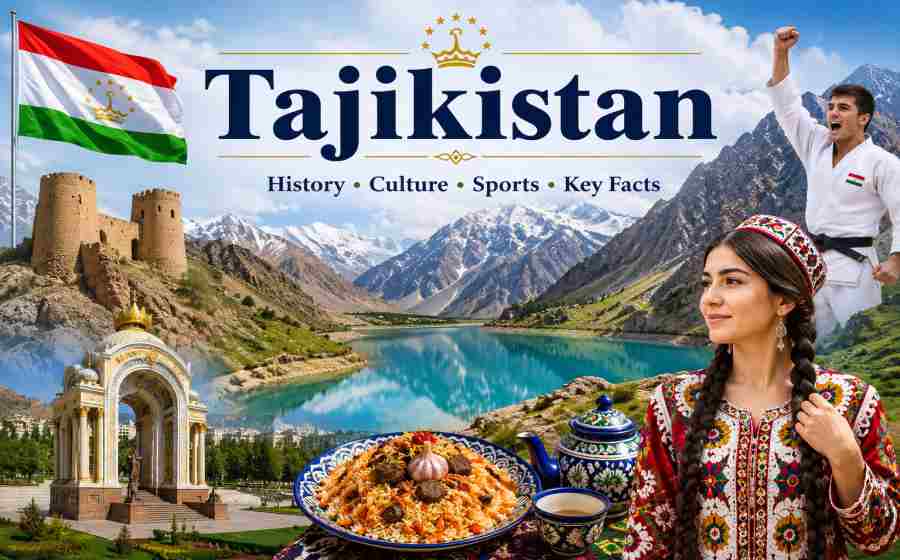
Tajikistan – History, Culture, Sports and Key Facts About this Asian Nation
Discover Tajikistan through its rich history, vibrant culture, popular sports, stunning landscapes, important landmarks, economy and fascinating key facts.
Tajikistan
Tajikistan is a beautiful mountainous country located in Central Asia. Known for its breathtaking landscapes, ancient Silk Road heritage, and rich Persian cultural roots, Tajikistan offers a unique blend of history, traditions, and natural beauty. Although it is one of the smallest countries in Central Asia by population, it is famous for its towering mountains, hospitable people, and centuries-old customs.
The country shares borders with Afghanistan, China, Kyrgyzstan, and Uzbekistan. More than 90% of the country is covered by mountains, making it one of the most mountainous nations in the world. Its scenic valleys, crystal-clear lakes, and high-altitude peaks attract trekkers and adventure lovers from across the globe.
Table of Contents
Location and Geography
This country is situated in the heart of Central Asia. It covers an area of approximately 143,100 square kilometers. The country is dominated by the Pamir Mountains, often called the “Roof of the World.”
The climate varies according to altitude. Lowland regions experience hot summers and cold winters, while mountainous areas remain cool throughout the year and receive heavy snowfall during winter.
Some major rivers, including the Amu Darya and Vakhsh River, originate or flow through Tajikistan, making water resources one of the country’s greatest natural assets.
Capital and Major Cities
The capital city of Tajikistan is Dushanbe, which is also the country’s largest city and economic center.
Other important cities include:
- Khujand
- Bokhtar
- Kulob
- Istaravshan
These cities are known for their historical importance, agriculture, trade, and educational institutions.
History of Tajikistan
The history of the country stretches back thousands of years. Ancient civilizations settled in the region due to its fertile valleys and strategic location on the Silk Road.
During ancient times, the region became part of several great empires, including the Achaemenid Persian Empire, the empire of Alexander the Great, and later the Kushan Empire.
In the 7th and 8th centuries, Islam spread throughout the region after Arab conquests. Persian language and culture continued to flourish, especially under the Samanid Empire during the 9th and 10th centuries. This period is often considered the golden age of Tajik culture and literature.
In later centuries, the territory came under the control of various Turkic and Mongol rulers. During the 19th century, the Russian Empire gradually expanded into Central Asia. After the Russian Revolution, Tajikistan became part of the Soviet Union. It officially became the Tajik Soviet Socialist Republic in 1929.
Tajikistan declared independence on 9 September 1991 following the collapse of the Soviet Union. Soon after independence, the country experienced a civil war from 1992 to 1997, which caused significant damage. Peace agreements eventually restored stability, allowing the country to rebuild and develop.
Government and Economy
Tajikistan is a presidential republic.
The economy mainly depends on:
- Agriculture
- Hydropower
- Mining
- Aluminum production
- Cotton cultivation
- Remittances from citizens working abroad
Hydroelectric power is one of Tajikistan’s strongest economic sectors because of its abundant rivers and mountainous terrain. The country has enormous potential for renewable energy development.
People and Language
The majority of the population belongs to the Tajik ethnic group. The official language is Tajik, which is closely related to Persian (Farsi). Russian is also widely used in government, education, and business.
Most people follow Islam, primarily Sunni Islam, while smaller communities practice other religions. Family values, hospitality, and respect for elders are deeply rooted in Tajik society.
Culture and Traditions
Tajikistan has preserved many traditions that reflect its Persian heritage and Central Asian influences. Traditional music uses instruments like the dutar, rubab, and doira. Folk dances are performed during festivals, weddings, and celebrations.
Traditional clothing remains popular during cultural events. Women often wear colorful embroidered dresses, while men wear long coats and embroidered caps.
Hospitality is considered a sacred value. Guests are warmly welcomed with tea, bread, fruits, and traditional meals. The country celebrates both national and religious festivals with great enthusiasm.
Traditional Food
Tajik cuisine is flavorful and heavily influenced by Central Asian and Persian cooking traditions.
Popular dishes include:
- Plov (rice cooked with meat and vegetables)
- Qurutob
- Shashlik
- Laghman noodles
- Sambusa
- Fresh bread (Non)
Tea is the most common beverage and plays an important role in daily life and social gatherings.
Education
Education has remained an important priority since the Soviet era. Primary and secondary education are widely available, and literacy rates are relatively high. Universities in Dushanbe offer higher education in science, engineering, medicine, and humanities. The government continues to improve educational infrastructure and digital learning opportunities.
Sports in Tajikistan
Football is the most popular sport in Tajikistan.
The national football team participates in regional and international competitions, while domestic clubs compete in the Tajikistan Higher League.
Other popular sports include:
- Wrestling
- Boxing
- Judo
- Athletics
- Basketball
- Volleyball
- Mountaineering
Traditional wrestling remains an important part of local festivals and cultural celebrations.
Due to its mountainous landscape, trekking, climbing, skiing, and adventure tourism are becoming increasingly popular.
Tourism and Wildlife
Although tourism is still developing, Tajikistan offers spectacular natural attractions.
Popular destinations include:
- Pamir Mountains
- Iskanderkul Lake
- Fann Mountains
- Wakhan Valley
- Seven Lakes
- Dushanbe city
Adventure travelers visit the country for hiking, cycling, mountain climbing, and exploring remote valleys.
Nature lovers appreciate the country’s glaciers, alpine lakes, and diverse wildlife.
Wildlife
Tajikistan’s mountains provide habitats for several rare species.
Some notable animals include:
- Snow leopard
- Marco Polo sheep
- Brown bear
- Ibex
- Wolf
- Golden eagle
Protected national parks and conservation areas help preserve biodiversity.
National Symbols
- Capital: Dushanbe
- Official Language: Tajik
- Currency: Tajikistani Somoni (TJS)
- Independence Day: 9 September
- National Animal: Snow Leopard (commonly associated)
- National Flower: Tulip (widely recognized)
- Time Zone: UTC +5
Interesting Facts About Tajikistan
- Over 90% of Tajikistan is mountainous.
- The Pamir Highway is one of the world’s highest international roads.
- Tajik is one of the few Persian-based languages spoken in Central Asia.
- The country possesses enormous hydropower potential.
- It is home to some of Asia’s highest mountain peaks.
- Tajikistan lies along the historic Silk Road.
- Hospitality is one of the country’s most respected cultural traditions.
- The nation has numerous glaciers that provide water to much of Central Asia.
- Traditional crafts such as embroidery and carpet weaving remain popular.
- Adventure tourism is growing rapidly because of its untouched natural landscapes.
Summary
Tajikistan is a fascinating Central Asian nation where ancient history, Persian culture, majestic mountains, and warm hospitality come together. From the legendary Silk Road and the towering Pamir Mountains to colorful traditions and delicious cuisine, the country offers a unique identity shaped by centuries of cultural exchange. Although it continues to develop economically, Tajikistan remains rich in natural beauty, cultural heritage, and renewable energy potential. Learning about Tajikistan provides valuable insight into one of Central Asia’s most distinctive and historically significant countries.
Also Check: General Knowledge