
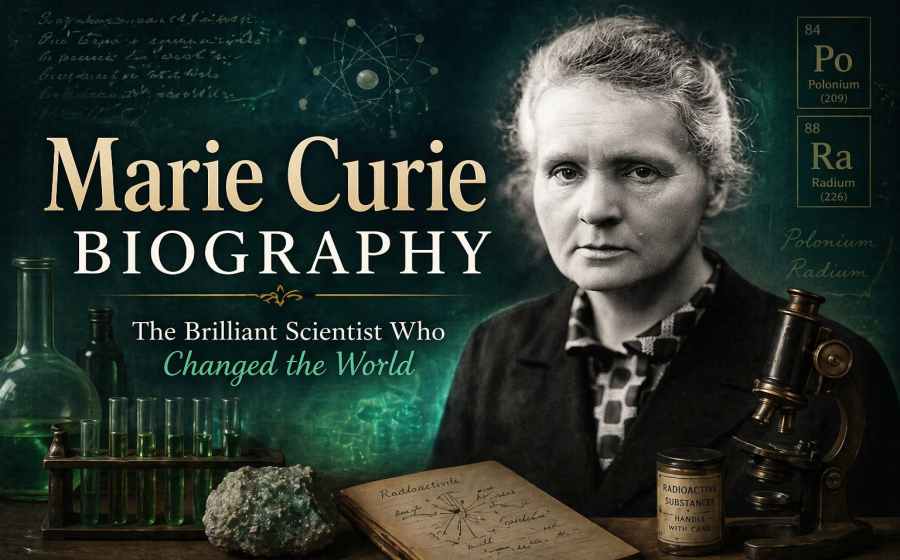
Marie Curie Biography – The Fearless Pioneer Who Changed Science Forever
Discover the inspiring life of Marie Curie Biography, the first woman Nobel laureate who revolutionized science with her groundbreaking work on radioactivity.
Marie Curie Biography
Marie Curie stands as one of the most remarkable figures in the history of science. Known for her groundbreaking research in radioactivity, she not only transformed the scientific world but also broke barriers for women in education and research. Her life story is a powerful blend of determination, sacrifice, and intellectual brilliance.
Table of Contents
Early Life and Education
Marie Curie was born on November 7, 1867, in Warsaw, Poland, which was then part of the Russian Empire. Her birth name was Maria Skłodowska. From a young age, she displayed exceptional intelligence and a deep passion for learning. However, opportunities for women in education were extremely limited in Poland at the time.
Determined to pursue higher education, she moved to Paris in 1891 and enrolled at the University of Paris (Sorbonne). Despite facing financial struggles and harsh living conditions, she excelled in her studies, earning degrees in physics and mathematics.
Marriage and Scientific Partnership
In Paris, she met Pierre Curie, a brilliant physicist who shared her passion for research. The two married in 1895 and formed one of the most famous scientific partnerships in history. Together, they began studying mysterious rays emitted by certain elements, a phenomenon later known as radioactivity.
Marie Curie coined the term “radioactivity” and conducted extensive research on radioactive substances. Their work led to the discovery of two new elements: Polonium, named after her homeland Poland, and Radium.
Groundbreaking Achievements
Marie Curie’s contributions to science were revolutionary. In 1903, she, along with Pierre Curie and Henri Becquerel, was awarded the Nobel Prize in Physics for their work on radiation. This made her the first woman to receive a Nobel Prize.
After Pierre’s tragic death in 1906, Marie continued her research with unwavering dedication. In 1911, she won her second Nobel Prize, this time in chemistry, for discovering radium and polonium. She became the first person ever to win two Nobel Prizes in different scientific fields.
Challenges and Struggles
Despite her achievements, Marie Curie faced numerous challenges. As a woman in a male-dominated field, she often encountered discrimination and skepticism. Additionally, her work with radioactive materials exposed her to harmful radiation, the dangers of which were not fully understood at the time.
She also endured personal hardships, including the loss of her husband and public criticism during certain periods of her life. Yet, she remained committed to her scientific pursuits and never allowed obstacles to deter her.
Contributions During War
During World War I, Marie Curie played a crucial role by developing mobile X-ray units to help treat wounded soldiers. These units, often called “Little Curies,” were used on the battlefield to diagnose injuries quickly and save lives. Her efforts demonstrated her dedication not only to science but also to humanity.
5 Inspirational Lessons from Marie Curie
- Pursue Knowledge Relentlessly
Marie Curie’s thirst for learning drove her to overcome financial and social barriers. Never stop seeking knowledge. - Break Barriers with Courage
She challenged gender norms and proved that women can excel in science and leadership roles. - Stay Dedicated Despite Hardships
Even after personal and professional struggles, she continued her research with determination. - Work for the Greater Good
Her contributions during World War I show the importance of using knowledge to help humanity. - Leave a Lasting Impact
Focus on meaningful work that benefits future generations, just as Marie Curie did.
Legacy and Impact
Marie Curie’s legacy extends far beyond her discoveries. She paved the way for future generations of scientists, especially women, to pursue careers in science. Her research laid the foundation for advancements in medical treatments, including cancer therapy using radiation.
Institutions, scholarships, and research centers around the world continue to honor her contributions. Her life remains a symbol of perseverance, curiosity, and courage.
Marie Curie passed away on July 4, 1934, due to aplastic anemia, a condition linked to prolonged exposure to radiation. Though her life was cut short, her influence continues to shape modern science.
Also Check: Biography