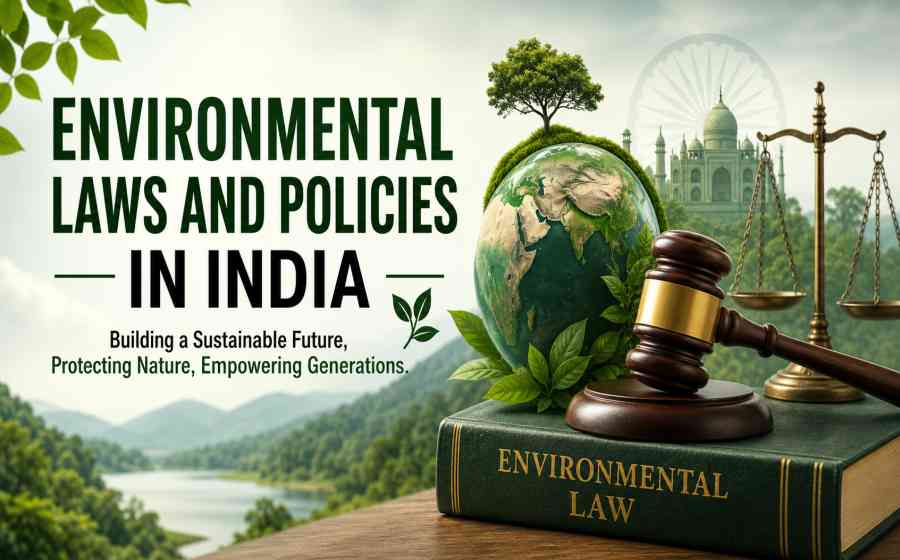
Environmental Laws and Policies in India – Key acts and Their Role in Protecting Nature
Learn about Environmental Laws and Policies in India, key acts, policies and their role in protecting nature and promoting sustainable development.
Environmental Laws and Policies in India
India, with its vast population and diverse ecosystems, faces significant environmental challenges ranging from air and water pollution to deforestation and climate change. To address these concerns, the country has developed a comprehensive framework of environmental laws and policies aimed at protecting natural resources and ensuring sustainable development. Over the years, India has strengthened its legal structure to balance economic growth with environmental conservation.
Table of Contents
Evolution of Environmental Laws in India
The roots of environmental protection in India can be traced back to ancient traditions that emphasized harmony with nature. However, modern environmental legislation began taking shape after global awareness increased, especially following the Stockholm Conference 1972. This event encouraged countries, including India, to adopt environmental safeguards.
The Indian Constitution also plays a crucial role. Article 48A directs the state to protect and improve the environment, while Article 51A(g) makes it a fundamental duty of citizens to safeguard natural resources.
Key Environmental Laws in India
India has enacted several important laws to regulate environmental protection. Some of the most significant ones include:
1. Environment (Protection) Act, 1986
The Environment Protection Act 1986 is one of the most comprehensive environmental laws in the country. It was enacted in response to the Bhopal Gas Tragedy. This act empowers the central government to take all necessary measures to protect and improve environmental quality, regulate industrial emissions, and manage hazardous substances.
2. Water (Prevention and Control of Pollution) Act, 1974
The Water Prevention and Control of Pollution Act 1974 aims to prevent and control water pollution and maintain or restore the wholesomeness of water bodies. It led to the establishment of Pollution Control Boards at both central and state levels.
3. Air (Prevention and Control of Pollution) Act, 1981
The Air Prevention and Control of Pollution Act 1981 focuses on controlling air pollution by regulating emissions from industries and vehicles. It provides the framework for monitoring air quality across the country.
4. Forest (Conservation) Act, 1980
The Forest Conservation Act 1980 restricts the use of forest land for non-forest purposes without prior approval from the central government. It plays a vital role in reducing deforestation and preserving biodiversity.
5. Wildlife Protection Act, 1972
The Wildlife Protection Act 1972 provides protection to wild animals, birds, and plants. It has helped in conserving endangered species and establishing protected areas such as national parks and wildlife sanctuaries.
Important Environmental Policies
In addition to laws, India has adopted various policies to guide environmental governance:
National Environment Policy, 2006
The National Environment Policy 2006 aims to promote sustainable development by integrating environmental concerns into economic planning. It emphasizes conservation, efficient resource use, and equitable access.
National Action Plan on Climate Change (NAPCC)
The National Action Plan on Climate Change outlines India’s strategy to combat climate change. It includes missions on solar energy, energy efficiency, sustainable agriculture, and water conservation.
National Forest Policy, 1988
The National Forest Policy 1988 focuses on maintaining ecological balance and increasing forest cover through community participation and conservation efforts.
Role of Institutions
Several institutions are responsible for implementing environmental laws in India. The most important among them is the Ministry of Environment Forest and Climate Change, which formulates policies and oversees environmental protection programs.
Additionally, the Central Pollution Control Board (CPCB) and State Pollution Control Boards monitor pollution levels and enforce environmental standards. The judiciary, especially the National Green Tribunal, plays a key role in resolving environmental disputes and ensuring accountability.
Challenges in Implementation
Despite having strong laws, India faces several challenges in effective implementation:
- Lack of Awareness: Many citizens and industries are unaware of environmental regulations.
- Weak Enforcement: Limited resources and corruption can hinder strict enforcement.
- Industrial Pressure: Economic growth often takes precedence over environmental protection.
- Urbanization: Rapid urban expansion increases pollution and strains natural resources.
These challenges highlight the need for stronger governance, public participation, and technological solutions.
Recent Developments and Reforms
India is continuously updating its environmental framework to meet modern challenges. Initiatives such as stricter emission norms (BS-VI), promotion of renewable energy, and plastic waste management rules show the government’s commitment to sustainability.
The country is also actively participating in global agreements like the Paris Agreement, aiming to reduce carbon emissions and transition toward clean energy.
Importance of Environmental Laws
Environmental laws are essential for:
- Protecting biodiversity and ecosystems
- Ensuring public health and safety
- Promoting sustainable economic growth
- Preventing resource depletion
- Combating climate change
Without these laws, unchecked industrialization and urbanization could lead to severe environmental degradation.
Summary
Environmental laws and policies in India form a robust framework designed to protect nature while supporting development. Although challenges remain, continuous reforms, technological advancements, and public awareness can significantly improve their effectiveness. The responsibility does not lie solely with the government, citizens, industries, and communities must also play an active role in preserving the environment for future generations.
A sustainable future depends on how well these laws are implemented and respected. Strengthening environmental governance today will ensure a healthier and more balanced ecosystem tomorrow.
Also Check: Environment