
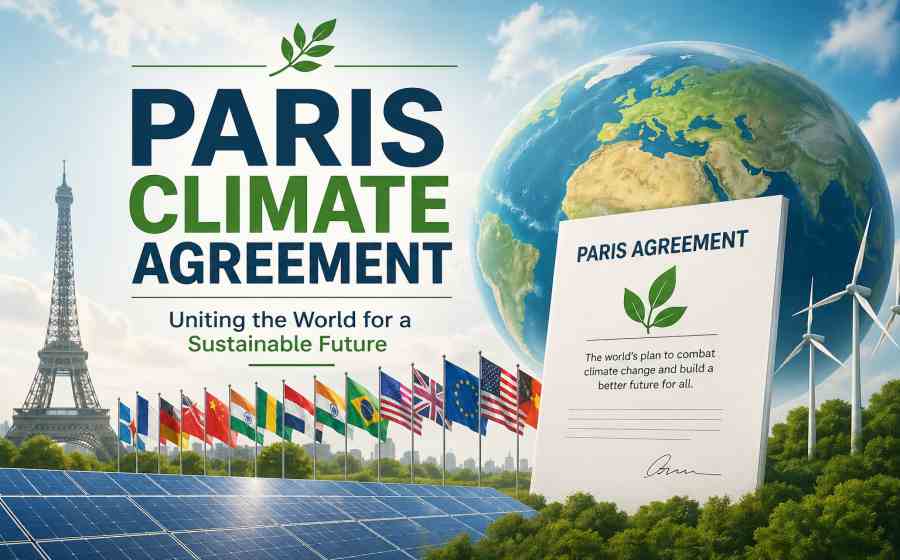
Paris Climate Agreement – Goals, Key Features and Global Impact
Learn how the Paris Climate Agreement works, its goals, key features and why it matters for fighting climate change worldwide.
Paris Climate Agreement
The Paris Climate Agreement is one of the most important global efforts to combat climate change. Adopted in 2015 during the COP21 conference in Paris, this landmark deal brought nearly every nation together to address the growing threat of global warming. Formally established under the United Nations Framework Convention on Climate Change, the agreement represents a unified commitment to reduce greenhouse gas emissions and limit the rise in global temperatures.
Unlike previous climate treaties, the Paris Agreement is flexible, inclusive, and forward-looking. It recognizes that climate change is a global issue requiring cooperation from both developed and developing nations, while also allowing countries to set their own realistic targets.
Table of Contents
Background and Formation
Before the Paris Agreement, the world relied on the Kyoto Protocol, which imposed binding emission reduction targets mainly on developed countries. However, it lacked participation from many major emitters and had limited success.
To create a more effective framework, global leaders gathered in Paris in December 2015. The result was the Paris Agreement, adopted by 196 parties and entering into force in November 2016. It marked a turning point in international climate policy by encouraging universal participation and long-term commitment.
Main Goals of the Paris Agreement
The agreement focuses on three primary objectives:
1. Limiting Global Temperature Rise
The central goal is to keep the increase in global average temperature well below 2°C above pre-industrial levels, while aiming to limit it to 1.5°C. This threshold is considered critical to avoid the most severe impacts of climate change, such as extreme weather events, sea-level rise, and biodiversity loss.
2. Reducing Greenhouse Gas Emissions
Countries are required to take steps to reduce emissions through nationally determined contributions (NDCs). These plans outline each country’s targets and strategies for lowering emissions over time.
3. Strengthening Climate Resilience
The agreement also emphasizes adaptation, helping countries cope with the effects of climate change. This includes building resilient infrastructure, protecting ecosystems, and supporting vulnerable communities.
Key Features of the Paris Agreement
Nationally Determined Contributions (NDCs)
Each country sets its own climate targets based on its capabilities and circumstances. These targets must be updated every five years, with increasing ambition over time.
Transparency and Accountability
The agreement includes a system for monitoring, reporting, and verifying progress. Countries must regularly report their emissions and efforts, ensuring transparency and global trust.
Global Stocktake
Every five years, a global assessment evaluates collective progress toward achieving the agreement’s goals. This helps identify gaps and encourages stronger action.
Climate Finance
Developed countries are expected to provide financial support to developing nations. This funding helps poorer countries transition to clean energy and adapt to climate impacts.
Why the Paris Agreement Matters
The Paris Agreement is significant for several reasons:
- Global Cooperation: It unites nearly all countries in a shared mission to fight climate change.
- Flexibility: Nations can set realistic goals based on their economic and technological capacity.
- Long-Term Vision: It provides a roadmap for sustainable development and a low-carbon future.
- Focus on Equity: It acknowledges that developing countries need support and fairness in climate action.
Without such a coordinated effort, individual actions by countries would not be enough to address a problem as vast and interconnected as climate change.
Challenges and Criticism
Despite its importance, the Paris Agreement faces several challenges:
Lack of Binding Enforcement
While countries are required to submit and update their NDCs, there are no strict penalties for failing to meet targets. This reliance on voluntary compliance can weaken effectiveness.
Insufficient Commitments
Current national pledges are not enough to limit warming to 1.5°C. Many experts argue that stronger and more immediate action is needed.
Financial Gaps
Developing countries often struggle to access sufficient climate finance, slowing down their transition to greener technologies.
Progress So Far
Since its adoption, many countries have taken steps toward cleaner energy, increased use of renewables, and improved energy efficiency. However, global emissions have not decreased at the pace required to meet the agreement’s targets.
Recent climate conferences continue to push for stronger commitments, greater funding, and faster implementation of climate policies.
The Future of the Paris Agreement
The success of the Paris Agreement depends on continuous global cooperation and increasing ambition. Governments, businesses, and individuals all play a role in reducing emissions and promoting sustainability.
Technological innovation, policy reforms, and public awareness are key drivers that can accelerate progress. As climate impacts become more visible, the urgency to act is stronger than ever.
Summary
The Paris Climate Agreement is a historic and essential step in the global fight against climate change. While it is not perfect, it provides a powerful framework for collective action and long-term sustainability. Its success ultimately depends on how seriously nations commit to their promises and how quickly they act.
By working together under this agreement, the world has a real chance to protect the planet for future generations.
Also Check: Environment