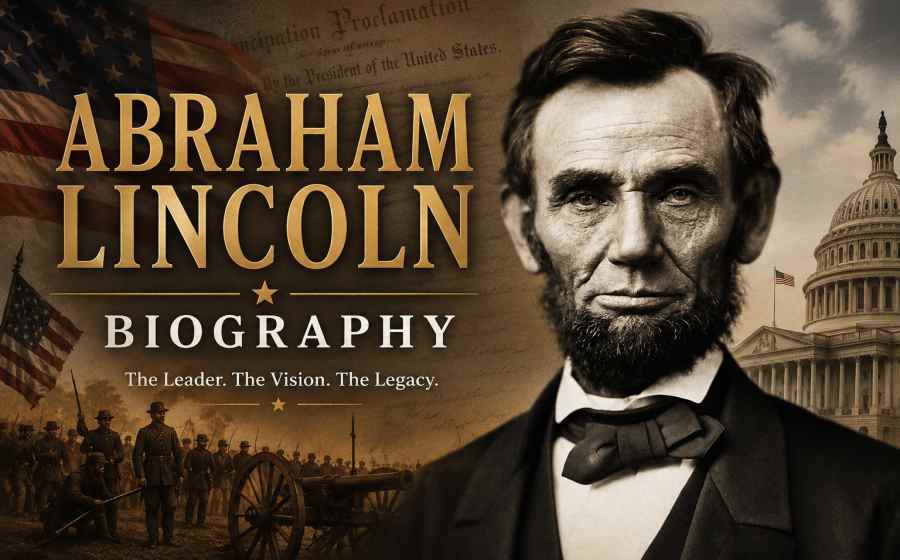
Abraham Lincoln Biography – The Visionary Leader Who Preserved the United States
Discover the inspiring Abraham Lincoln Biography, the 16th President of the United States, who ended slavery and led America through its greatest crisis.
Abraham Lincoln Biography
Abraham Lincoln is remembered as one of the greatest leaders in world history. He served as the 16th President of the United States and played a crucial role in preserving the nation during the Civil War. Lincoln is especially admired for abolishing slavery and promoting equality, freedom, and democracy. His journey from a poor log cabin to the highest office in America continues to inspire millions around the world.
Table of Contents
Early Life and Childhood
Abraham Lincoln was born on February 12, 1809, in a small log cabin in Hardin County, Kentucky, which is now part of Kentucky. His parents, Thomas Lincoln and Nancy Hanks Lincoln, belonged to a humble farming family. Lincoln grew up in poverty and had very limited access to formal education. Despite these difficulties, he developed a deep love for reading and learning.
As a child, Lincoln worked on farms and performed hard physical labor to support his family. He borrowed books from neighbors and spent hours reading by candlelight. His dedication to self-education helped him gain knowledge in history, law, and politics.
After the death of his mother in 1818, Lincoln faced emotional hardship, but he continued to work hard and build his character through discipline and determination.
Education and Career Growth
Although Abraham Lincoln attended school for less than a year in total, he educated himself through books and practical experience. He worked in various jobs, including storekeeper, postmaster, surveyor, and rail splitter. These experiences helped him understand the struggles of ordinary people.
Lincoln later became interested in law and politics. By studying legal books independently, he qualified as a lawyer and started practicing law in Illinois. He quickly became known for his honesty, intelligence, and powerful speaking skills. People often called him “Honest Abe” because of his integrity and fairness.
Entry into Politics
Abraham Lincoln entered politics in the 1830s and served in the Illinois State Legislature. His political ideas focused on economic development, equal opportunities, and national unity. He later joined the newly formed Republican Party, which strongly opposed the expansion of slavery.
Lincoln gained national recognition during his debates with Stephen Douglas in 1858. His speeches against slavery impressed many Americans. Although he lost the Senate election, his popularity continued to grow across the country.
In 1860, Abraham Lincoln was elected President of the United States. His election caused major tensions between northern and southern states because several southern states supported slavery.
The American Civil War
Soon after Lincoln became president, the American Civil War began in 1861. Southern states separated from the Union and formed the Confederate States of America. Lincoln believed that preserving the unity of the nation was extremely important.
The Civil War became one of the deadliest conflicts in American history. Despite criticism and political pressure, Lincoln remained calm and determined. He inspired soldiers and citizens with his leadership and speeches.
One of his most famous speeches was the Gettysburg Address, delivered in 1863. In just a few words, Lincoln emphasized democracy, equality, and national unity. The speech remains one of the greatest speeches in history.
Ending Slavery
Abraham Lincoln’s greatest achievement was ending slavery in the United States. In 1863, he issued the Emancipation Proclamation, which declared freedom for enslaved people in Confederate states. This historic step changed the purpose of the Civil War and gave hope to millions.
Lincoln strongly believed that slavery was morally wrong. His leadership eventually led to the passing of the 13th Amendment, which permanently abolished slavery throughout the United States.
His efforts transformed American society and made him a global symbol of freedom and human rights.
Personal Life
Abraham Lincoln married Mary Todd in 1842, and the couple had four sons. Despite his success, Lincoln faced many personal tragedies, including the deaths of his children. These painful experiences deeply affected him emotionally.
Lincoln was known for his simple lifestyle, kindness, and sense of humor. He treated people with respect regardless of their social status. His compassion and humility made him highly respected by ordinary citizens.
Assassination and Death
On April 15, 1865, just days after the Civil War ended, Abraham Lincoln was shot by John Wilkes Booth at Ford’s Theatre in Washington, D.C.. He died the next day, becoming the first American president to be assassinated.
The nation mourned deeply after his death. Millions of people paid tribute to the leader who had saved the Union and fought for human equality.
Legacy of Abraham Lincoln
Abraham Lincoln’s influence continues to shape modern democracy and civil rights movements. His leadership during one of America’s darkest periods demonstrated courage, wisdom, and moral strength.
Today, Lincoln is honored through monuments, books, films, and memorials across the United States. The famous Lincoln Memorial stands as a symbol of freedom and justice.
Historians widely consider him one of the greatest presidents in American history because of his commitment to democracy, equality, and national unity.
5 Inspirational Lessons from Abraham Lincoln
- Never Stop Learning
Lincoln proved that self-education and curiosity can lead to greatness, even without formal schooling. - Stay Honest and Humble
His honesty earned him the trust and respect of people across the nation. - Face Challenges with Courage
During the Civil War, Lincoln showed remarkable strength and determination under pressure. - Stand for Equality
He fought against slavery and defended human rights despite strong opposition. - Failure Is Not the End
Lincoln lost several elections before becoming president, teaching us the importance of persistence and resilience.
Summary
Abraham Lincoln remains a timeless symbol of leadership, freedom and perseverance. His journey from poverty to the presidency proves that determination and honesty can overcome even the greatest obstacles. Through his actions, Lincoln changed the course of history and inspired generations to fight for justice and equality.
Also Check: Biography