Stephen Hawking Biography – Inspiring Story of the Genius Physicist
Discover the inspiring Stephen Hawking Biography, the legendary physicist who transformed modern science despite physical challenges and became a global icon.
Stephen Hawking Biography
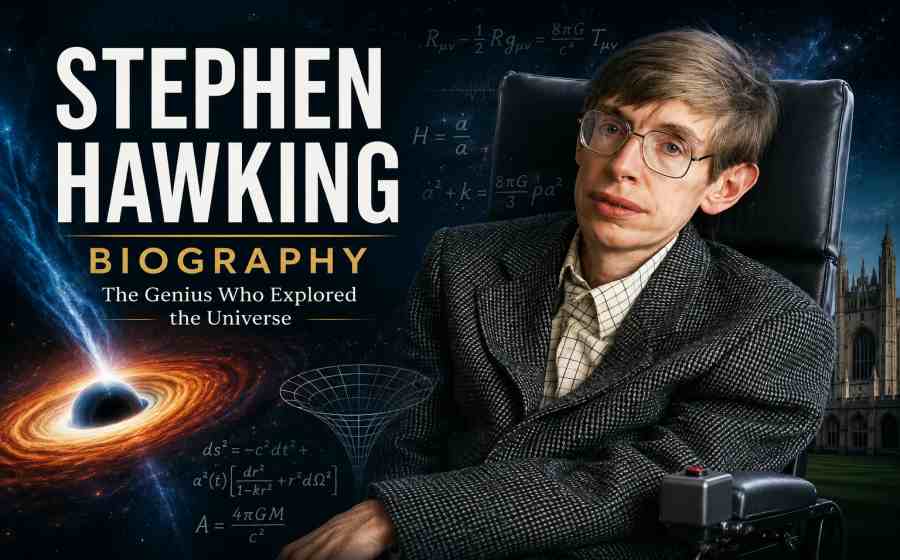
Stephen Hawking was born on January 8, 1942, in Oxford, England. He grew up in a family that valued education and knowledge. His parents, Frank and Isobel Hawking, encouraged him to study and explore science from a young age. During his childhood, Stephen showed a strong interest in mathematics and scientific experiments. Although he was not always the highest-scoring student in school, his intelligence and curiosity impressed both teachers and classmates.
Table of Contents
Education and Academic Journey
Stephen Hawking attended University College, Oxford, where he studied physics. He completed his graduation with excellent results and later joined the University of Cambridge to study cosmology. At Cambridge, he focused on understanding the origin of the universe, black holes, and space-time theories. His academic talent quickly made him one of the brightest young scientists of his generation.
Diagnosis of ALS Disease
At the age of 21, Hawking was diagnosed with Amyotrophic Lateral Sclerosis (ALS), a serious motor neuron disease. Doctors believed that he might survive only for a few years because the disease gradually weakened his muscles and affected body movement. Despite this difficult situation, Hawking remained determined and continued his scientific studies. Over time, he lost the ability to walk and eventually started using a wheelchair permanently.
Scientific Discoveries and Research
Stephen Hawking became famous for his groundbreaking research in theoretical physics and cosmology. One of his most important discoveries explained that black holes could release energy, which later became known as “Hawking Radiation.” This theory changed scientists’ understanding of black holes and the universe.
Hawking also worked on theories related to the Big Bang and the beginning of time. Along with Roger Penrose, he developed mathematical theories about gravitational singularities. His work connected quantum mechanics with Einstein’s theory of relativity and became highly influential in modern science.
Life with Physical Disability
As Hawking’s illness progressed, he gradually lost the ability to speak naturally. In 1985, he underwent surgery that permanently affected his voice. Later, he used a computerized speech-generating device to communicate. Although he faced severe physical limitations, he continued giving lectures, writing books, and participating in scientific discussions. His determination inspired millions of people around the world.
Famous Books and Publications
Stephen Hawking became popular among common readers after publishing A Brief History of Time in 1988. The book explained complex scientific ideas in simple language and became an international bestseller. He later wrote several other famous books, including The Universe in a Nutshell and Brief Answers to the Big Questions. These books increased public interest in cosmology and space science.
Awards and Achievements
Stephen Hawking received numerous awards and honors for his contributions to science. He served as the Lucasian Professor of Mathematics at Cambridge University, a position once held by Isaac Newton. Hawking was widely respected as one of the most brilliant physicists after Albert Einstein. His work continued to influence scientific research across the world.
Popularity in Media and Culture
Stephen Hawking became a global icon beyond the scientific community. He appeared in famous television shows such as The Simpsons and The Big Bang Theory. His inspiring life story was also portrayed in the movie The Theory of Everything, which received worldwide appreciation.
Death and Legacy
Stephen Hawking passed away on March 14, 2018, at the age of 76. His death marked the end of an extraordinary scientific journey. However, his discoveries, books, and inspirational life continue to motivate scientists, students, and readers worldwide. He remains remembered as one of the greatest scientific minds in history.
5 Inspirational Lessons from Stephen Hawking
- Never Lose Hope
Hawking continued achieving success despite serious physical challenges. - Knowledge Creates Power
His passion for science helped him make revolutionary discoveries. - Challenges Can Be Overcome
He proved that determination is stronger than difficulties. - Curiosity Leads to Discovery
Hawking always encouraged people to ask questions about the universe. - Hard Work Brings Greatness
His dedication and persistence made him one of the world’s greatest scientists.
Summary
Stephen Hawking was one of the most influential scientists in modern history. Despite suffering from ALS disease, he made revolutionary discoveries about black holes, cosmology, and the universe. His theories, books, and scientific research inspired millions of people across the world. Hawking’s life proved that determination, intelligence, and courage could overcome even the greatest challenges. He remains a symbol of knowledge, perseverance, and scientific excellence.
Also Check: Biography