
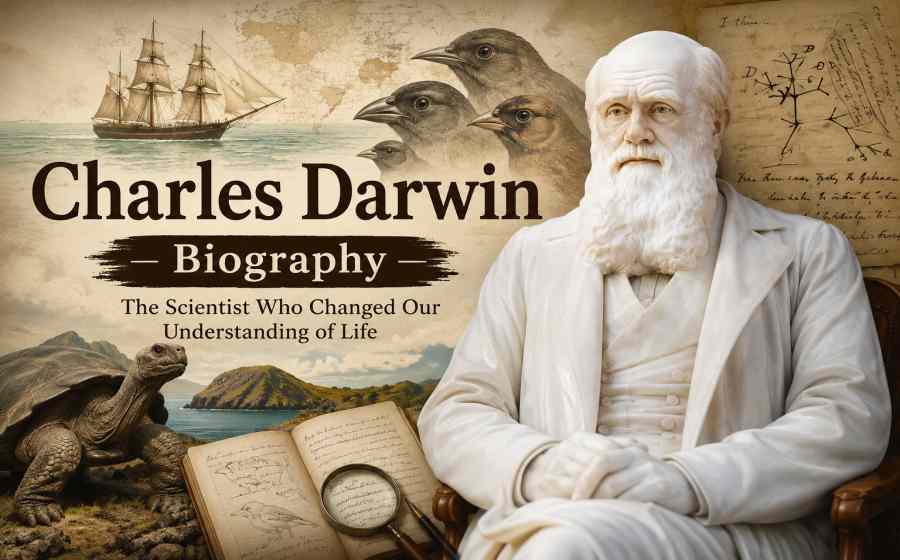
Charles Darwin Biography – The Scientist Who Changed Human Understanding
Charles Darwin Biography: Discover the life, discoveries and evolution theory of Charles Darwin, the scientist who transformed modern biology forever.
Charles Darwin Biography
Charles Darwin was one of the greatest scientists in history. He is best known for developing the theory of evolution through natural selection, which changed the way people understood life on Earth. His observations during his famous voyage on the HMS Beagle helped him study plants, animals, and fossils from different parts of the world. Darwin’s ideas influenced biology, genetics, and modern science forever. Despite criticism during his time, his work later became one of the foundations of modern scientific understanding.
Table of Contents
Early Life and Education
Charles Darwin was born on February 12, 1809, in Shrewsbury, England. He came from a wealthy and educated family. His father, Robert Darwin, was a successful doctor, while his grandfather, Erasmus Darwin, was also a respected thinker and scientist.
From childhood, Charles showed a strong interest in nature, insects, plants, and collecting different objects. However, he was not very interested in traditional school subjects. His father wanted him to become a doctor, so Darwin joined the University of Edinburgh. But he disliked medical studies and could not continue.
Later, he attended Christ’s College at Cambridge University with the aim of becoming a clergyman. During this period, he developed a deep interest in natural science and met professors who encouraged his curiosity about the natural world.
Voyage on the HMS Beagle
One of the most important events in Darwin’s life was his journey on the HMS Beagle. In 1831, at the age of 22, he joined the ship as a naturalist for a five-year scientific expedition around the world.
During the journey, Darwin visited South America, the Galápagos Islands, Australia, Africa, and many other regions. He carefully observed animals, birds, fossils, rocks, and plants. His experiences on the Galápagos Islands became especially important.
Darwin noticed that finches on different islands had different types of beaks depending on their food habits. He realized that living organisms slowly changed over time to survive in their environment. These observations later became the basis of his theory of evolution.
Theory of Evolution
After returning to England, Darwin spent many years studying and organizing his observations. He read scientific books, conducted experiments, and discussed ideas with other scientists.
In 1859, he published his famous book, On the Origin of Species. In this book, Darwin explained the theory of evolution by natural selection.
According to Darwin:
- Organisms produce more offspring than can survive.
- There is competition for food and survival.
- Individuals with useful traits survive better.
- These traits are passed to future generations.
- Over time, species gradually change and evolve.
His theory challenged traditional beliefs about the origin of life. Many people criticized him at first, but scientists later found strong evidence supporting his ideas.
Today, evolution is considered one of the most important concepts in biology.
Scientific Contributions
Charles Darwin made several major contributions to science:
- Developed the theory of natural selection.
- Changed the understanding of human origins.
- Improved the study of biology and genetics.
- Inspired future scientific research on evolution.
- Encouraged observation and evidence-based science.
His ideas influenced many fields, including medicine, anthropology, environmental science, and genetics.
Personal Life
Charles Darwin married Emma Wedgwood in 1839. The couple had ten children and lived a peaceful family life. Darwin spent much of his later years at Down House in Kent, England.
Although he suffered from health problems for many years, he continued writing and researching. He remained dedicated to science throughout his life.
Darwin was known as a humble and thoughtful person. He preferred quiet study rather than public attention.
Challenges and Criticism
Darwin’s theory created major controversy during the 19th century. Some religious groups strongly opposed his ideas because they believed evolution conflicted with traditional beliefs.
Darwin himself was careful and patient while presenting his work. He avoided unnecessary arguments and focused on scientific evidence. Over time, more discoveries in fossils, genetics, and biology supported his theory.
Despite criticism, Darwin never stopped believing in scientific research and observation.
Death and Legacy
Charles Darwin died on April 19, 1882, at the age of 73. Due to his extraordinary contributions to science, he was buried in Westminster Abbey in London, near famous scientists like Isaac Newton.
Today, Darwin is remembered as one of the most influential scientists in human history. His theory of evolution transformed scientific thinking and continues to guide modern biology.
Schools, universities, museums, and scientific organizations around the world honor his work and discoveries.
5 Inspirational Lessons from Charles Darwin
1. Curiosity Leads to Discovery
Darwin’s curiosity about nature helped him make one of the greatest scientific discoveries ever.
2. Patience Brings Success
He spent many years researching before publishing his theory, showing the importance of patience and careful study.
3. Never Stop Learning
Darwin constantly observed, read, and experimented throughout his life.
4. Face Criticism with Confidence
Even when many people criticized him, he trusted scientific evidence and continued his work.
5. Small Observations Can Change the World
Simple observations during his travels eventually changed humanity’s understanding of life itself.
Summary
Charles Darwin changed the world through his groundbreaking theory of evolution. His dedication to observation, research, and science helped humanity better understand nature and life on Earth. Even today, Darwin’s ideas remain essential in modern biology and scientific education. His life continues to inspire students, researchers, and thinkers across the world.
Also Check: Biography