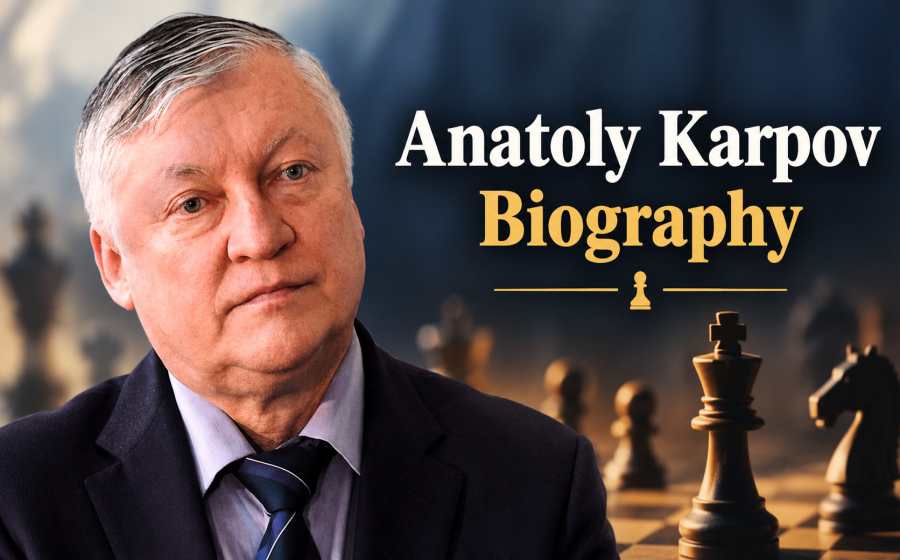
Anatoly Karpov Biography – The Chess Genius Who Ruled the World
Discover the Anatoly Karpov biography, his early life, world chess championships, legendary rivalry with Kasparov, achievements and five inspiring life lessons.
Anatoly Karpov Biography
Anatoly Karpov is one of the greatest chess players in history, celebrated for his extraordinary strategic thinking, positional mastery, and remarkable consistency. He became the 12th World Chess Champion in 1975 and dominated international chess for a decade. His legendary rivalry with Garry Kasparov, numerous tournament victories, and return to the world championship spotlight in the 1990s established his place among chess’s most influential figures.
Table of Contents
Early Life and Childhood
Anatoly Yevgenyevich Karpov was born on May 23, 1951, in Zlatoust, a city in the Ural region of the Soviet Union, now part of Russia. From an early age, he displayed an exceptional interest in chess and a remarkable ability to understand the game.
Karpov learned chess as a young child and steadily developed his skills through practice, study, and competition. Unlike players who depend primarily on spectacular attacks, he became known for his patience, accurate calculation, and ability to recognize small positional advantages.
His talent developed rapidly during his childhood and teenage years. He entered the Soviet chess training system, where he received guidance and opportunities to compete against strong players. In 1966, at just 15 years old, he became one of the youngest chess masters in the Soviet Union.
These early accomplishments demonstrated that Karpov was more than a talented young player. He had the discipline and determination required to compete at the highest level of international chess.
Education and Development as a Chess Player
Alongside chess, Karpov pursued his education. He studied economics while continuing to participate in important chess tournaments. Managing academic responsibilities alongside professional ambitions required discipline and careful time management.
One of the important stages in his development came when he trained under the guidance of experienced chess professionals, including grandmaster Semyon Furman. Their work helped refine his understanding of positional play, opening preparation, and endgame technique.
In 1969, Karpov won the World Junior Chess Championship, an achievement that brought him international recognition. The following year, in 1970, he earned the title of International Grandmaster.
These milestones marked the beginning of his rise into the world’s chess elite. His success was built on a combination of natural ability, structured training, practical experience, and an exceptional understanding of strategic positions.
Rise to World Chess Champion
The early 1970s proved to be a turning point in Karpov’s career. He competed against increasingly powerful opponents and established himself as one of the strongest players in the Soviet Union.
In 1973, he performed impressively at the Leningrad Interzonal tournament, helping him qualify for the Candidates cycle. This competition determined who would challenge the reigning world champion, Bobby Fischer.
Karpov then defeated three formidable opponents in the Candidates matches:
- Lev Polugaevsky: Karpov demonstrated superior preparation and consistency.
- Boris Spassky: He overcame the former world champion in a demanding match.
- Viktor Korchnoi: He secured the right to challenge Fischer after another difficult contest.
Karpov had earned his opportunity to fight for the highest title in chess. However, the anticipated championship match against Fischer never took place because Fischer declined to defend his title under the proposed conditions.
In 1975, the International Chess Federation (FIDE) declared Karpov the 12th World Chess Champion. Although he won the title without playing a championship match, he subsequently proved his ability through years of outstanding tournament performances and successful title defenses.
Defending the World Championship
After becoming world champion, Karpov faced the challenge of proving himself against the strongest players in the world. He answered his critics through consistent results, strategic excellence, and successful championship defenses.
In 1978, he defended his title against Viktor Korchnoi in Baguio City, Philippines. The match was intense and psychologically demanding, but Karpov ultimately emerged victorious.
In 1981, the two grandmasters met again for the world championship in Merano, Italy. Karpov won convincingly, reinforcing his reputation as a formidable champion.
His success during this period reflected his ability to maintain concentration under pressure. Rather than relying on risky attacks, he frequently built small advantages and gradually converted them into victories.
These achievements helped establish Karpov as one of the dominant players of his generation.
The Legendary Rivalry with Garry Kasparov
One of the most famous chapters in Karpov’s career was his rivalry with Garry Kasparov, another extraordinary chess talent from the Soviet Union.
Their first world championship match began in Moscow in 1984. The contest became one of the longest and most controversial championship matches in chess history. It continued for months and reached 48 games before FIDE president Florencio Campomanes stopped it without declaring a winner.
The two players met again in 1985. This time, Kasparov defeated Karpov by a score of 13–11, becoming the youngest undisputed world champion at that time.
Their rivalry continued through championship matches in 1986, 1987, and 1990. Although Karpov did not regain the undisputed title, he remained a formidable challenger and repeatedly pushed Kasparov to his limits.
Their encounters became legendary because they showcased two contrasting approaches to chess. Karpov was famous for his positional precision and gradual pressure, while Kasparov was renowned for his dynamic play, tactical energy, and intensive preparation.
Together, they helped define a major era in modern chess history.
Playing Style: Why Anatoly Karpov Was So Special
Karpov’s playing style made him one of the most respected strategists in chess. He was particularly skilled at identifying weaknesses, restricting his opponent’s options, and improving his position without taking unnecessary risks.
His approach is often associated with the nickname “the Boa Constrictor.” Like a constrictor gradually tightening its grip, Karpov could reduce an opponent’s freedom of movement until defending the position became extremely difficult.
Some defining characteristics of his style included:
- Positional understanding: He recognized how to improve the placement of his pieces.
- Patience: He was willing to wait for small opportunities rather than force an attack.
- Endgame technique: He converted favorable positions with remarkable precision.
- Defensive strength: He understood how to neutralize threats and limit counterplay.
- Consistency: He maintained a high standard across tournaments and championship matches.
His style demonstrated that chess excellence does not always require spectacular sacrifices. Often, the ability to make accurate decisions repeatedly is enough to overcome even the strongest opposition.
Major Achievements and Records
Anatoly Karpov’s career includes numerous milestones that demonstrate his lasting influence on the game.
12th World Chess Champion
Held the undisputed world championship from 1975 to 1985.
Three-time FIDE World Champion in the 1990s
Won the FIDE championship in 1993, 1996, and 1998.
Peak Elo rating of 2780
Reached this rating in July 1994.
Six Chess Olympiad team victories
Won gold medals with the Soviet team in 1972, 1974, 1980, 1982, 1986, and 1988.
Karpov also won the first FIDE-recognized World Rapid Chess Championship in 1988 and received nine Chess Oscars during his career. His tournament record includes more than 160 first-place finishes, according to major chess history sources.
Anatoly Karpov’s Return to World Championship Glory
Following the division in the world championship system during the 1990s, Karpov regained the FIDE world title in 1993 by defeating Jan Timman.
He successfully defended that title in 1996 against Gata Kamsky and in 1998 against Viswanathan Anand. These victories demonstrated his ability to remain competitive against a new generation of elite chess players.
In 1999, Karpov relinquished the FIDE title following disagreements over the championship format. Nevertheless, his achievements across different decades had already secured his place among the greatest players in chess history.
His later chess activities included exhibitions, rapid competitions, public appearances, and efforts to promote the game. His career remains an important example of sustained excellence and the ability to adapt as competitive chess evolves.
Personal Life and Activities Beyond Chess
Beyond the chessboard, Karpov has pursued interests in education, public service, and collecting. He has been involved in chess organizations and initiatives intended to encourage wider participation in the game.
He also entered Russian politics and became a member of the State Duma. His public activities extended his influence beyond competitive chess, although his international reputation remains primarily connected with his achievements as a grandmaster.
Karpov’s life illustrates how expertise developed in one field can lead to opportunities in other areas. His career has combined competitive success, public recognition, and continued involvement in the intellectual sport that made him famous.
5 Inspirational Lessons from Anatoly Karpov’s Life
1. Consistent Practice Builds Excellence
Karpov developed his talent through years of learning and disciplined preparation. His journey reminds us that regular effort and continuous improvement can turn ability into exceptional achievement.
2. Patience Is a Powerful Strength
His strategic approach shows that success does not always come from quick action. Sometimes, careful planning and waiting for the right opportunity produce better results.
3. Challenges Can Make You Stronger
Karpov faced difficult opponents and demanding championship matches. His persistence demonstrates the importance of remaining focused when circumstances become challenging.
4. Learn from Your Rivals
His long rivalry with Kasparov showed the value of competing against exceptional opponents. Strong competition can encourage us to examine our weaknesses and improve our abilities.
5. Success Requires Long-Term Commitment
Karpov achieved major milestones across several decades. His career teaches us that meaningful accomplishments often require dedication, adaptability, and the willingness to keep learning.
Summary
Anatoly Karpov’s biography is the story of a talented young chess player who became one of the most successful champions in the history of the game. From his early development in the Soviet Union to his world championship victories and legendary rivalry with Garry Kasparov, he demonstrated the value of patience, precision, and determination.
His achievements extend beyond the titles he won. Karpov helped shape modern chess through his distinctive playing style, exceptional tournament record, and memorable championship battles. His career continues to inspire aspiring chess players and students who want to develop their analytical abilities and pursue ambitious goals.
Also Check: Biography