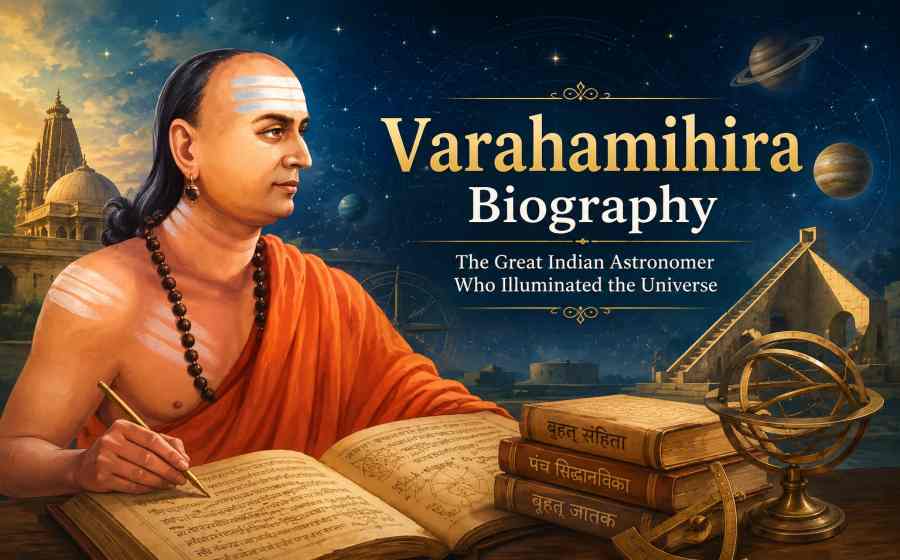
Varahamihira Biography – The Brilliant Ancient Indian Astronomer Who Changed Science
Discover Varahamihira Biography, his life, achievements, astronomy discoveries, books and contributions to Indian science and mathematics.
Varahamihira Biography
Varahamihira was one of the greatest scholars of ancient India. He was a renowned astronomer, mathematician, astrologer, and scientist whose work influenced Indian science for centuries. His remarkable contributions in astronomy and mathematics made him one of the brightest intellectual figures in Indian history. Even after many centuries, his discoveries and ideas continue to attract students, historians, and researchers around the world.
Varahamihira lived during a period when India had become a center of learning and scientific thinking. His works combined observation, calculations, and knowledge gathered from earlier traditions. He played an important role in making scientific studies more systematic and organized.
Table of Contents
Early Life of Varahamihira
Varahamihira was born around 505 CE in ancient India, in a place believed to be near Ujjain in present-day Madhya Pradesh. Ujjain was considered an important center for astronomy and education during that time.
His father, Adityadasa, was a learned man and a worshipper of the Sun. He introduced young Varahamihira to astronomy and mathematics. Under his father’s guidance, Varahamihira developed a deep interest in studying stars, planets, and celestial movements.
As he grew older, his curiosity and intelligence helped him gain expertise in several subjects. He learned not only Indian knowledge systems but also studied ideas that came from Greek and other traditions.
Education and Interest in Astronomy
Varahamihira showed exceptional talent from an early age. He devoted much of his life to studying astronomy because people in ancient times believed that understanding the movements of celestial bodies was essential.
He carefully observed the sky and made detailed studies of stars and planets. Unlike many people who accepted ideas without questioning them, Varahamihira emphasized observation and logical analysis.
His studies eventually earned him a respected position among scholars of his era.
Association with King Vikramaditya
Varahamihira became associated with the court of the famous king Vikramaditya. He was considered one of the “Nine Gems” or Navaratnas in the royal court.
The Navaratnas were highly respected scholars and intellectuals known for their exceptional abilities. Being included among them demonstrated the immense respect Varahamihira received for his knowledge and scientific contributions.
His presence in the royal court gave him opportunities to conduct studies and share his findings with other scholars.
Major Works of Varahamihira
Varahamihira wrote several important books that significantly influenced science and astronomy.
1. Brihat Samhita
This is considered one of his most famous works. It contains information on astronomy, architecture, weather prediction, agriculture, geography, gemstones, and many other subjects.
The book demonstrated his broad knowledge and practical approach toward science.
2. Pancha Siddhantika
This work summarized five astronomical systems that were popular during his time.
It provided detailed discussions about planetary movements, eclipses, and calculations related to astronomy.
3. Brihat Jataka
This text focused mainly on astrology and became one of the most influential works in that field.
Contributions to Science and Mathematics
Varahamihira made many valuable contributions to scientific knowledge.
Astronomy Contributions
- He studied planetary movements carefully.
- He worked on eclipse calculations.
- He improved methods for astronomical observations.
- He contributed to calendar systems.
Mathematical Contributions
He used mathematical calculations in astronomical studies. His work helped improve methods used for measurement and prediction.
Weather Science
Varahamihira also studied weather patterns. He observed clouds, rainfall, and natural signs to predict seasonal changes. Many historians consider his observations an early form of meteorology.
Scientific Thinking of Varahamihira
One of the most impressive qualities of Varahamihira was his scientific attitude. He valued observation and evidence.
He believed that knowledge should not rely only on assumptions but should also come from careful study of nature. His ideas reflected a practical approach to understanding the world.
This thinking made him different from many scholars of his period.
Legacy and Influence
Varahamihira’s works influenced generations of scientists and scholars. His books continued to be studied for hundreds of years.
His writings helped preserve and expand knowledge in astronomy and mathematics. Even today, historians recognize him as one of India’s greatest scientific minds.
Modern researchers admire his ability to combine different fields of study into a single body of knowledge. His achievements remind us that curiosity and dedication can create discoveries that survive for centuries.
5 Inspirations from Varahamihira
- Knowledge has no limits – Keep learning from different fields and cultures.
- Observation leads to discovery – Study things carefully before reaching conclusions.
- Curiosity creates innovation – Asking questions often leads to great achievements.
- Dedication brings success – Consistent effort can create a lasting impact.
- Use knowledge for society – Education becomes meaningful when it benefits others.
Summary
Varahamihira was not merely an astronomer; he was a visionary scholar whose ideas shaped ancient Indian science. Through his books and research, he contributed greatly to astronomy, mathematics, and natural sciences.
His life serves as an example of intellectual curiosity, hard work, and the pursuit of knowledge. Even in modern times, his contributions continue to inspire students and researchers around the world.
Also Check: Biography