Russia – History, Geography, Culture, Key Facts and Famous Landmarks
Explore Russia’s history, culture, geography, sports, economy and key facts. Discover what makes Russia one of the world’s most influential nations.
Russia
Russia is the largest country in the world, stretching across Eastern Europe and Northern Asia. Covering more than 17 million square kilometers, it spans eleven time zones and shares borders with numerous countries. Russia is known for its rich history, diverse culture, scientific achievements, natural resources, and significant influence on global affairs. From magnificent palaces and historic cities to vast forests and icy landscapes, Russia offers a unique blend of tradition and modernity.
Table of Contents
Geography of Russia
Russia occupies about one-eighth of the Earth’s inhabited land area, making it the world’s largest nation by territory. The country extends from the Baltic Sea in the west to the Pacific Ocean in the east. It has diverse geographical features, including mountains, plains, rivers, forests, and tundra.
Some of the major geographical landmarks include:
- The Ural Mountains, which separate Europe and Asia.
- Lake Baikal, the world’s deepest freshwater lake.
- The Volga River, the longest river in Europe.
- Siberia, known for its vast wilderness and extreme climate.
Russia experiences various climate zones, ranging from Arctic conditions in the north to more moderate climates in the south.
Brief History of Russia
Russia’s history dates back more than a thousand years. The early East Slavic state known as Kievan Rus emerged in the 9th century and laid the foundation for Russian civilization.
During the 16th century, Ivan IV, often called Ivan the Terrible, became the first ruler to adopt the title of Tsar. Over the centuries, Russia expanded significantly under various rulers, including Peter the Great and Catherine the Great.
In 1917, the Russian Revolution led to the fall of the monarchy and the rise of the Soviet Union. The Soviet Union became a major global power and played a crucial role in World War II. In 1991, the Soviet Union dissolved, and modern Russia emerged as an independent nation.
Today, Russia remains an important political, economic, and military power on the global stage.
Capital and Major Cities
The capital city of Russia is Moscow, one of the largest and most influential cities in the world. Moscow serves as the country’s political, economic, and cultural center.
Other major cities include:
- Saint Petersburg
- Novosibirsk
- Yekaterinburg
- Kazan
- Nizhny Novgorod
These cities contribute significantly to Russia’s economy, education, and cultural development.
Culture and Traditions of Russia
Russian culture is among the richest and most influential in the world. It reflects centuries of history, literature, art, music, and religious traditions.
Language
Russian is the official language and is spoken by the vast majority of the population. It is one of the most widely spoken languages globally.
Literature
Russia has produced many world-famous writers, including:
- Leo Tolstoy
- Fyodor Dostoevsky
- Anton Chekhov
- Alexander Pushkin
Their literary works continue to influence readers worldwide.
Music and Dance
Traditional Russian music and folk dances remain important parts of national culture. Ballet is especially famous in Russia, with institutions such as the Bolshoi Theatre gaining international recognition.
Festivals
Russians celebrate several traditional and national festivals, including:
- New Year’s Day
- Orthodox Christmas
- Victory Day
- Maslenitsa Festival
These celebrations showcase Russian customs, food, and cultural heritage.
Population and Society
Russia has a population of over 140 million people. It is a multicultural nation consisting of more than 190 ethnic groups and nationalities.
The country is home to various religions, with Russian Orthodox Christianity being the most widely practiced faith. Islam, Buddhism, Judaism, and other religions are also represented.
Education and literacy rates in Russia are high, and the country has a strong tradition of scientific research and technological innovation.
Economy of Russia
Russia possesses abundant natural resources and has one of the world’s largest reserves of oil, natural gas, coal, and minerals.
Major sectors of the Russian economy include:
- Energy production
- Manufacturing
- Mining
- Agriculture
- Technology
- Defense industries
Russia is a significant exporter of energy products and plays an important role in global energy markets.
Sports in Russia
Sports are highly popular in Russia, and the country has achieved remarkable success in international competitions.
Football
Football is one of the most widely followed sports in Russia. The country hosted the FIFA World Cup in 2018, attracting millions of visitors and viewers worldwide.
Ice Hockey
Ice hockey is considered one of Russia’s strongest sports. Russian teams and players have achieved considerable success in international tournaments.
Athletics and Olympics
Russian athletes have won numerous medals in Olympic Games across various disciplines, including:
- Gymnastics
- Wrestling
- Athletics
- Figure skating
- Weightlifting
Chess
Russia has a long tradition of excellence in chess and has produced many world champions. Chess remains a popular intellectual sport throughout the country.
Famous Tourist Attractions
Russia offers many attractions that draw tourists from around the world.
Some notable destinations include:
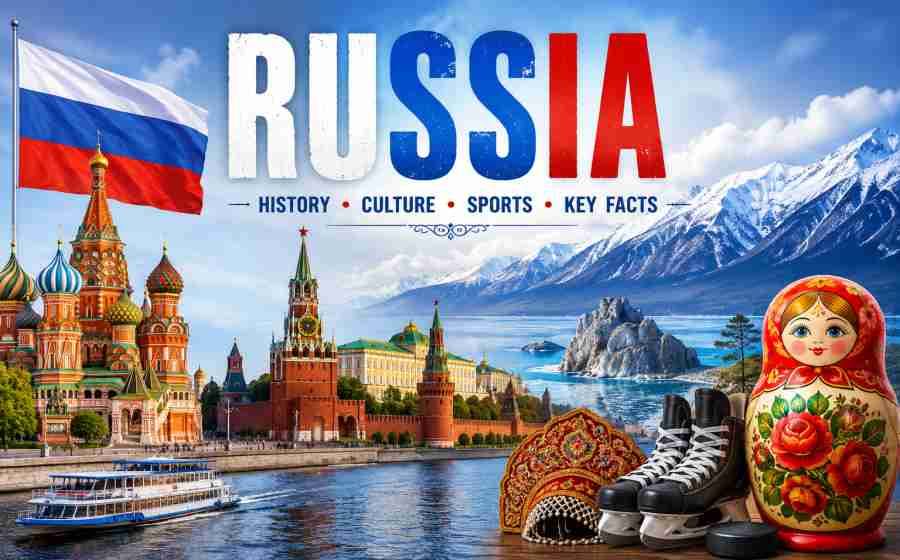
- The Kremlin in Moscow
- Red Square
- Saint Basil’s Cathedral
- Hermitage Museum
- Lake Baikal
- Trans-Siberian Railway
These landmarks showcase Russia’s history, architecture, and natural beauty.
Interesting Facts About Russia
- Russia is the largest country in the world by land area.
- It spans eleven time zones.
- Lake Baikal contains about 20% of the world’s unfrozen freshwater.
- Moscow is one of Europe’s largest cities.
- The Trans-Siberian Railway is among the longest railway networks in the world.
- Russia shares borders with more countries than any other nation.
- Russian is one of the six official languages of the United Nations.
- The country has vast forests that form one of the largest woodland areas on Earth.
Summary
Russia is a nation of immense size, historical significance, and cultural richness. Its long history, remarkable achievements in literature, science, sports, and exploration have shaped its identity and global influence. From the bustling streets of Moscow to the remote landscapes of Siberia, Russia presents a fascinating blend of tradition, innovation, and natural beauty. Understanding Russia’s history, culture, sports, and key facts provides valuable insight into one of the world’s most influential countries.
Also Check: General Knowledge