
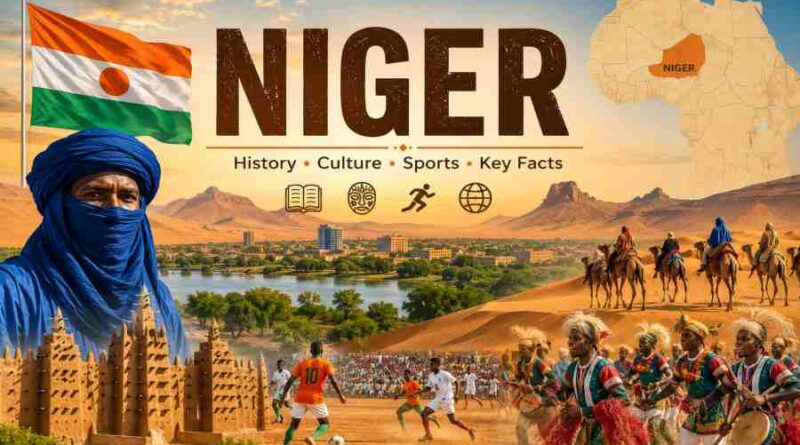
Niger – History, Culture, Sports and Fascinating Facts About the Saharan Nation
Explore Niger’s history, culture, sports, geography, economy and key facts. Learn about this unique West African nation, its traditions, people and challenges.
Niger
Niger is a landlocked country located in West Africa. Known for its vast deserts, rich cultural heritage, and resilient people, Niger is one of the largest countries in Africa by area. Despite facing environmental and economic challenges, the nation possesses a unique history and vibrant traditions that make it an important part of the African continent.
Bordered by Algeria, Libya, Chad, Nigeria, Benin, Burkina Faso, and Mali, Niger serves as a crossroads between North and Sub-Saharan Africa. The country derives its name from the Niger River, which flows through its southwestern region and provides a vital source of water and livelihood.
Table of Contents
History of Niger
The history of Niger dates back thousands of years. Archaeological evidence suggests that the region was inhabited by humans during prehistoric times when the Sahara Desert was greener and more suitable for settlement.
Several ancient kingdoms and empires influenced Niger’s development, including the Songhai Empire, Kanem-Bornu Empire, and various Hausa states. These kingdoms played significant roles in trans-Saharan trade, exchanging goods such as gold, salt, textiles, and livestock.
In the late 19th century, Niger became part of French West Africa during the colonial period. French rule continued until Niger gained independence on August 3, 1960. Since independence, the country has experienced periods of political change, including military governments and democratic transitions. Today, Niger continues to strengthen its institutions while addressing economic and security challenges.
Geography and Climate
Niger covers approximately 1.27 million square kilometers, making it one of Africa’s largest countries. However, much of its territory lies within the Sahara Desert.
Key Geographic Features:
- Capital: Niamey
- Official Language: French
- Area: About 1.27 million square kilometers
- Major River: Niger River
- Highest Point: Mont Idoukal-n-Taghès
- Currency: West African CFA Franc (XOF)
The climate is mostly hot and dry. Northern regions experience extreme desert conditions, while southern areas receive more rainfall and support agriculture.
Culture and Traditions
Niger is home to diverse ethnic groups, each contributing to the country’s rich cultural identity.
Major Ethnic Groups
- Hausa
- Zarma-Songhai
- Tuareg
- Fulani (Peul)
- Kanuri
- Toubou
Traditional music, storytelling, dance, and crafts remain important aspects of daily life. Cultural festivals celebrate community values and historical traditions passed down through generations.
Traditional Clothing
Colorful robes, turbans, and embroidered garments are common throughout Niger. Tuareg communities are particularly known for their distinctive blue veils and desert attire.
Music and Dance
Music in Niger often features traditional instruments such as drums, flutes, and stringed instruments. Songs frequently tell stories about history, family, and social values.
Languages Spoken in Niger
French serves as the official language and is used in government and education. However, many indigenous languages are spoken across the country.
Popular local languages include:
- Hausa
- Zarma
- Fulfulde
- Kanuri
- Tamasheq
This linguistic diversity reflects Niger’s multicultural society.
Economy of Niger
Niger’s economy relies heavily on agriculture, livestock farming, and natural resources.
Main Economic Activities
- Agriculture
- Livestock production
- Mining
- Trade
One of Niger’s most important exports is uranium, a mineral used in nuclear energy production. The country is among the world’s significant uranium producers.
Farmers cultivate crops such as millet, sorghum, cowpeas, and rice, particularly in the southern regions where rainfall is more abundant.
Despite resource wealth, economic development remains challenging due to climate conditions, population growth, and limited infrastructure.
Sports in Niger
Sports play an important role in promoting unity and national pride.
Football (Soccer)
Football is by far the most popular sport in Niger. The national team, known as the “Mena,” has participated in major African football competitions and continues to develop its international presence.
Local football leagues attract passionate supporters across the country.
Other Popular Sports
- Athletics
- Basketball
- Wrestling
- Martial arts
Traditional wrestling competitions remain especially popular in many communities and are often linked to cultural celebrations.
Wildlife and Natural Attractions
Although much of Niger consists of desert landscapes, the country is home to remarkable wildlife and protected areas.
Notable Natural Attractions
- Air Mountains
- Ténéré Desert
- W National Park
- Niger River Valley
W National Park is known for its biodiversity and supports species such as elephants, buffalo, antelopes, and numerous bird species.
The Air Mountains provide stunning scenery and offer insight into the geological history of the Sahara.
Education and Development
The government of Niger has worked to improve access to education and healthcare. Schools have expanded in many regions, though challenges remain in rural areas.
International organizations and local initiatives continue supporting programs focused on literacy, healthcare access, food security, and sustainable development.
Investments in renewable energy and infrastructure are also helping to improve living standards for many citizens.
Interesting Facts About Niger
- Niger is the largest country in West Africa by land area.
- More than 80% of its territory is covered by the Sahara Desert.
- The country is named after the Niger River.
- Uranium is one of Niger’s most valuable natural resources.
- Niamey is both the capital and largest city.
- Traditional camel caravans still operate in some desert regions.
- Niger has a young population, with a large percentage under the age of 25.
- The Air Mountains contain ancient rock art dating back thousands of years.
- Traditional storytelling remains an important cultural practice.
- The country connects North Africa and Sub-Saharan Africa through historic trade routes.
Summary
Niger is a nation of vast deserts, rich traditions, and enduring resilience. From ancient empires and trans-Saharan trade routes to modern development efforts, the country has a fascinating story to tell. Its diverse cultures, unique landscapes, growing sporting traditions, and valuable natural resources make Niger an important part of Africa’s heritage. Understanding Niger helps us appreciate the diversity, history, and potential of one of West Africa’s most distinctive nations.
Also Check: General Knowledge