Czech Republic – History, Culture, Sports, Tourist Places and Fascinating Facts
Explore the Czech Republic with its rich history, vibrant culture, famous landmarks, popular sports, traditional cuisine, economy and fascinating facts.
Czech Republic
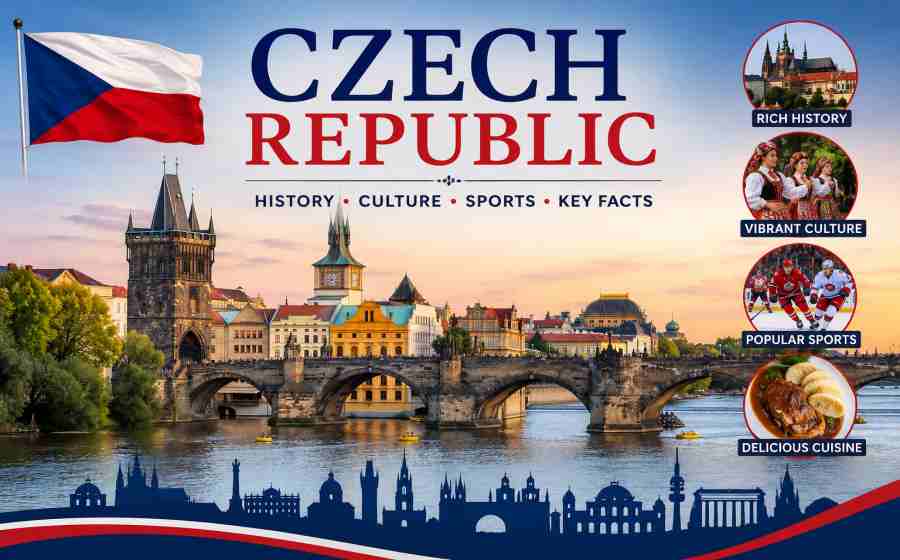
The Czech Republic, officially known as the Czechia, is a beautiful landlocked country located in Central Europe. It is famous for its medieval castles, historic cities, world-class architecture, rich cultural heritage, and remarkable scientific contributions. Although relatively small in size, the Czech Republic has played an important role in European history and continues to be one of the continent’s most popular tourist destinations.
The country is known for its charming capital city, Prague, which attracts millions of visitors every year. From Gothic churches and Renaissance palaces to modern industries and successful athletes, the Czech Republic offers a fascinating blend of history and modern development.
Table of Contents
History of the Czech Republic
The history of the Czech Republic dates back thousands of years. During ancient times, Celtic tribes inhabited the region before being replaced by Germanic and Slavic peoples. By the 9th century, the area became part of the Great Moravian Empire, one of the earliest Slavic states.
In the 10th century, the Kingdom of Bohemia emerged as a powerful state under the Přemyslid dynasty. Bohemia later became an important part of the Holy Roman Empire and flourished as a political and cultural center.
During the 14th century, King Charles IV transformed Prague into one of Europe’s leading cities. He founded Charles University in 1348, the first university in Central Europe.
The region later came under Habsburg rule and remained part of the Austrian Empire for centuries. Following World War I in 1918, Czechoslovakia became an independent nation.
After World War II, the country came under communist rule until the peaceful Velvet Revolution of 1989 restored democracy. On 1 January 1993, Czechoslovakia peacefully split into two independent countries—the Czech Republic and Slovakia—in what is known as the Velvet Divorce.
Today, the Czech Republic is a democratic nation and a member of the European Union, NATO, and several international organizations.
Geography and Climate
The Czech Republic covers approximately 78,871 square kilometers and shares borders with Germany, Poland, Slovakia, and Austria.
The country consists of rolling hills, fertile plains, forests, rivers, and mountain ranges. Major rivers include the Vltava and Elbe.
The climate is temperate, with warm summers and cold winters. Snowfall is common in higher elevations, making winter sports popular.
Capital and Major Cities
Prague is the capital and largest city. It is often called the “City of a Hundred Spires” because of its magnificent churches and historic buildings.
Other important cities include:
- Brno
- Ostrava
- Plzeň (Pilsen)
- Liberec
- Olomouc
These cities contribute significantly to education, manufacturing, tourism, and technology.
Culture and Traditions
Czech culture reflects centuries of European influence combined with unique national traditions. The Czech people highly value education, literature, music, theatre, and the arts. Classical music has a strong tradition, with famous composers such as Antonín Dvořák and Bedřich Smetana gaining worldwide recognition.
Popular traditions include:
- Christmas markets
- Easter celebrations
- Folk music and dance
- Traditional puppet theatre
- Harvest festivals
The country is also famous for its crystal glassmaking and handcrafted ceramics.
Language and Religion
The official language is Czech, a West Slavic language closely related to Slovak. Although many citizens identify as non-religious, Christianity remains the country’s largest religion, with Roman Catholicism being the most common denomination. English and German are widely understood, especially in tourist areas.
Famous Food
Czech cuisine is hearty and flavorful. Some popular dishes include:
- Svíčková (marinated beef with creamy sauce)
- Goulash
- Roast pork with dumplings and cabbage
- Fried cheese (Smažený sýr)
- Trdelník (sweet pastry)
- Koláče (traditional pastries)
The Czech Republic is also internationally famous for producing high-quality beer and has one of the highest beer consumption rates per capita in the world.
Sports in the Czech Republic
Sports are an important part of Czech society.
Ice Hockey
Ice hockey is the country’s most successful sport. The Czech national team has won multiple World Championships and Olympic medals.
Football
Football is extremely popular, with clubs such as Sparta Prague and Slavia Prague enjoying large fan followings.
Tennis
The Czech Republic has produced many world-class tennis players, including Martina Navratilova, Petra Kvitová, and several Grand Slam champions.
Athletics
Czech athletes have earned international recognition in javelin throw, long-distance running, rowing, canoeing, and other Olympic events. Winter sports such as skiing and snowboarding are also widely enjoyed.
Economy
The Czech Republic has one of the strongest economies in Central Europe.
Major industries include:
- Automobile manufacturing
- Engineering
- Machinery
- Electronics
- Information technology
- Tourism
- Pharmaceuticals
- Glass production
Global automobile manufacturers have significant production facilities in the country, making automotive exports an important source of income.
Education
Education is highly developed and compulsory for children. The Czech Republic is home to several prestigious universities, including Charles University, one of Europe’s oldest universities. The country places strong emphasis on science, engineering, and research.
Tourism
Millions of tourists visit the Czech Republic every year because of its historic architecture and scenic beauty. Popular tourist attractions include:
- Prague Castle
- Charles Bridge
- Old Town Square
- Český Krumlov
- Karlovy Vary
- Kutná Hora
- Bohemian Switzerland National Park
Many UNESCO World Heritage Sites are located throughout the country.
Government
The Czech Republic is a parliamentary democratic republic. The President serves as the head of state, while the Prime Minister leads the government. The country has a multi-party political system and an independent judiciary.
Interesting Facts About the Czech Republic
- Prague Castle is one of the largest ancient castle complexes in the world.
- Charles University, founded in 1348, is the oldest university in Central Europe.
- The Czech Republic has more than 2,000 castles and châteaux.
- The country is famous for Bohemian crystal and glass production.
- Czechia consistently ranks among Europe’s safest countries.
- The Czech Republic has one of the world’s highest beer consumption rates.
- The astronomical clock in Prague is among the oldest working astronomical clocks in the world.
- The country has numerous UNESCO World Heritage Sites.
- Czech engineers and scientists have contributed significantly to global innovation.
- Tourism is one of the country’s most important economic sectors.
National Symbols
- Official Name: Czech Republic (Czechia)
- Capital: Prague
- Official Language: Czech
- Currency: Czech Koruna (CZK)
- National Flag: White, red, and blue
- National Animal: Double-tailed Bohemian Lion
- National Flower: Rose (commonly associated)
- National Day: 28 October (Independent Czechoslovak State Day)
Summary
The Czech Republic is a nation where rich history meets modern progress. From the medieval beauty of Prague and magnificent castles to its strong economy, excellent education system, vibrant culture, and sporting achievements, the country offers much to admire. Whether exploring its historic landmarks, enjoying traditional Czech cuisine, or learning about its remarkable past, the Czech Republic remains one of Europe’s most fascinating and culturally significant destinations. Its commitment to preserving heritage while embracing innovation makes it an excellent subject for students, travelers, and general knowledge enthusiasts alike.
Also Check: General Knowledge