Panama – History of A Land of Two Oceans, Culture, Sports and Global Importance
Discover Panama, its rich history, vibrant culture, famous Panama Canal, sports, geography, economy and fascinating facts that make the nation unique.
Panama
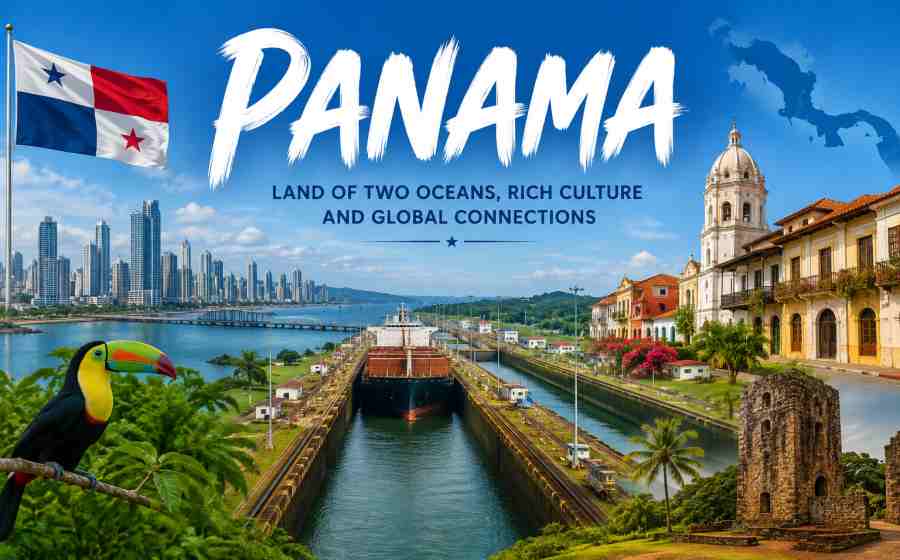
Panama is a fascinating country located in Central America, connecting North America and South America through a narrow strip of land called an isthmus. It is one of the world’s most strategically important nations because of the Panama Canal, an engineering marvel that links the Atlantic Ocean with the Pacific Ocean. Despite its relatively small size, Panama has played a major role in global trade, transportation, and international commerce.
The country is known for its tropical rainforests, beautiful beaches, vibrant festivals, diverse wildlife, and multicultural society. Panama combines modern cities with rich indigenous traditions, making it a unique destination for tourists, students, and researchers alike.
Table of Contents
Location and Geography
Panama lies between Costa Rica to the west and Colombia to the southeast. It has coastlines along both the Caribbean Sea and the Pacific Ocean, making it one of the few countries with access to two major bodies of water.
- Capital: Panama City
- Largest City: Panama City
- Continent: North America (Central America)
- Official Language: Spanish
- Currency: Panamanian Balboa (PAB) and US Dollar (USD)
- Area: Approximately 75,417 square kilometers
- Population: Around 4.6 million (estimated)
The country’s landscape includes mountains, tropical forests, rivers, islands, and fertile valleys. Panama enjoys a tropical climate with a rainy season and a dry season.
History of Panama
Early Civilizations
Long before Europeans arrived, Panama was home to indigenous peoples such as the Guna, Emberá, Ngäbe-Buglé, and Bri Bri. These communities developed rich cultures based on agriculture, fishing, and trade.
Spanish Colonization
Spanish explorer Rodrigo de Bastidas reached Panama in 1501, and Vasco Núñez de Balboa crossed the isthmus in 1513, becoming the first European to see the Pacific Ocean from the Americas.
During Spanish rule, Panama became an important route for transporting gold and silver from South America to Spain.
Independence
- Panama declared independence from Spain in 1821.
- It voluntarily joined Gran Colombia, led by Simón Bolívar.
- In 1903, Panama separated from Colombia with support from the United States and became an independent nation.
Construction of the Panama Canal
One of the most significant events in Panama’s history was the construction of the Panama Canal.
- France first attempted the project in the 1880s but failed.
- The United States completed the canal in 1914.
- On 31 December 1999, the canal was officially transferred to Panama.
Today, the Panama Canal remains one of the world’s busiest shipping routes.
Culture of Panama
Panamanian culture reflects a blend of Spanish, Indigenous, African, and Caribbean traditions.
Language
Spanish is the official language, although English is widely understood in business and tourism.
Religion
Most Panamanians follow Christianity, especially Roman Catholicism. Other religions are also practiced peacefully.
Traditional Clothing
Traditional attire is an important part of festivals.
- Women wear the beautiful Pollera, one of Latin America’s most elaborate traditional dresses.
- Men often wear white shirts, trousers, and straw hats.
Music and Dance
Popular music includes:
- Tamborito
- Cumbia
- Salsa
- Reggae en Español
- Jazz
Traditional dances are performed during national celebrations and cultural festivals.
Festivals in Panama
Panama celebrates numerous colorful festivals throughout the year.
Panama Carnival
Held before Lent, Carnival is the country’s largest celebration with music, dancing, costumes, and parades.
Independence Day
Celebrated on 3 November, marking independence from Colombia.
Flag Day
Observed on 4 November, honoring the national flag.
Christmas and Easter
These Christian festivals are celebrated across the country with family gatherings and religious services.
Food of Panama
Panamanian cuisine combines indigenous, Spanish, and Caribbean influences.
Popular dishes include:
- Sancocho (traditional chicken soup)
- Arroz con pollo
- Ceviche
- Tamales
- Patacones (fried plantains)
- Empanadas
- Fresh tropical fruits
Seafood is especially popular due to the country’s long coastlines.
Sports in Panama
Sports play an important role in Panamanian society.
Baseball
Baseball is the most popular sport in Panama. The country has produced several internationally recognized players who have played in Major League Baseball.
Football (Soccer)
Football has grown rapidly in popularity. Panama qualified for the FIFA World Cup for the first time in 2018, marking a historic achievement.
Boxing
Panama has produced multiple world boxing champions and remains one of Latin America’s strongest boxing nations. Other popular sports include basketball, athletics, volleyball, and surfing.
Economy of Panama
Panama has one of the strongest economies in Central America. Major sectors include:
- International trade
- Banking
- Shipping
- Tourism
- Logistics
- Agriculture
- Construction
The Panama Canal contributes billions of dollars to the national economy by allowing ships to travel between the Atlantic and Pacific Oceans without sailing around South America. Panama City is considered one of Latin America’s leading financial centers.
Wildlife and Natural Beauty
Panama is one of the world’s most biodiverse countries. Its forests are home to:
- Jaguars
- Sloths
- Monkeys
- Tapirs
- Toucans
- Scarlet macaws
- Hundreds of butterfly species
Marine life includes dolphins, sea turtles, sharks, whales, and colorful coral reefs. Popular natural attractions include tropical rainforests, volcanoes, islands, waterfalls, and national parks.
Education in Panama
Education is compulsory for children during their primary years. The country has:
- Public and private schools
- Universities
- Technical institutes
The government continues to improve educational access and digital learning opportunities.
Tourist Attractions
Panama attracts millions of visitors every year. Major attractions include:
- Panama Canal
- Casco Viejo (Old Quarter)
- Biomuseo
- Bocas del Toro Islands
- San Blas Islands
- Coiba National Park
- Boquete Highlands
- Metropolitan Natural Park
Tourists enjoy rainforest adventures, beach vacations, diving, birdwatching, and cultural experiences.
Government
Panama is a democratic republic.
- Capital: Panama City
- President: Head of State and Government
- Legislature: National Assembly
The country follows a constitutional system with regular elections.
Interesting Facts About Panama
- The Panama Canal connects the Atlantic and Pacific Oceans.
- Panama uses both the US Dollar and the Panamanian Balboa.
- More than 14,000 ships pass through the Panama Canal annually.
- Panama has coastlines on two oceans.
- The country is home to over 1,000 bird species.
- Panama City is one of the few capitals with a tropical rainforest within its city limits.
- The famous Panama Hat actually originated in Ecuador but became internationally known through Panama.
- The country has hundreds of islands, many of which remain untouched.
- Panama is one of the world’s leading international banking centers.
- The Bridge of the Americas connects North and South America by road.
Summary
Panama is much more than the home of the famous Panama Canal. It is a country rich in history, cultural diversity, natural beauty, and economic importance. From ancient indigenous traditions to modern financial districts, Panama successfully blends heritage with progress. Its strategic location has made it a global hub for trade and transportation, while its tropical landscapes, vibrant festivals, and welcoming people continue to attract visitors from around the world. Whether studying geography, world history, economics, or culture, Panama offers valuable lessons about how a small nation can have a significant impact on the global stage.
Also Check: General Knowledge