North Korea – History, Tourism, Culture, Sports and Important Facts
Explore North Korea with its history, culture, sports, geography, government, economy, traditions and important facts in one informative overview.
North Korea
North Korea, officially known as the Democratic People’s Republic of Korea (DPRK), is one of the most secretive countries in the world. Located in East Asia, it occupies the northern half of the Korean Peninsula and shares borders with China, Russia, and South Korea. Despite its limited interaction with many nations, North Korea has a rich historical background, unique culture, and significant geopolitical importance.
Table of Contents
History of North Korea
The Korean Peninsula has a history dating back thousands of years. For centuries, Korea remained a unified kingdom under different dynasties, including the famous Joseon Dynasty.
In 1910, Korea was annexed by Japan and remained under Japanese colonial rule until the end of World War II in 1945. After Japan’s defeat, the peninsula was divided along the 38th parallel. The Soviet Union administered the northern region, while the United States oversaw the south.
In 1948, North Korea was officially established under the leadership of Kim Il Sung, while South Korea formed its own government in the south.
The Korean War (1950–1953) began when North Korean forces crossed into South Korea. Although fighting ended with an armistice agreement, no formal peace treaty has been signed. As a result, North and South Korea technically remain in a state of conflict.
Today, North Korea continues to be governed by the Kim family, making it one of the world’s longest-running hereditary political systems.
Geography of North Korea
North Korea covers an area of approximately 120,540 square kilometers.
Important geographical features include:
- Capital city: Pyongyang
- Highest mountain: Mount Paektu
- Major river: Yalu River
- Border countries: China, Russia, and South Korea
- Coastlines along the Yellow Sea and the Sea of Japan (East Sea)
Much of the country’s landscape consists of mountains and hills, while fertile plains are found mainly in the western regions.
Climate
North Korea experiences a temperate climate with four distinct seasons.
- Spring is generally mild.
- Summers are warm and humid with significant rainfall.
- Autumn is cool and pleasant.
- Winters are cold, particularly in northern mountainous areas.
Seasonal weather influences agriculture, transportation, and daily life.
Government and Political System
North Korea is officially described as a socialist republic. The country’s political system is centered around the Workers’ Party of Korea, which plays the leading role in governance.
The Supreme Leader serves as the nation’s highest authority. The government exercises extensive control over politics, media, education, and many aspects of public life.
Population and Language
North Korea has an estimated population of around 26 million people.
Key facts include:
- Official language: Korean
- Capital: Pyongyang
- Currency: North Korean Won (KPW)
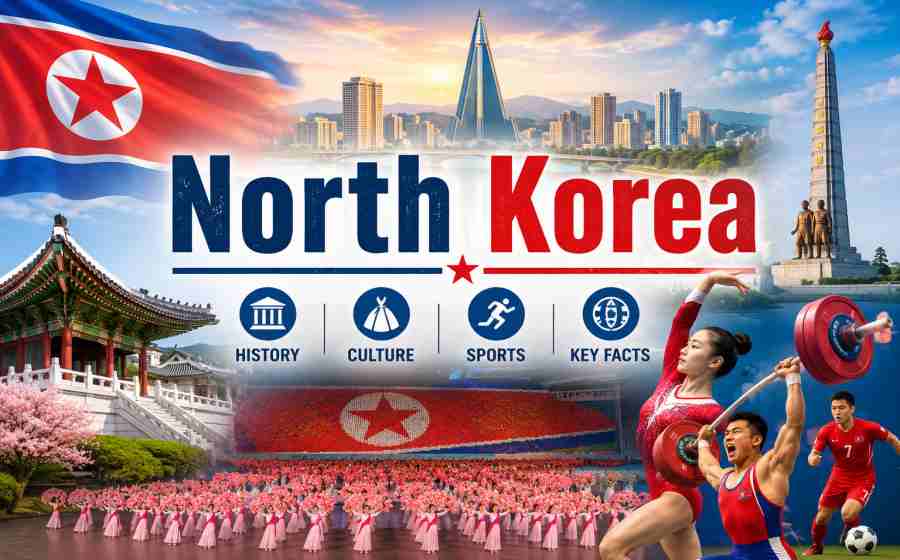
- National flag: Features red, blue, and white colors with a red star.
The population is largely ethnically Korean, making it one of the world’s most ethnically homogeneous countries.
Economy
North Korea operates a centrally planned economy.
Major sectors include:
- Agriculture
- Mining
- Manufacturing
- Heavy industries
- Energy production
Coal, iron ore, magnesite, zinc, and rare minerals are among the country’s important natural resources.
International trade remains limited due to economic sanctions and government policies.
Culture of North Korea
North Korean culture reflects traditional Korean customs combined with state-guided cultural values.
Some important cultural characteristics include:
Traditional Clothing
The traditional Korean dress known as Hanbok is worn during festivals and special occasions.
Music and Dance
Music often includes orchestral performances, patriotic songs, and traditional Korean instruments.
Mass performances involving thousands of participants demonstrate synchronized dance, gymnastics, and artistic displays.
Festivals
Important celebrations include:
- Day of the Sun
- Day of the Shining Star
- Korean New Year
- Harvest Festival (Chuseok)
These occasions feature cultural performances and family gatherings.
Education
Education is compulsory for children in North Korea.
Schools emphasize:
- Mathematics
- Science
- Korean language
- History
- Physical education
Higher education institutions focus on engineering, medicine, agriculture, and technical fields.
Sports in North Korea
Sports play an important role in promoting physical fitness and national pride.
Popular sports include:
- Football (Soccer)
- Table Tennis
- Gymnastics
- Wrestling
- Weightlifting
- Basketball
- Volleyball
North Korean athletes have earned medals in international competitions, particularly in gymnastics, weightlifting, wrestling, boxing, and judo.
Football is among the country’s most popular team sports, with both men’s and women’s national teams participating in international tournaments.
Food of North Korea
North Korean cuisine shares similarities with traditional Korean food.
Popular dishes include:
- Kimchi
- Cold noodles (Naengmyeon)
- Rice
- Soybean soup
- Dumplings
- Grilled fish
- Tofu dishes
Meals often feature vegetables, fermented foods, and seasonal ingredients.
Tourism
Tourism in North Korea is carefully regulated.
Popular attractions include:
- Kim Il Sung Square
- Juche Tower
- Mount Paektu
- Demilitarized Zone (DMZ)
- Arch of Triumph
- Pyongyang Metro
Visitors usually travel through organized tours with official guides.
International Relations
North Korea maintains diplomatic relations with several countries while having limited relations with others. The country’s nuclear program has significantly influenced its international standing and has led to various sanctions imposed by the United Nations and other countries. Despite political challenges, diplomatic discussions occasionally occur regarding peace and regional security.
Interesting Facts About North Korea
- Official name: Democratic People’s Republic of Korea (DPRK).
- Capital city is Pyongyang.
- Mount Paektu is considered the country’s highest and most sacred mountain.
- The Korean Peninsula remains divided since 1945.
- Korean is the official language.
- The country has a highly centralized government.
- Football is one of the most popular sports.
- Coal and mineral resources contribute significantly to the economy.
- Education is compulsory for children.
- Tourism is allowed only under regulated conditions.
Importance of North Korea in World Affairs
Although geographically small, North Korea has considerable global importance because of its strategic location in East Asia, military capabilities, and role in international diplomacy. Relations involving North Korea often influence security discussions among neighboring countries and major world powers. Understanding its political system, history, and culture helps students develop a broader perspective on global affairs and international relations.
Summary
North Korea is a nation with a unique historical journey, distinct political system, rich cultural traditions, and significant geopolitical influence. From its mountainous landscapes and traditional Korean heritage to its achievements in sports and centralized economy, the country remains an important subject in world general knowledge. Learning about North Korea enables students and readers to better understand East Asian history, global politics, and cultural diversity while preparing for competitive examinations and enhancing their knowledge of the world.
Also Check: General Knowledge