
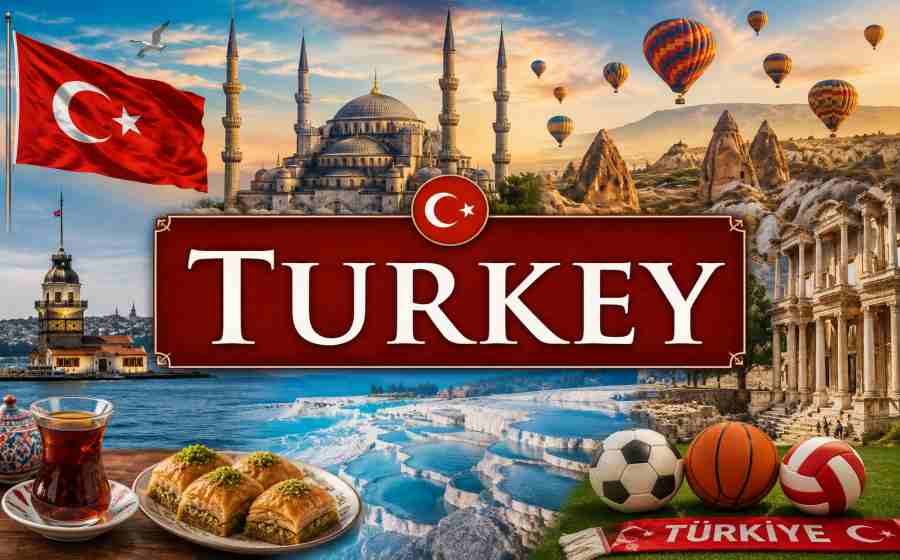
Turkey – History, Culture, Sports, Tourist Places and Fascinating Facts
Explore Turkey’s rich history, vibrant culture, famous sports, geography and key facts that highlight Turkey’s unique heritage and global importance.
Turkey
Turkey is a fascinating country that bridges two continents, Europe and Asia. Known for its rich historical heritage, vibrant culture, breathtaking landscapes, and strategic location, Turkey has played a major role in shaping world civilization. From the mighty Ottoman Empire to modern achievements in sports and tourism, Turkey continues to attract global attention. This article explores Turkey’s history, culture, sports, geography, economy, and other important facts that are useful for general knowledge and competitive examinations.
Table of Contents
Introduction to Turkey
Turkey, officially known as the Republic of Turkey, is located mainly in Western Asia, with a smaller portion in Southeastern Europe. It shares borders with eight countries and is surrounded by the Mediterranean Sea, the Aegean Sea, and the Black Sea.
- Capital: Ankara
- Largest City: Istanbul
- Official Language: Turkish
- Currency: Turkish Lira (TRY)
- Government: Presidential Republic
- Population: Approximately 85 million people
- National Day: Republic Day (29 October)
Turkey’s unique geographical position has made it a crossroads of civilizations, trade routes, and cultural exchanges for thousands of years.
Historical Background of Turkey
Turkey’s history dates back to ancient times. Several great civilizations flourished in this region, including the Hittites, Greeks, Romans, Byzantines, and Seljuks.
Byzantine Empire
The city of Constantinople, now Istanbul, served as the capital of the Byzantine Empire for more than a thousand years. It became one of the world’s most influential centers of Christianity, commerce, and learning.
Ottoman Empire
In 1453, Sultan Mehmed II conquered Constantinople, marking the rise of the Ottoman Empire as a dominant global power. The empire expanded across Europe, Asia, and Africa and lasted for over six centuries.
The Ottomans contributed significantly to architecture, administration, military organization, and arts. Magnificent mosques, palaces, and public buildings constructed during this period remain symbols of Turkey’s rich heritage.
Formation of Modern Turkey
Following the collapse of the Ottoman Empire after World War I, Mustafa Kemal Atatürk led the Turkish War of Independence. In 1923, the Republic of Turkey was established, and Atatürk became its first president.
He introduced major reforms, including:
- Secular governance
- Educational modernization
- Adoption of the Latin alphabet
- Women’s rights initiatives
- Economic development policies
These reforms transformed Turkey into a modern nation-state.
Geography and Climate
Turkey covers an area of approximately 783,000 square kilometers. Because of its diverse landscape, the country experiences varying climatic conditions.
Major geographical features include:
- The Anatolian Plateau
- Taurus Mountains
- Pontic Mountains
- Fertile coastal plains
- Numerous rivers and lakes
Turkey experiences:
- Mediterranean climate along the southern and western coasts,
- Oceanic influences near the Black Sea,
- Continental climate in central regions.
Its strategic location has historically connected Europe and Asia through trade and cultural interactions.
Turkish Culture and Traditions
Turkey’s culture reflects influences from Central Asia, the Middle East, Europe, and the Mediterranean world.
Hospitality
Turkish people are renowned for their warm hospitality. Guests are often welcomed with tea, coffee, and traditional sweets.
Turkish Cuisine
Turkish cuisine is among the most celebrated in the world. Popular dishes include:
- Kebabs
- Baklava
- Döner
- Pide
- Meze platters
- Turkish delight
- Simit
Turkish tea and Turkish coffee are important aspects of social life and cultural identity.
Arts and Music
Traditional Turkish music combines folk melodies with classical influences. Handcrafted carpets, ceramics, calligraphy, and decorative arts demonstrate the country’s artistic excellence.
Festivals
Turkey celebrates both national and religious festivals. Republic Day, Ramadan festivities, and local cultural events strengthen community bonds and preserve traditions.
Sports in Turkey
Sports occupy an important place in Turkish society.
Football
Football is the most popular sport in Turkey. The Turkish national football team has achieved notable success, including reaching the semifinals of the 2002 FIFA World Cup. The country’s domestic football league attracts millions of passionate supporters.
Basketball
Basketball has gained tremendous popularity over recent decades. Turkish clubs regularly compete at high levels in European competitions.
Wrestling
Traditional oil wrestling, known as Yağlı Güreş, is one of Turkey’s oldest sporting traditions. Wrestlers cover themselves in olive oil before competing in physically demanding matches.
Other Popular Sports
- Volleyball
- Athletics
- Weightlifting
- Martial arts
- Swimming
Turkey has hosted several international sporting events, demonstrating its growing influence in global sports.
Economy of Turkey
Turkey possesses a diversified economy supported by several sectors.
Major industries include:
- Manufacturing
- Tourism
- Agriculture
- Construction
- Automotive production
- Textiles
- Electronics
Tourism contributes significantly to the national economy. Millions of visitors travel annually to explore Turkey’s historical sites, beaches, and cultural attractions. Agricultural products such as hazelnuts, figs, apricots, olives, and tea are also important exports.
Famous Tourist Attractions
Turkey is home to numerous world-famous destinations, including:
- Hagia Sophia
- Blue Mosque
- Cappadocia
- Pamukkale
- Topkapi Palace
- Ephesus
- Mount Ararat
These attractions showcase the country’s natural beauty and architectural brilliance.
Interesting Facts About Turkey
- Turkey spans both Europe and Asia.
- Istanbul is the only major city located on two continents.
- Tulips, often associated with the Netherlands, originally became popular through the Ottoman Empire.
- Turkey is one of the world’s largest producers of hazelnuts.
- The ancient city of Troy was located within present-day Turkey.
- Turkish coffee culture has international recognition and historical significance.
- The country hosts some of the world’s oldest continuously practiced sporting traditions.
Summary
Turkey stands as a remarkable nation where ancient history meets modern development. Its strategic location, rich cultural heritage, delicious cuisine, sporting traditions, and economic importance make it one of the most interesting countries in the world. Understanding Turkey’s history, culture, sports, and key facts not only enhances general knowledge but also provides valuable insights for students preparing for competitive examinations.
Whether admired for its Ottoman legacy, vibrant traditions, or stunning landscapes, Turkey continues to captivate people across the globe with its unique identity and enduring influence.
Also Check: General Knowledge