Malawi – History, Culture, Tourism, Sports and Fascinating Key Facts
Explore Malawi through its rich history, vibrant culture, popular sports, geography, economy, wildlife and interesting key facts in this detailed overview.
Malawi
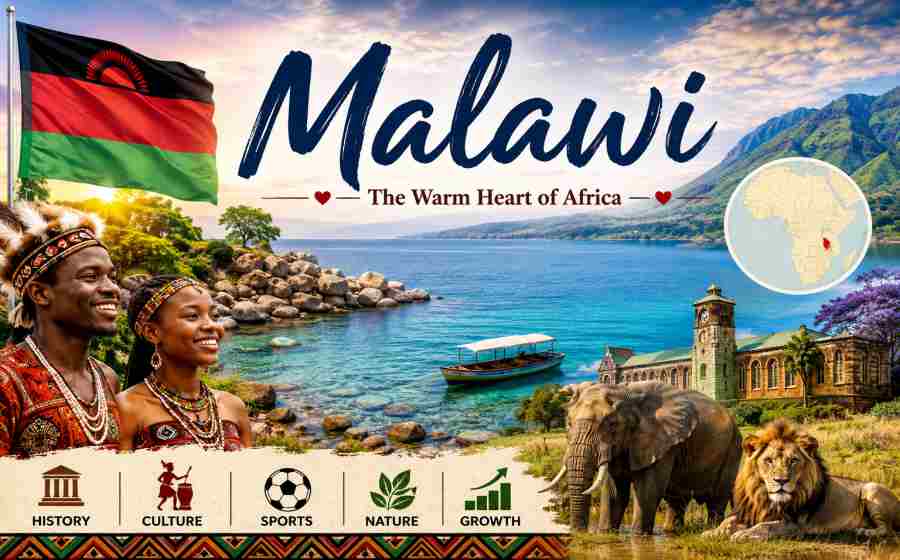
Malawi is a beautiful landlocked country located in southeastern Africa. Known as the “Warm Heart of Africa,” Malawi is famous for its friendly people, breathtaking landscapes, rich cultural heritage, and the magnificent Lake Malawi. Despite being one of Africa’s smaller countries, Malawi has a unique identity shaped by centuries of tradition, colonial history, and remarkable natural beauty.
Today, Malawi continues to develop its economy while preserving its customs and protecting its diverse wildlife. It is an important country for anyone interested in African geography, history, and culture.
Table of Contents
Location and Geography
Malawi shares borders with Tanzania to the north, Mozambique to the east, south, and southwest, and Zambia to the west. The country’s total area is approximately 118,484 square kilometers.
One of Malawi’s most striking geographical features is Lake Malawi, which covers nearly one-fifth of the country’s total area. The lake is among the largest freshwater lakes in Africa and is home to hundreds of unique fish species found nowhere else in the world.
The country experiences a tropical climate with a rainy season from November to April and a dry season during the remaining months.
Capital and Major Cities
The capital city of Malawi is Lilongwe, which serves as the country’s political and administrative center. Other important cities include:
- Blantyre
- Mzuzu
- Zomba
Blantyre is the commercial hub, while Zomba was once the colonial capital and remains an important educational center.
Brief History of Malawi
Human settlement in Malawi dates back thousands of years. The region was originally inhabited by various Bantu-speaking communities who established farming villages and trade networks.
During the 15th and 16th centuries, local kingdoms developed, and trade flourished with neighboring regions. In the 19th century, Scottish missionary David Livingstone visited the area, drawing international attention to the region.
Later, the British established colonial control, and the territory became known as Nyasaland. After years of political movements and demands for self-rule, Malawi gained independence from Britain on 6 July 1964.
Following independence, Hastings Kamuzu Banda became the country’s first president. Since the early 1990s, Malawi has embraced a multi-party democratic system.
Government and Political System
Malawi is a democratic republic with a President serving as both the head of state and the head of government. The country holds regular elections, and its Constitution guarantees fundamental rights and freedoms. The Parliament is responsible for making laws, while the judiciary operates independently to uphold justice.
Population and Languages
Malawi has a population of over 21 million people.
The official language is English, which is widely used in government, education, and business. However, Chichewa is the national language and is spoken by a large majority of the population.
Other local languages include:
- Tumbuka
- Yao
- Lomwe
- Sena
- Tonga
- Ngoni
This linguistic diversity reflects Malawi’s multicultural society.
Culture and Traditions
Malawi’s culture is deeply rooted in community values, hospitality, music, storytelling, and traditional ceremonies.
Families often live in close-knit communities where cooperation and mutual support are highly valued. Traditional dances remain an essential part of celebrations, weddings, harvest festivals, and religious events.
Wood carving, basket weaving, pottery, and textile production are important forms of traditional craftsmanship. Colorful ceremonies showcasing local music and dance attract both domestic and international visitors.
Traditional Food
Malawian cuisine is simple yet nutritious.
Popular dishes include:
- Nsima (maize porridge)
- Grilled fish from Lake Malawi
- Beans
- Sweet potatoes
- Cassava
- Rice
- Groundnut sauces
- Vegetables
- Goat and chicken dishes
Fresh fish plays an important role in the local diet due to the abundance of Lake Malawi.
Economy
Malawi’s economy mainly depends on agriculture.
Major agricultural products include:
- Tobacco
- Tea
- Sugar
- Coffee
- Cotton
- Maize
- Groundnuts
- Soybeans
Agriculture employs a significant portion of the country’s workforce. Tourism, fisheries, and small-scale manufacturing also contribute to economic growth. The government continues to invest in infrastructure, education, and renewable energy to improve living standards.
Wildlife and Natural Attractions
Malawi offers spectacular natural scenery and abundant biodiversity.
Some famous attractions include:
- Lake Malawi
- Nyika Plateau
- Mount Mulanje
- Liwonde National Park
- Kasungu National Park
- Majete Wildlife Reserve
Visitors can enjoy safaris, hiking, birdwatching, boating, snorkeling, and scuba diving.
The country is home to elephants, lions, leopards, zebras, hippos, crocodiles, antelopes, and hundreds of bird species.
Education
Education has expanded significantly since independence. Primary education is free in public schools, while secondary schools and universities continue to grow across the country.
Major institutions focus on science, medicine, agriculture, education, engineering, and business studies. Improving literacy and expanding educational opportunities remain important national priorities.
Sports in Malawi
Football is by far the most popular sport in Malawi. Local leagues attract enthusiastic supporters, and the national football team proudly represents the country in international competitions.
Other popular sports include:
- Netball
- Athletics
- Basketball
- Volleyball
- Cricket
- Boxing
Malawi’s women’s national netball team has achieved notable international recognition and consistently ranks among Africa’s strongest teams.
Tourism
Tourism is becoming an increasingly important sector of Malawi’s economy.
Visitors are attracted by:
- Crystal-clear freshwater beaches
- Wildlife safaris
- Mountain trekking
- Cultural festivals
- Adventure tourism
- Birdwatching
- Friendly local communities
Lake Malawi National Park, a UNESCO World Heritage Site, is particularly popular among international travelers.
Interesting Facts About Malawi
- Malawi is known as the “Warm Heart of Africa.”
- Lake Malawi is one of Africa’s largest freshwater lakes.
- The lake contains hundreds of endemic fish species.
- Malawi gained independence on 6 July 1964.
- Lilongwe is the capital city.
- English and Chichewa are the official languages.
- Agriculture is the backbone of the economy.
- Football is the country’s most popular sport.
- Malawi is famous for its hospitality and welcoming culture.
- The country has rich biodiversity, including national parks and wildlife reserves.
Summary
Malawi is a nation rich in history, culture, and natural beauty. From the stunning waters of Lake Malawi to its vibrant traditions and welcoming people, the country offers a fascinating glimpse into southeastern Africa. Although Malawi continues to face economic challenges, it has made steady progress in education, conservation, and democratic governance. Its unique wildlife, cultural diversity, agricultural heritage, and peaceful communities make Malawi an important country to learn about and an attractive destination for visitors from around the world.
Also Check: General Knowledge