Vikramshila University Ancient Center of Learning – India’s Greatest Centers of Buddhist learning
Discover the history, significance, architecture and legacy of Vikramshila University Ancient Center of Learning for Buddhist and higher education.
Vikramshila University Ancient Center of Learning
Vikramshila University was one of the most prestigious centers of higher learning in ancient India. Established during the Pala Empire, it became a world-renowned institution for Buddhist education, philosophy, and scholarly research. Alongside Nalanda University, Vikramshila played a crucial role in preserving and spreading knowledge across Asia. Students and scholars from India, Tibet, Nepal, China, and other regions traveled long distances to study here, making it an important international university of its time.
Located in present-day Bhagalpur district of Bihar, Vikramshila University symbolizes India’s rich educational heritage. Even though the university was destroyed centuries ago, its influence on Buddhism, education, and intellectual traditions continues to inspire historians, archaeologists and students around the world.
Table of Contents
Foundation of Vikramshila University
Vikramshila University was founded by King Dharmapala of the Pala dynasty during the late 8th century CE. The Pala rulers were great patrons of Buddhism and learning. According to historical records, Dharmapala established Vikramshila to promote advanced Buddhist studies and to complement the already famous Nalanda University.
The king believed that education should not only preserve religious knowledge but also encourage intellectual discussions in philosophy, logic, grammar, medicine, and ethics. As a result, Vikramshila quickly became one of the leading educational institutions of medieval India.
Location
The ancient university is located at Antichak village near Kahalgaon in Bhagalpur district of Bihar. The site lies close to the banks of the Ganga River, making it easily accessible for scholars traveling from different regions.
Today, the archaeological remains of Vikramshila provide valuable insights into the planning and architecture of one of India’s greatest universities.
Why Vikramshila Was Established
Although Nalanda University was already flourishing, King Dharmapala wanted another institution dedicated to maintaining high academic standards in Buddhist education.
The main objectives were:
- Promote advanced Buddhist philosophy.
- Train highly qualified monks and teachers.
- Encourage international scholarly exchange.
- Preserve ancient manuscripts and literature.
- Strengthen the spread of Buddhism across Asia.
These goals helped Vikramshila emerge as a globally respected center of education.
Subjects Taught
Vikramshila University offered a wide variety of subjects. Education was not limited to religion but included many academic disciplines.
Some important subjects included:
- Buddhist Philosophy
- Logic (Nyaya)
- Grammar
- Sanskrit Literature
- Meditation
- Ethics
- Medicine (Ayurveda)
- Astronomy
- Mathematics
- Theology
- Linguistics
Students received both theoretical and practical education, preparing them to become scholars, teachers, translators, and spiritual leaders.
Admission Process
Admission to Vikramshila University was highly competitive. Historical accounts mention that six learned scholars, known as Gate Scholars, were appointed at the entrances of the university. They examined every applicant before granting admission.
Students had to demonstrate exceptional knowledge and intellectual ability. Only the most deserving candidates were allowed to study at Vikramshila, ensuring high academic standards.
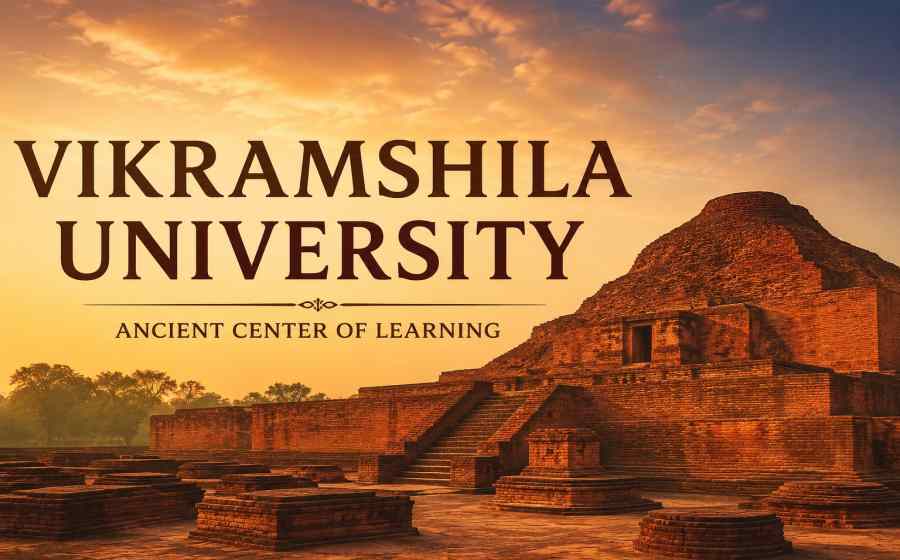
Campus and Architecture
The university campus was carefully planned and beautifully constructed.
Archaeological excavations have revealed:
- A massive central monastery.
- More than 100 residential rooms for monks.
- Six gateways.
- Numerous temples.
- Prayer halls.
- Lecture rooms.
- Meditation centers.
- Libraries.
- Courtyards.
The central stupa formed the heart of the university and was surrounded by educational buildings.
The architecture reflected both artistic excellence and practical design, creating a peaceful environment for learning.
Library and Manuscripts
Vikramshila possessed an extensive library containing valuable Buddhist scriptures and scholarly works.
Manuscripts covered subjects such as:
- Religion
- Philosophy
- Grammar
- Science
- Medicine
- Logic
- Literature
The library served as an important repository of knowledge. Scholars copied manuscripts and translated them into different languages, helping spread Indian knowledge across Asia.
Famous Scholars
Many distinguished scholars taught and studied at Vikramshila. Among the most celebrated was Atisha Dipankara Shrijnana, one of the greatest Buddhist teachers in history.
Atisha later traveled to Tibet, where he played a significant role in reviving Buddhism and establishing educational traditions that continued for centuries.
Other learned monks and teachers from Vikramshila also contributed to Buddhist scholarship in Nepal, Tibet, Sri Lanka, and Southeast Asia.
International Importance
Vikramshila attracted students from many countries.
Foreign scholars came from:
- Tibet
- Nepal
- Bhutan
- China
- Sri Lanka
- Southeast Asian kingdoms
The university became a center for cultural exchange, where ideas, languages, religious teachings, and scientific knowledge were shared across national boundaries.
This international reputation placed Vikramshila among the world’s earliest global universities.
Contribution to Buddhism
Vikramshila became one of the most influential centers for Vajrayana Buddhism.
Its contributions included:
- Training Buddhist monks.
- Producing respected scholars.
- Translating sacred texts.
- Preserving Buddhist philosophy.
- Sending missionaries abroad.
- Strengthening Buddhist education in Tibet.
Many Tibetan monasteries were directly influenced by teachers trained at Vikramshila.
Decline and Destruction
Like several ancient Indian universities, Vikramshila eventually faced destruction. Around the early 13th century CE, the university was attacked during the invasions led by Bakhtiyar Khilji. Buildings were burned, libraries were destroyed, and countless manuscripts were lost forever.
The destruction marked the end of one of India’s greatest educational institutions and dealt a severe blow to Buddhist scholarship in the region.
Archaeological Discoveries
Excavations conducted by the Archaeological Survey of India uncovered important remains of Vikramshila University.
These include:
- Monastery foundations
- Brick temples
- Stone sculptures
- Terracotta plaques
- Prayer halls
- Stupa remains
- Residential complexes
These discoveries have helped historians reconstruct the layout and functioning of the university.
Legacy of Vikramshila University
Although the original university no longer exists, its legacy continues to inspire educators and historians. Vikramshila demonstrated that ancient India possessed highly organized institutions dedicated to advanced learning and international scholarship.
Its educational principles emphasized:
- Academic excellence
- Open intellectual discussion
- International collaboration
- Preservation of knowledge
- Ethical education
These values remain relevant even in modern universities.
Interesting Facts About Vikramshila University
- Founded in the late 8th century CE by King Dharmapala.
- Located in present-day Bhagalpur district of Bihar.
- One of the largest Buddhist universities of ancient India.
- Admission was based on rigorous entrance examinations.
- Famous scholar Atisha Dipankara studied and taught here.
- Specialized in Vajrayana Buddhism.
- Attracted students from across Asia.
- Destroyed during the early 13th century.
- Archaeological remains still exist today.
- Considered one of ancient India’s greatest educational achievements.
Importance in Modern Times
Vikramshila University remains an important symbol of India’s educational history. It reminds us that universities in ancient India were centers of innovation, cultural exchange, and intellectual growth long before the rise of many modern institutions elsewhere in the world.
Today, scholars continue to study its contributions to Buddhism, philosophy, architecture, and education. The archaeological site also attracts tourists, researchers, and students interested in India’s rich heritage. Efforts to preserve and promote Vikramshila’s legacy help future generations appreciate the country’s long tradition of higher learning.
Summary
Vikramshila University was far more than a Buddhist monastery—it was a world-class center of knowledge that shaped intellectual and spiritual traditions across Asia. Founded by King Dharmapala, it stood as a beacon of academic excellence, attracting brilliant scholars and students from distant lands. Its rigorous education system, remarkable architecture, and lasting influence on Buddhist philosophy made it one of the finest universities of the ancient world. Although it was destroyed centuries ago, the legacy of Vikramshila continues to highlight India’s glorious educational past and its enduring contribution to global knowledge.
Also Check: Bihar GK