
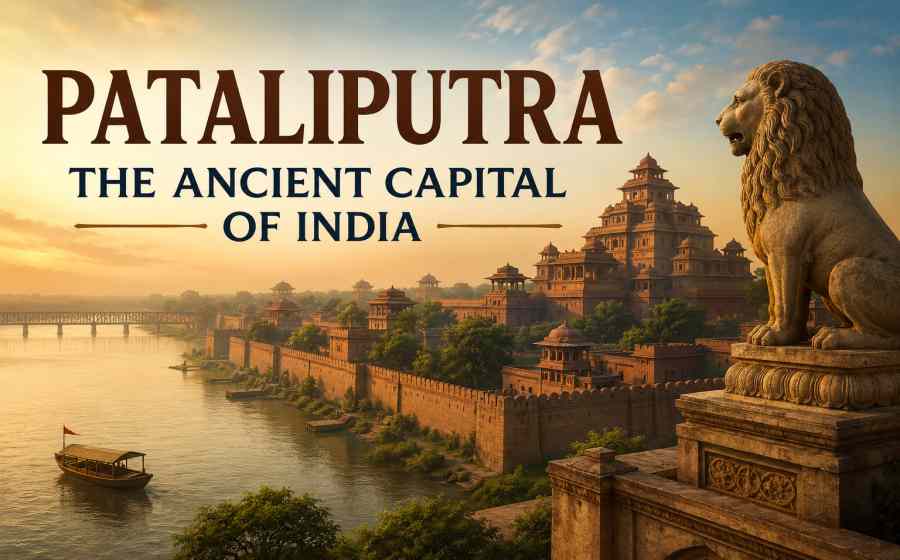
Pataliputra The Ancient Capital of India – The Glory of Magadha Empire
Discover the history of Pataliputra the ancient capital of India. Learn about its rise under the Magadha Empire, famous rulers, culture and lasting legacy.
Pataliputra The Ancient Capital of India
Pataliputra was one of the greatest cities of the ancient world and served as the capital of some of India’s most powerful empires. Located on the banks of the Ganga River in present-day Patna, Bihar, Pataliputra played a central role in shaping India’s political, cultural, economic, and intellectual history. It was the capital of the Magadha Kingdom and later became the seat of the Maurya and Gupta Empires, which are often regarded as India’s golden periods.
For many centuries, Pataliputra was not only a political center but also a hub of trade, education, administration, and diplomacy. Great rulers such as Chandragupta Maurya, Emperor Ashoka, and Samudragupta ruled from this magnificent city. Foreign travelers like Megasthenes and the Chinese monk Faxian described Pataliputra as one of the largest and most prosperous cities in the world. Today, the remains of ancient Pataliputra continue to remind us of India’s glorious past and Bihar’s significant contribution to world civilization.
Table of Contents
Origin of Pataliputra
The history of Pataliputra dates back to the 5th century BCE. It was originally founded by King Ajatashatru of the Haryanka dynasty as a military fort near the confluence of the Ganga and Son rivers. Later, King Udayin shifted the capital of Magadha from Rajagriha (modern Rajgir) to Pataliputra because of its strategic location.
The city’s geographical position made it ideal for defense, agriculture, and trade. Rivers served as natural barriers while also connecting the city with different parts of India.
Capital of the Magadha Empire
Pataliputra became the capital of the Magadha Kingdom, one of the sixteen Mahajanapadas of ancient India. Under rulers such as Bimbisara, Ajatashatru, and later the Nanda dynasty, Magadha expanded rapidly.
Its fertile plains, abundant natural resources, and strong military allowed Magadha to emerge as the dominant kingdom in northern India. Pataliputra became the administrative center from where rulers managed their vast territories.
Pataliputra Under the Maurya Empire
The greatest period in the history of Pataliputra came during the Maurya Empire (321–185 BCE). Chandragupta Maurya established the first large empire covering most of the Indian subcontinent and made Pataliputra its capital.
His advisor, Chanakya (Kautilya), played a major role in strengthening the administration and economy. The famous political treatise Arthashastra reflects the advanced administrative system of the Mauryan period.
The city reached its peak during the reign of Emperor Ashoka. After the Kalinga War, Ashoka embraced Buddhism and promoted peace, non-violence, and social welfare. From Pataliputra, he sent Buddhist missionaries to Sri Lanka, Central Asia, and Southeast Asia, spreading Indian culture across the world.
Description by Megasthenes
The Greek ambassador Megasthenes visited the court of Chandragupta Maurya and wrote a book called Indica. Although the original work has been lost, later writers preserved many of its descriptions.
According to Megasthenes:
- Pataliputra was one of the largest cities in the world.
- The city was surrounded by massive wooden walls and deep moats.
- It had numerous gates and watchtowers for security.
- Roads were well-planned and administration was highly organized.
- The city had bustling markets, gardens, and royal palaces.
These accounts indicate that Pataliputra was far ahead of many contemporary cities in terms of planning and governance.
Pataliputra During the Gupta Empire
Pataliputra continued to flourish under the Gupta Empire (4th–6th century CE), often called the Golden Age of India.
During this period:
- Science and mathematics made remarkable progress.
- Sanskrit literature reached new heights.
- Art and architecture flourished.
- Trade and commerce expanded.
- Education and scholarship received royal support.
Renowned scholars like Aryabhata were associated with this era. The city remained an important center of administration and intellectual activity.
Economic Importance
Pataliputra became one of the richest cities in ancient India due to its strategic location.
Major economic activities included:
- Agriculture supported by fertile river plains.
- Trade through river routes.
- Handicrafts and metalwork.
- Textile production.
- Trade in spices, precious stones, ivory, and timber.
Merchants from different regions visited the city, making it an important commercial hub.
Cultural and Religious Significance
Pataliputra was home to multiple religions and traditions. Hinduism, Buddhism, and Jainism flourished here. Emperor Ashoka organized the Third Buddhist Council in Pataliputra, which helped preserve Buddhist teachings and spread them internationally.
The city welcomed scholars, monks, philosophers, and travelers from across Asia, making it a vibrant center of learning and cultural exchange.
Administration and Urban Planning
Ancient Pataliputra was known for its efficient governance.
Some remarkable features included:
- Planned streets and residential areas.
- Effective drainage systems.
- Strong city fortifications.
- Organized taxation.
- Public welfare measures.
- Efficient law and order.
The Mauryan administration divided responsibilities among various departments, ensuring smooth governance of the empire.
Decline of Pataliputra
After the Gupta period, Pataliputra gradually declined due to several reasons:
- Repeated invasions.
- Political instability.
- Floods caused by nearby rivers.
- Shift of political power to other regions.
- Decline in long-distance trade.
Although the city’s political importance decreased, its historical significance remained immense.
Archaeological Discoveries
Excavations in modern Patna have uncovered valuable remains of ancient Pataliputra.
Important discoveries include:
- Wooden palisades.
- Pillared halls.
- Mauryan structures.
- Pottery and coins.
- Sculptures.
- Ancient inscriptions.
Sites such as Kumhrar provide evidence of the city’s advanced architecture and urban planning.
Pataliputra and Modern Patna
Modern Patna, the capital of Bihar, stands on the site of ancient Pataliputra. While today’s city has evolved into a modern urban center, traces of its ancient heritage remain visible.
Museums, archaeological sites, and historical monuments continue to preserve the memory of one of the greatest capitals in Indian history. Visitors from across India and the world come to Patna to explore its rich historical legacy.
Interesting Facts About Pataliputra
- Pataliputra served as the capital of several major Indian empires.
- It was among the largest cities in the ancient world.
- Emperor Ashoka ruled much of the Indian subcontinent from here.
- Greek ambassador Megasthenes praised its administration and planning.
- The Third Buddhist Council was held in Pataliputra.
- Modern Patna is built on the site of ancient Pataliputra.
- The city played a key role in spreading Buddhism across Asia.
- Archaeological remains continue to reveal its glorious past.
Summary
Pataliputra was far more than just an ancient capital; it was the political heart of India for several centuries and a symbol of power, knowledge, culture, and progress. From the rise of the Magadha Kingdom to the achievements of the Maurya and Gupta Empires, the city witnessed some of the most significant events in Indian history. Its advanced administration, thriving economy, cultural diversity, and contribution to Buddhism made it one of the greatest cities of the ancient world. Even today, the legacy of Pataliputra lives on through modern Patna, inspiring historians, students, and travelers alike.
Also Check: Bihar GK