Azerbaijan – Culture, History, Sports, Tourist Attractions and Fascinating Key Facts
Discover Azerbaijan’s history, culture, sports, geography, economy, traditions and key facts. Learn why Azerbaijan is known as the Land of Fire.
Azerbaijan
Azerbaijan is a beautiful country located at the crossroads of Eastern Europe and Western Asia. Known as the “Land of Fire,” Azerbaijan is famous for its ancient fire temples, rich cultural heritage, modern cities, and breathtaking landscapes. The country has a unique blend of Eastern and Western traditions, making it one of the most culturally diverse nations in the Caucasus region.
Its capital city, Baku, is a modern metropolis situated on the western coast of the Caspian Sea. Azerbaijan has gained international recognition for its oil and natural gas resources, historical monuments, traditional music, and sporting events. Today, the country continues to develop rapidly while preserving its centuries-old traditions.
Table of Contents
Location and Geography
Azerbaijan is located in the South Caucasus region. It shares borders with:
- Russia (north)
- Georgia (northwest)
- Armenia (west)
- Iran (south)
It also has a coastline along the Caspian Sea, the world’s largest inland body of water.
The country covers approximately 86,600 square kilometers and has diverse landscapes including mountains, forests, plains, rivers, and semi-deserts. The Greater Caucasus Mountains in the north provide stunning scenery and attract tourists throughout the year.
Brief History
The history of Azerbaijan dates back thousands of years. Ancient civilizations flourished in this region because it served as an important route connecting Europe and Asia.
Ancient Period
The territory was inhabited by early tribes and later became part of several empires, including the Persian Empire. Due to natural gas escaping from underground, eternal flames fascinated ancient people, leading to the development of fire worship.
Medieval Era
During the medieval period, Azerbaijan became an important center for trade, science, literature, and Islamic culture. The Silk Road passed through the region, bringing merchants and travelers from many countries.
Russian Rule
In the early 19th century, Azerbaijan became part of the Russian Empire after several wars between Persia and Russia.
Soviet Period
After a brief period of independence in 1918, Azerbaijan became one of the republics of the Soviet Union in 1920.
Independence
Azerbaijan regained its independence in 1991 after the collapse of the Soviet Union. Since then, the country has focused on economic development, infrastructure, and international cooperation.
Government and Economy
Azerbaijan is a presidential republic.
The country’s economy is largely based on:
- Oil production
- Natural gas exports
- Agriculture
- Tourism
- Manufacturing
- Transportation
The discovery of vast oil reserves transformed Azerbaijan into one of the leading energy producers in the region. Baku has long been known as one of the world’s historic oil-producing cities.
In recent years, Azerbaijan has also invested in renewable energy, technology, and tourism to diversify its economy.
People and Language
The population of Azerbaijan is over 10 million people.
Official Language
The official language is Azerbaijani (Azeri).
Russian and English are also spoken in many urban areas, especially among younger generations and in business sectors.
Most Azerbaijanis belong to the Turkic ethnic group.
Religion
Islam is the largest religion in Azerbaijan, with the majority of the population following Shia Islam, while a significant minority follows Sunni Islam. The country is known for religious tolerance, where mosques, churches, and synagogues coexist peacefully.
Culture of Azerbaijan
Azerbaijan has a vibrant culture influenced by Persian, Turkish, Russian, and Caucasian traditions.
Music
Traditional Azerbaijani music includes:
- Mugham
- Folk songs
- Ashiq performances
Mugham is recognized by UNESCO as an important cultural heritage.
Dance
Traditional dances are colorful and energetic. Performers wear beautifully embroidered costumes during festivals and celebrations.
Literature
Azerbaijan has produced many famous poets and writers. Classical poetry remains an important part of the nation’s cultural identity.
Traditional Food
Azerbaijani cuisine is rich in flavor and variety. Popular dishes include:
- Plov (rice dish)
- Dolma
- Kebab
- Dushbara (small dumpling soup)
- Piti
- Lavangi
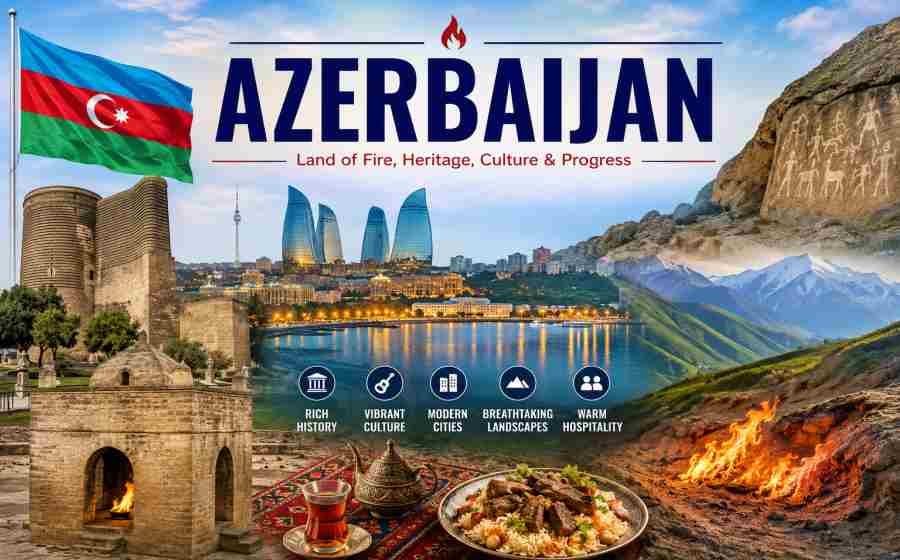
Tea is an important part of Azerbaijani hospitality and is often served with sweets and jam.
Festivals
Some major festivals celebrated in Azerbaijan include:
Novruz
The most important festival marking the arrival of spring. Families gather, prepare traditional foods, and celebrate new beginnings.
Republic Day
Celebrated annually to commemorate the establishment of the first democratic republic in 1918.
Independence Day
Marks Azerbaijan’s independence after the dissolution of the Soviet Union.
Sports in Azerbaijan
Sports play an important role in Azerbaijani society.
Popular sports include:
Wrestling
Wrestling is one of the country’s strongest sports and has produced many Olympic medalists.
Judo
Azerbaijan has achieved remarkable success in international judo competitions.
Boxing
The country regularly participates in major boxing championships.
Chess
Chess enjoys widespread popularity, and Azerbaijani players have achieved international recognition.
Football
Football is the most watched team sport. Domestic leagues continue to grow, and the national team competes in international tournaments.
Formula One
Since 2016, Baku has hosted a Formula One Grand Prix, attracting fans from around the world.
Tourist Attractions
Azerbaijan offers many attractions for visitors.
Baku Old City
A UNESCO World Heritage Site featuring narrow streets, historic buildings, and ancient architecture.
Flame Towers
These modern skyscrapers symbolize Azerbaijan’s nickname, “Land of Fire.”
Gobustan National Park
Famous for prehistoric rock carvings and mud volcanoes.
Ateshgah Fire Temple
An ancient fire temple where natural gas flames once burned continuously.
Yanar Dag
Known as the “Burning Mountain,” where natural flames emerge from the hillside due to underground gas.
Sheki
A historic town known for its beautiful palace, traditional crafts, and mountain scenery.
Education
Education is highly valued in Azerbaijan.
The country has:
- Public and private schools
- Universities
- Technical institutions
- Research centers
The government has invested in improving educational quality and international cooperation.
Wildlife
Azerbaijan has diverse ecosystems supporting many species of animals.
Wildlife includes:
- Brown bears
- Wolves
- Lynx
- Wild goats
- Eagles
- Flamingos
Protected national parks help conserve biodiversity.
Climate
The climate varies across the country.
- Coastal regions experience mild winters.
- Mountain areas receive heavy snowfall.
- Central plains have hot summers.
Interestingly, Azerbaijan is home to several different climate zones despite its relatively small size.
Economy and Energy
Oil and natural gas remain the backbone of Azerbaijan’s economy.
Major industries include:
- Petroleum
- Chemicals
- Agriculture
- Construction
- Tourism
- Transportation
The country also serves as an important energy corridor connecting Central Asia and Europe.
Interesting Facts About Azerbaijan
- Azerbaijan is called the Land of Fire because of its natural gas flames.
- Baku is the world’s lowest-lying national capital, situated below sea level.
- The Caspian Sea, bordering Azerbaijan, is the largest enclosed inland water body on Earth.
- Azerbaijan was among the first countries to develop a commercial oil industry.
- Gobustan contains thousands of ancient rock carvings dating back thousands of years.
- Mud volcanoes are more numerous in Azerbaijan than in almost any other country.
- Azerbaijani carpets are world-famous for their craftsmanship and artistic designs.
- Tea is traditionally served in pear-shaped glasses known as armudu.
- The country bridges both Europe and Asia, making it culturally unique.
- Hospitality is considered one of the most respected traditions in Azerbaijani society.
Summary
Azerbaijan is a nation where ancient history blends seamlessly with modern development. From the eternal flames of Yanar Dag and the UNESCO-listed Old City of Baku to its rich traditions, delicious cuisine, and achievements in sports, the country offers a fascinating mix of heritage and progress. Its strategic location between Europe and Asia has shaped a unique identity that continues to attract visitors, scholars, and investors alike. Whether exploring its historical landmarks, enjoying its vibrant culture, or learning about its remarkable natural resources, Azerbaijan stands out as one of the most intriguing countries in the Caucasus region.
Also Check: General Knowledge