Jagadish Chandra Bose Biography – Life, Inventions and Contributions to Science
Explore Jagadish Chandra Bose Biography covering his life, inventions, wireless communication and contributions to plant science and modern research.
Jagadish Chandra Bose Biography
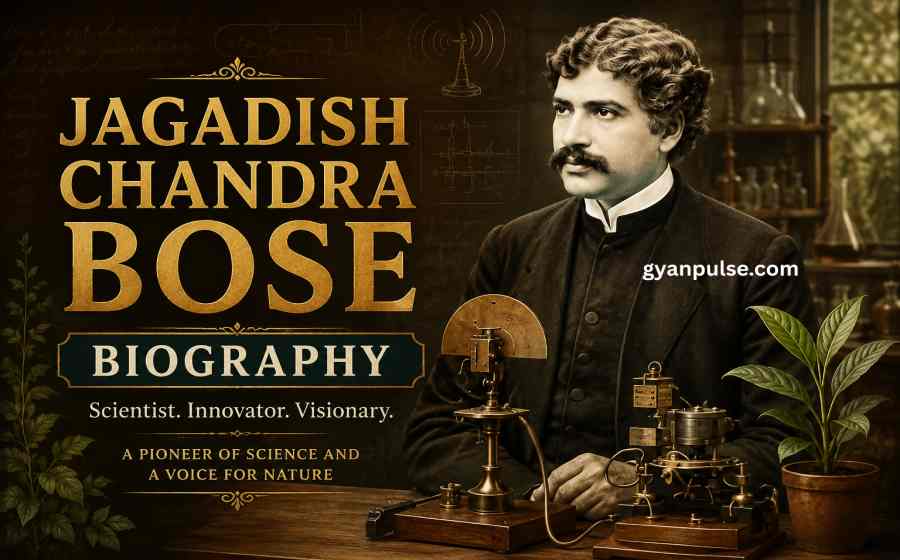
Jagadish Chandra Bose, one of India’s most brilliant scientists, was a physicist, biologist, botanist, and an early inventor in radio technology. A true polymath, Bose not only contributed immensely to science but also fought against colonial biases to prove India’s intellectual strength on the global stage. His groundbreaking research in plant life and wireless signals paved the way for many important scientific discoveries in the future.
Table of Contents
Early Life and Education
Jagadish Chandra Bose was born on 30 November 1858 in Mymensingh, Bengal Presidency (present-day Bangladesh). His father, Bhagawan Chandra Bose, was a deputy magistrate and a strong advocate for education in the vernacular language. From a young age, Jagadish was taught in Bengali, which helped him stay rooted in Indian culture.
He later attended St. Xavier’s College, Calcutta, and then went to England to study at Christ’s College, Cambridge. There, he came under the guidance of some of the most brilliant scientific thinkers of that era. Despite facing racial discrimination, Bose persevered and completed his studies in Natural Sciences.
Scientific Career and Inventions
After returning to India, Bose joined Presidency College in Calcutta as a professor of physics. Despite being paid far less than his British colleagues, Bose continued his research and teaching with unmatched dedication.
Pioneer of Wireless Communication
Before Guglielmo Marconi became known as the father of radio, Bose had already demonstrated wireless communication in 1895 – two years earlier than Marconi’s first public demonstration. He used electromagnetic waves to ring a bell and ignite gunpowder remotely. However, Bose did not commercialize his work, believing science should be pursued for knowledge, not profit.
Revolutionary Work in Plant Physiology
Bose was also the first to prove that plants are living organisms that respond to stimuli like pain and stress. Using an instrument he invented called the Crescograph, he measured plant responses to various stimuli, showing that plants “feel” and “react.”
This groundbreaking work laid the foundation for biophysics and plant neurobiology, fields that were virtually nonexistent during his time.
Achievements and Honors
- Knighted by the British government in 1917
- Fellow of the Royal Society (FRS), one of the first Indian scientists to receive this honor
- Founded the Bose Institute in 1917 in Calcutta, which remains a premier research institute to this day
Legacy
Jagadish Chandra Bose’s contributions spanned multiple scientific fields. His work in radio science, biology, and material science continues to inspire scientists worldwide. His refusal to patent his inventions and his belief in scientific pursuit for the benefit of humanity makes him not only a scientist but a true humanitarian.
Many historians believe Bose did not receive the global recognition he deserved due to colonial politics and his own humility in not seeking credit or wealth for his discoveries. Jagadish Chandra Bose died on 23 November 1937 in Giridih, Bihar, leaving a lasting legacy of innovation and scientific excellence.
Enduring Impact on Modern Science
Jagadish Chandra Bose’s work continues to influence modern scientific thought across multiple disciplines. His early experiments in wireless communication laid a conceptual foundation for future innovations in radio and telecommunication, while his pioneering research in plant physiology reshaped how scientists understand plant behavior. Beyond his discoveries, Bose’s commitment to knowledge over profit and his resilience against discrimination highlight a legacy rooted in integrity, curiosity, and service to humanity.
Interesting Facts About Jagadish Chandra Bose
- Bose used homemade instruments built from scrap for his experiments.
- He wrote science fiction in Bengali, making him one of India’s earliest science fiction writers.
- Despite colonial prejudice, he never let racial discrimination prevent him from teaching or experimenting.
Summary
Jagadish Chandra Bose was more than just a scientist, he was a visionary who bridged the gap between ancient Indian wisdom and modern science. His interdisciplinary approach, passion for truth, and commitment to education continue to inspire generations.
His story serves as a reminder that great minds often come from humble beginnings, and that true science serves humanity, not ego.
Also Check: Biography