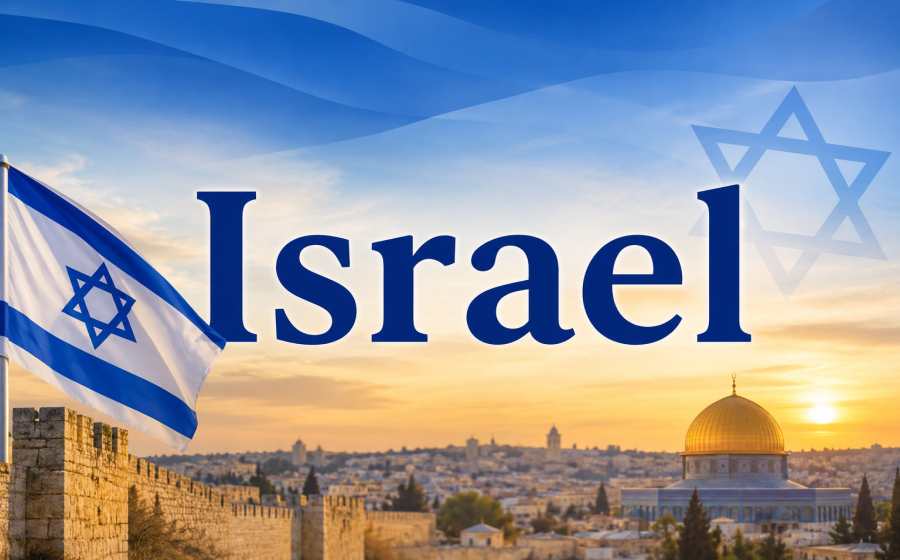
Israel – History, Culture, Tourism, Sports and Fascinating Key Facts
Learn about Israel, its history, culture, geography, sports, economy, traditions, important places and key facts of this Middle Eastern country.
Israel
Israel is a country in the Middle East, located on the eastern shore of the Mediterranean Sea. It is known for its ancient history, religious significance, diverse population, technological development, distinctive culture, and important archaeological sites. Despite its relatively small geographical size, Israel has played a significant role in the history and politics of the Middle East and has connections with several major world religions.
The country combines ancient traditions with modern cities, advanced industries, agricultural innovation, and a vibrant cultural scene. Jerusalem, Tel Aviv, Haifa, and other cities reflect different aspects of Israeli society and history. Israel is also home to places of major importance to Judaism, Christianity, and Islam.
Table of Contents
History of Israel
The history of the land associated with modern Israel extends back thousands of years. Ancient kingdoms, including the Kingdoms of Israel and Judah, existed in the region during the biblical period. The area later came under the control of several major powers, including the Assyrian, Babylonian, Persian, Greek, and Roman empires.
During the Roman period, the region experienced major political and religious changes. Jerusalem was an important center of Jewish life, while the wider area became increasingly connected to the Roman Empire. After the Roman period, the land was governed by various powers, including the Byzantine Empire, Islamic caliphates, Crusader states, and the Ottoman Empire.
In the late 19th and early 20th centuries, modern political movements and increasing Jewish migration contributed to significant demographic and political changes in the region. After the end of the British Mandate for Palestine, the State of Israel declared independence on 14 May 1948.
The establishment of Israel was followed by war with neighboring Arab states. The decades that followed included further wars, political agreements, conflicts, migration, and major changes in the region. The Israeli-Palestinian conflict remains one of the most important and contested political issues in the contemporary Middle East.
Geography of Israel
Israel is situated in the eastern Mediterranean region. It has a varied landscape that includes coastal plains, mountains, valleys, desert areas, and the Jordan Rift Valley.
The Mediterranean Sea lies to the west, while the country shares borders with Lebanon, Syria, Jordan, and Egypt. Israel also has access to the Red Sea through the Gulf of Aqaba at its southern tip.
One of the country’s most distinctive geographical features is the Dead Sea, famous for its extremely high salt concentration and its location at one of the lowest land elevations on Earth. The Negev Desert covers a large part of southern Israel and has played an important role in the country’s agricultural and technological development.
Jerusalem is the country’s internationally recognized capital according to Israeli law and is one of the world’s most historically and religiously significant cities. Tel Aviv is a major economic, cultural, and technological center.
Culture and Traditions
Israeli culture is shaped by a mixture of Jewish traditions, Middle Eastern influences, Mediterranean lifestyles, and cultural traditions brought by communities from many parts of the world.
Hebrew is the country’s main official language, while Arabic has a special status and is widely spoken among Arab citizens. English is also commonly understood, particularly in tourism, business, education, and technology.
Jewish holidays such as Passover, Rosh Hashanah, Yom Kippur, and Hanukkah are important parts of cultural life. Different Jewish communities have also contributed their own customs, foods, music, and traditions.
Israeli cuisine reflects the country’s diverse population. Popular foods and dishes include falafel, hummus, shakshuka, sabich, fresh salads, and various breads and pastries. Food culture is particularly important in family gatherings and social life.
Music, cinema, literature, dance, and visual arts are also important elements of Israeli cultural expression. The country has produced writers, filmmakers, musicians, scientists, and artists who have gained international recognition.
Sports in Israel
Sports are popular throughout Israel, with football and basketball among the country’s most followed sports.
Football has a strong fan base, and Israel has a national football team that competes in international competitions. Several Israeli clubs have also participated in European football tournaments.
Basketball has a particularly strong tradition in the country. Israeli clubs have competed successfully in European competitions, with Maccabi Tel Aviv being one of the country’s best-known basketball teams.
Other popular sports include tennis, swimming, gymnastics, athletics, judo, cycling, and sailing. Israeli athletes have won medals at the Olympic Games, with judo becoming especially notable for the country’s Olympic success.
Economy and Technology
Israel has developed a highly diversified economy and is particularly well known for technology and innovation. The country has a strong presence in fields such as cybersecurity, software, medical technology, agriculture, telecommunications, defense technology, and artificial intelligence.
The technology sector has earned Israel the nickname “Start-Up Nation”, reflecting its large number of technology companies and startups relative to its population.
Agriculture is another area where Israel has gained international attention. Technologies such as drip irrigation, water recycling, greenhouse farming, and desert agriculture have helped farmers improve productivity in areas with limited water resources.
The country also has important industries in tourism, pharmaceuticals, manufacturing, finance, and diamond processing.
Famous Places in Israel
Israel contains many historical, religious, and natural attractions.
Jerusalem
Jerusalem is one of the world’s most significant religious cities. The Western Wall, Temple Mount, and Church of the Holy Sepulchre are among its best-known sites.
Dead Sea
The Dead Sea attracts visitors because of its mineral-rich waters and unusual geographical setting. Its high salinity makes it possible for people to float easily on the surface.
Masada
Masada is an ancient fortress located on a plateau overlooking the Dead Sea. It is an important archaeological and historical site.
Tel Aviv
Tel Aviv is known for its beaches, modern architecture, nightlife, arts, restaurants, and technology industry. Its White City is particularly famous for its collection of Bauhaus-influenced buildings.
Haifa
Haifa is a major port city located on the Mediterranean coast. It is known for the Baháʼí World Centre and its terraced gardens, as well as Mount Carmel.
Education and Innovation
Israel has a strong education and research system. Universities and research institutions contribute to scientific and technological development in areas including medicine, engineering, computer science, agriculture, and environmental studies.
Research and innovation have played an important role in the country’s economic development. Cooperation between universities, research centers, entrepreneurs, and private companies has helped create a dynamic technology ecosystem.
Important National Symbols
The flag of Israel features a blue Star of David between two horizontal blue stripes on a white background. The Star of David is one of the most recognizable symbols associated with Judaism and Jewish identity.
The national anthem is “Hatikvah,” meaning “The Hope.” It expresses the historic aspiration of the Jewish people for a homeland.
The currency of Israel is the Israeli new shekel (NIS).
Quick Facts About Israel
- Official Name: State of Israel
- Capital: Jerusalem
- Largest City: Jerusalem
- Major Economic Center: Tel Aviv
- Region: Middle East
- Continent: Asia
- Independence: 14 May 1948
- Currency: Israeli new shekel
- Main Official Language: Hebrew
- Arabic: Has special status and is widely spoken
- Major Sea: Mediterranean Sea
- Famous Natural Feature: Dead Sea
- Major Desert: Negev Desert
- Popular Sports: Football, basketball, judo, tennis and athletics
- National Anthem: Hatikvah
- National Flag Symbol: Star of David
- Major Religions Associated With the Region: Judaism, Christianity and Islam
Summary
Israel is a country where ancient history and modern innovation exist side by side. From the historic streets of Jerusalem and archaeological remains at Masada to the beaches of Tel Aviv and the technological centers of the country’s modern economy, Israel presents a remarkable combination of heritage and contemporary development.
Its history is deeply connected with major events in the Middle East, while its culture reflects traditions from Jewish communities and the many populations that have shaped the region. Its achievements in technology, agriculture, science, and sports have also given it an important place on the global stage. Understanding Israel therefore provides valuable insight into the history, geography, culture, and modern development of the Middle East.
Also Check: General Knowledge