Desertification – Causes, Effects and Sustainable Solutions for a Drying Planet
Desertification causes land degradation, water scarcity, biodiversity loss and food insecurity. Learn causes, effects and solutions for a sustainable future.
Desertification
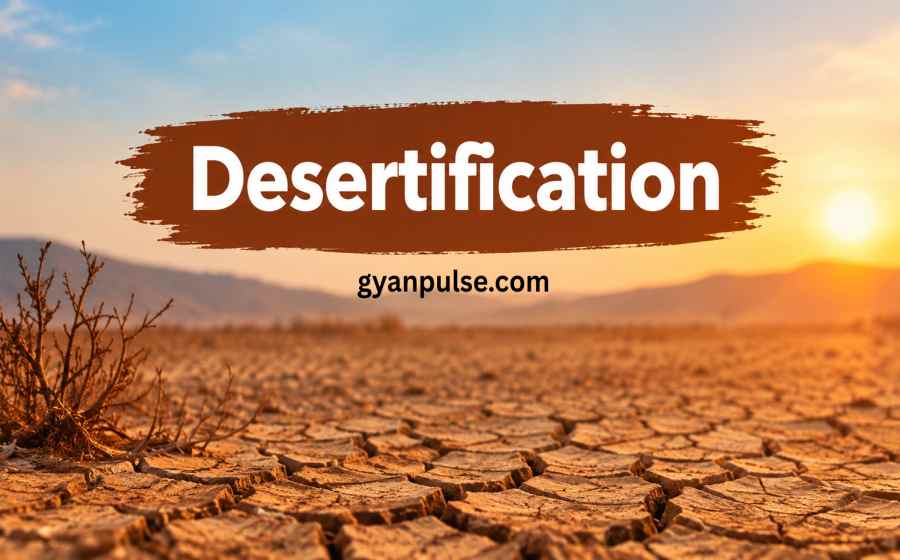
Desertification is one of the most pressing environmental challenges facing the world today. It refers to the process by which fertile land gradually transforms into desert, typically due to a combination of natural factors and human activities. This phenomenon is not limited to traditionally arid regions; it can occur in semi-arid and even sub-humid areas, affecting millions of people globally.
As populations grow and climate conditions shift, desertification is accelerating, threatening food security, biodiversity, and livelihoods. Understanding its causes and effects is crucial for developing effective strategies to combat it.
Table of Contents
What is Desertification?
Desertification is the degradation of land in dryland areas caused primarily by human activities and climatic variations. It results in the loss of vegetation, soil fertility, and water retention capacity, making the land unsuitable for agriculture and habitation.
Contrary to popular belief, desertification does not mean deserts are expanding. Instead, it is the degradation of previously productive land into desert-like conditions.
Causes of Desertification
It is driven by a mix of natural and human-induced factors. These causes often interact, intensifying the process over time.
1. Climate Change
Climate change plays a major role in desertification. Rising global temperatures lead to increased evaporation, reducing soil moisture. Changes in rainfall patterns, including prolonged droughts, further accelerate land degradation.
In many regions, unpredictable weather makes it difficult for vegetation to survive, leaving the soil exposed and vulnerable.
2. Deforestation
Trees and plants play a critical role in maintaining soil structure and moisture. When forests are cleared for agriculture, urban development, or fuel, the protective cover of vegetation is lost.
Without this cover, soil becomes prone to erosion by wind and water, a key step in desertification.
3. Overgrazing
Livestock grazing is essential for many communities, but excessive grazing can strip land of vegetation. When plants do not have enough time to recover, the soil becomes exposed and compacted.
This reduces its ability to absorb water, leading to further degradation.
4. Unsustainable Agricultural Practices
Poor farming methods, such as over-cultivation, improper irrigation, and excessive use of chemicals, can degrade soil quality. Over time, nutrients are depleted, and the soil structure weakens.
Irrigation without proper drainage can also lead to salinization, making the land infertile.
5. Urbanization and Land Misuse
Rapid urban expansion often leads to the conversion of agricultural land into infrastructure. Construction activities disturb the soil and reduce green cover.
Improper land management and lack of planning further contribute to degradation.
Effects of Desertification
The consequences of desertification are far-reaching, affecting the environment, economy, and society.
1. Loss of Agricultural Productivity
One of the most immediate effects is the decline in crop yields. As soil fertility decreases, farmers struggle to grow enough food.
This can lead to food shortages, increased prices, and hunger, especially in developing regions.
2. Water Scarcity
Degraded land loses its ability to retain water. Rivers, lakes, and groundwater sources begin to dry up.
Communities dependent on these water sources face severe shortages, impacting daily life and agriculture.
3. Biodiversity Loss
It destroys habitats, leading to the decline of plant and animal species. Many organisms cannot survive in degraded conditions.
This loss of biodiversity disrupts ecosystems and reduces their resilience to environmental changes.
4. Increased Poverty and Migration
As land becomes unproductive, people lose their livelihoods, particularly in farming and pastoral communities. This often forces migration to urban areas or other regions.
Such migration can lead to overcrowding, unemployment, and social tensions.
5. Contribution to Climate Change
Desertification and climate change are closely linked. Degraded land releases stored carbon into the atmosphere, contributing to global warming.
At the same time, the loss of vegetation reduces the planet’s ability to absorb carbon dioxide.
Solutions to Combat Desertification
While desertification is a serious issue, it is not irreversible. With proper strategies, degraded land can be restored.
1. Sustainable Land Management
Practices such as crop rotation, conservation tillage, and organic farming help maintain soil health. These methods improve fertility and reduce erosion.
2. Afforestation and Reforestation
Planting trees and restoring forests can stabilize soil, improve water retention and support biodiversity.
3. Efficient Water Management
Techniques like rainwater harvesting, drip irrigation, and proper drainage systems can conserve water and prevent soil salinity.
4. Controlled Grazing
Managing livestock movement and limiting grazing intensity allows vegetation to recover and maintain soil integrity.
5. Policy and Community Involvement
Government policies and local participation are essential for long-term success. Educating communities about sustainable practices can create lasting change.
Importance of Combating Desertification
Combating deserti-fication is essential for protecting fertile land, maintaining food production, conserving water resources, and preserving biodiversity. Restoring degraded land can also improve the livelihoods of farming and pastoral communities while reducing pressure on natural ecosystems. Through sustainable agriculture, responsible land use, vegetation restoration, efficient water management, and community participation, societies can help prevent further land degradation and build a more resilient environment.
Summary
It is a complex environmental issue with significant global implications. It threatens food security, water availability, and biodiversity while contributing to climate change.
However, with collective effort, sustainable practices and strong policies, it is possible to combat land degradation and restore affected areas. Addressing it is not just an environmental necessity, it is essential for ensuring a sustainable future for generations to come.
Also Check: Environment