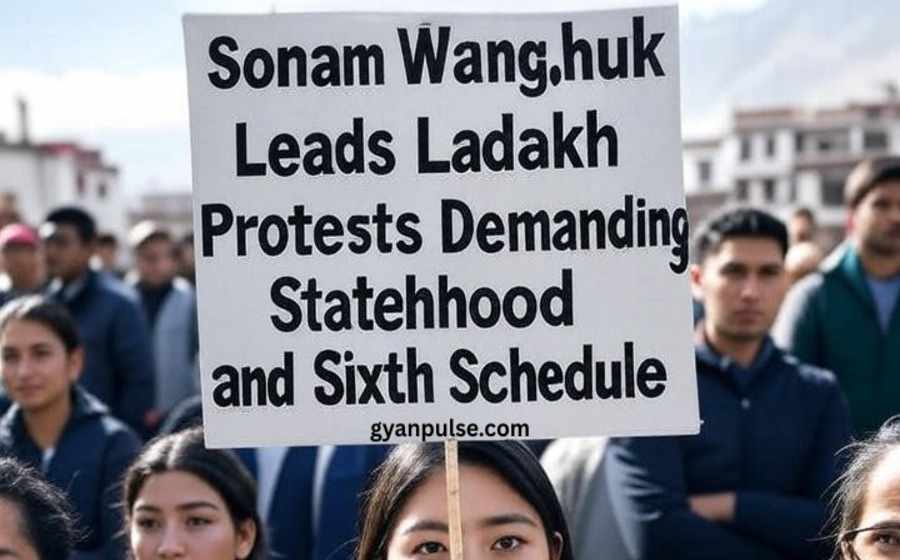
Sonam Wangchuk Leads Ladakh Protests Demanding Statehood and Sixth Schedule
Sonam Wangchuk Leads Ladakh Protests as the region demands statehood, Sixth Schedule inclusion and stronger protection of tribal rights.
Sonam Wangchuk Leads Ladakh Protests
In September 2025, Ladakh witnessed massive protests reflecting growing public anger. Demonstrators in Leh set fire to a Bharatiya Janata Party (BJP) office, prompting police to use teargas to control the situation. The clashes turned violent, leaving four people dead and nearly 30 injured. In response, the Leh Apex Body (LAB) announced a complete shutdown across the region.
Meanwhile, renowned climate activist Sonam Wangchuk ended his 15-day hunger strike, appealing to people to continue their struggle through peaceful means. These protests highlight Ladakh’s long-standing demands for statehood, inclusion under the Sixth Schedule, and stronger constitutional safeguards to protect the region’s unique identity and resources.
Table of Contents
Ladakh’s Political Background and Status
In 2019, the Government of India revoked Article 370, ending Jammu and Kashmir’s special status. Through the Jammu and Kashmir Reorganisation Act, the state was divided into two Union Territories. Jammu and Kashmir kept its own legislature, but Ladakh was made a Union Territory without one.
Since then, Ladakh has been under direct central rule, which has caused political dissatisfaction. Many residents feel excluded from decision-making and are demanding greater control over their local governance.
Call for Sixth Schedule Safeguards in Ladakh
More than 90% of Ladakh’s population belongs to Scheduled Tribes, and the people are demanding inclusion under the Sixth Schedule of the Indian Constitution. This provision allows the creation of Autonomous District Councils (ADCs) in tribal regions, giving them powers over land, forests, water, agriculture, health, and even policing.
At present, six states in Northeast India have such councils. Ladakh’s demand for the Sixth Schedule is centered on gaining similar autonomy to safeguard its tribal identity, resources, and cultural heritage.
Sonam Wangchuk’s Role in Ladakh Protests
Sonam Wangchuk, an engineer and innovator from Ladakh, famously inspired a character in the film 3 Idiots. He received the Ramon Magsaysay Award in 2018 for his work in educational reforms in the region.
Wangchuk has been a strong advocate for Ladakh’s inclusion under the Sixth Schedule, petitioning the Union Tribal Affairs Ministry in 2019.
While the ministry acknowledged his proposal, no concrete action was taken. He continues to promote decentralisation to protect local communities from exploitation by industrial interests.
Ladakh: History of Protests and Movements
Protests in Ladakh have been ongoing since 2019, with student-led movements gaining strength with backing from local leaders. Organizations like the Leh Apex Body (LAB) and Kargil Democratic Alliance (KDA) emerged to represent the region’s interests.
In early 2024, Sonam Wangchuk and other activists began a hunger strike, demanding dialogue and protections for the local population. A planned march toward the China border was called off due to restrictions. These movements reflect long-standing concerns over land rights, industrial projects, and border security in Ladakh.
Ladakh’s Current Demands and Political Agenda
The Leh Apex Body (LAB) is pushing for statehood for Ladakh and inclusion under the Sixth Schedule. Their demands also include faster recruitment for government jobs, the establishment of a public service commission, and separate Lok Sabha seats for Leh and Kargil.
The movement highlights growing frustration over reduced autonomy and missed economic opportunities since 2019, emphasizing the urgent need for political recognition and self-governance in the region.
Growing Demand for Autonomy and Constitutional Protection
The Ladakh protests led by Sonam Wangchuk represent a significant movement focused on political recognition, regional autonomy, and constitutional safeguards. Citizens across the region have raised concerns over governance, tribal rights, and the protection of local resources after Ladakh became a Union Territory without a legislature. The demand for inclusion under the Sixth Schedule and statehood reflects a broader effort to preserve Ladakh’s cultural identity, ensure greater participation in decision-making, and secure long-term protection for the interests of local communities.
Summary
The Ladakh protests under Sonam Wangchuk’s leadership have brought attention to the region’s demands for statehood, Sixth Schedule inclusion, and stronger constitutional protections. The movement reflects concerns about local governance, tribal rights, and preserving Ladakh’s cultural and environmental identity while seeking greater political representation and autonomy.
Also Check: Current Affairs