Circular Economy – Concept and Importance toward Sustainable Growth
Learn about the circular economy, its concept, principles and importance in building a sustainable future by reducing waste and maximizing resources.
Circular Economy
In today’s fast-growing world, the traditional “take-make-dispose” model of production and consumption is putting immense pressure on natural resources and the environment. This linear system leads to excessive waste, pollution, and resource depletion. To address these challenges, the concept of a circular economy has emerged as a sustainable alternative that focuses on reducing waste, reusing materials, and regenerating natural systems.
Table of Contents
What is a Circular Economy?
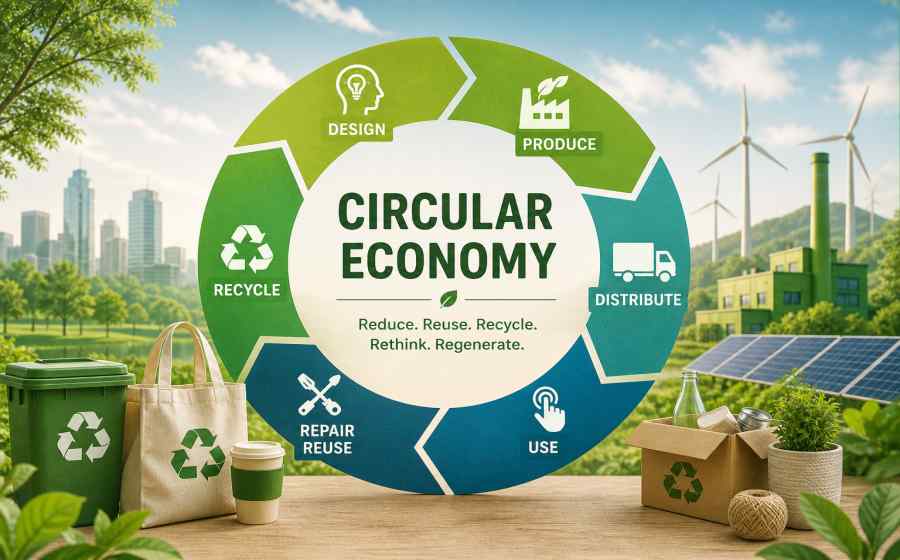
A circular economy is an economic system aimed at eliminating waste and the continual use of resources. Unlike the linear model, where products are made, used, and discarded, the circular economy promotes a closed-loop system. In this system, products, materials, and resources are kept in use for as long as possible through recycling, repairing, refurbishing, and reusing.
The idea is simple yet powerful: instead of throwing things away, we find ways to bring them back into the cycle. This approach not only reduces environmental damage but also creates economic and social benefits.
Key Principles of Circular Economy
The circular economy is built on three core principles:
- Design Out Waste and Pollution
Products are designed in a way that minimizes waste and environmental harm. This includes using eco-friendly materials and reducing unnecessary packaging. - Keep Products and Materials in Use
Items are reused, repaired, and recycled to extend their lifecycle. For example, old electronics can be refurbished instead of being discarded. - Regenerate Natural Systems
The circular economy supports natural processes by returning valuable nutrients to the environment, such as composting organic waste to enrich soil.
How Circular Economy Works
In a circular system, products are designed with durability and recyclability in mind. After their initial use, they are collected and processed to create new products. For instance, plastic bottles can be recycled into new containers, clothing, or even construction materials.
Industries are also adopting innovative business models like product leasing, sharing platforms, and take-back schemes. For example, companies may offer rental services instead of selling products, ensuring that items are returned, reused, and maintained efficiently.
Importance of Circular Economy
The circular economy plays a crucial role in addressing global environmental and economic challenges. Its importance can be understood through the following points:
1. Reduces Waste Generation
One of the biggest advantages of a circular economy is the significant reduction in waste. By reusing and recycling materials, less waste ends up in landfills and oceans.
2. Conserves Natural Resources
The Earth’s resources are limited. A circular approach ensures that resources are used efficiently and preserved for future generations.
3. Protects the Environment
Reducing waste and pollution leads to cleaner air, water, and soil. It also helps in combating climate change by lowering greenhouse gas emissions.
4. Promotes Economic Growth
This economy creates new business opportunities, jobs, and industries. Recycling, repair, and remanufacturing sectors are rapidly growing and contributing to economic development.
5. Encourages Innovation
Businesses are encouraged to develop sustainable products and processes. This leads to technological advancements and more efficient production methods.
6. Supports Sustainable Development
This economy aligns with global sustainability goals by promoting responsible consumption and production patterns.
Real Life Examples
Many companies and countries are already adopting circular practices. For instance, some fashion brands are using recycled fabrics to create new clothing lines. Tech companies are designing devices that can be easily repaired or upgraded. Even individuals contribute by reusing items, composting waste and supporting eco-friendly products.
Challenges of Circular Economy
Despite its benefits, implementing this economy is not without challenges:
- Lack of awareness among consumers and businesses
- High initial costs for redesigning products and systems
- Limited recycling infrastructure in many regions
- Resistance to change from traditional practices
However, with proper policies, education and innovation, these challenges can be overcome.
Future of this Economy
The future of this economy looks promising as governments, organizations, and individuals increasingly recognize its importance. Policies promoting recycling, sustainable production, and waste management are being introduced worldwide. Technological advancements are also making it easier to track, reuse, and recycle materials.
As awareness grows, the shift from a linear to a circular model will become more widespread, helping to create a more sustainable and resilient global economy.
Summary
This economy is not just an environmental concept, it is a practical solution for a sustainable future. By reducing waste, conserving resources, and promoting innovation, it offers a balanced approach to economic growth and environmental protection. Embracing this model requires collective efforts from individuals, businesses, and governments. If implemented effectively, this economy can transform the way we produce and consume, ensuring a healthier planet for generations to come.
Also Check: Environment