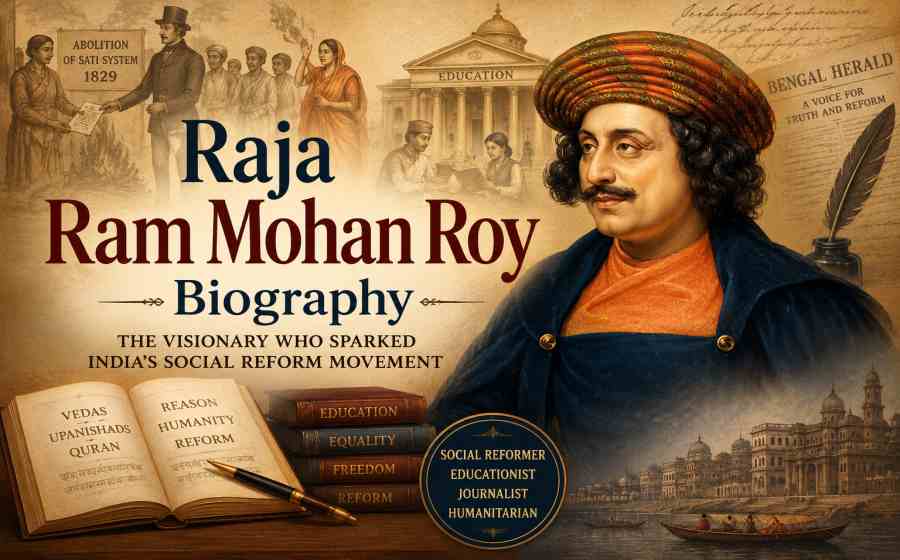
Raja Ram Mohan Roy Biography – The Visionary Who Sparked India’s Social Reform Movement
Read Raja Ram Mohan Roy Biography and discover his life, reforms, achievements and inspiring contribution to modern Indian society and education.
Raja Ram Mohan Roy Biography
Raja Ram Mohan Roy was one of the greatest social reformers in Indian history. He is often called the “Father of Modern India” because of his efforts to transform Indian society through education, rational thinking, and social reforms. During a period when many harmful traditions and social inequalities existed, Raja Ram Mohan Roy worked fearlessly to challenge outdated practices and promote a progressive society.
His contribution to Indian society was not limited to social reforms alone. He also played an important role in education, journalism, religious reform, and women’s rights. His ideas influenced later reformers and helped shape modern India.
Table of Contents
Early Life and Education
Raja Ram Mohan Roy was born on 22 May 1772 in Radhanagar village in Bengal, India. He belonged to a respected and educated family. His father was Ramakanta Roy, while his mother was Tarini Devi.
From a young age, Raja Ram Mohan Roy showed a strong interest in learning. He studied different subjects and languages including Sanskrit, Persian, Arabic, Bengali, and later English. His knowledge of multiple languages allowed him to study religious texts and understand different cultures and beliefs.
His education played a major role in shaping his thoughts. He read Hindu scriptures, Islamic teachings, and Western philosophy, which helped him develop a broad understanding of religion and society.
His Views on Society
During Raja Ram Mohan Roy’s time, Indian society faced many social problems. Several traditions negatively affected people’s lives, especially women. Raja Ram Mohan Roy strongly believed that society should progress through reason and education rather than blind customs.
He supported the idea that religion should focus on morality and humanity instead of rituals and superstition. He encouraged people to think logically and question practices that harmed society.
Fight Against Sati System
One of Raja Ram Mohan Roy’s most important contributions was his campaign against the Sati system. Sati was a practice in which a widow was forced or expected to sacrifice her life on her husband’s funeral pyre.
Raja Ram Mohan Roy strongly opposed this inhuman practice. He argued that no religious scripture truly supported such cruelty. He wrote articles, gave speeches, and raised awareness among people.
His efforts eventually influenced the British government, and in 1829 the Sati system was officially banned in India. This was a historic achievement that saved countless lives and marked a significant step toward women’s rights.
Contribution to Education
Raja Ram Mohan Roy believed education was the key to social development. He supported modern education that included science, mathematics, and practical subjects.
He encouraged the introduction of English education because he believed it would help Indians gain knowledge of modern ideas and scientific thinking.
He also helped establish educational institutions and promoted learning opportunities for young people. His vision of education influenced future educational reforms in India.
Founder of Brahmo Samaj
In 1828, Raja Ram Mohan Roy founded the Brahmo Samaj.
The organization aimed to promote monotheism and remove social evils from society. Brahmo Samaj opposed idol worship, caste discrimination, and meaningless rituals. It encouraged people to focus on moral values and spiritual understanding.
The movement later became an important force for social and religious reforms in India.
Contribution to Journalism
Raja Ram Mohan Roy also played a significant role in journalism. He believed that newspapers could spread awareness and educate society.
He started and supported several publications in different languages. Through his writings, he discussed social issues and encouraged freedom of expression.
His work in journalism helped create public awareness and opened discussions about important social reforms.
Final Years and Death
In 1831, Raja Ram Mohan Roy traveled to England to represent Indian interests and discuss important matters with British authorities.
While in England, he continued promoting his ideas and working for social progress. Unfortunately, he passed away on 27 September 1833 in Bristol, England.
Although his life ended far from India, his contributions continued to inspire generations.
Legacy of Raja Ram Mohan Roy
Raja Ram Mohan Roy’s legacy remains strong even today. He challenged harmful traditions and encouraged education, equality, and rational thinking. His courage and determination made him a pioneer of social reform in India.
Many later reformers and leaders drew inspiration from his ideas. Modern India still benefits from the foundations he helped create.
His life teaches us that one individual with knowledge, courage, and determination can bring positive change to society.
5 Inspirations from Raja Ram Mohan Roy
- Education is one of the strongest tools for social change.
- Question harmful traditions and support truth.
- Stand for equality and justice for everyone.
- Courage can create positive transformation in society.
- Knowledge and wisdom can shape a better future.
Summary
Raja Ram Mohan Roy was much more than a social reformer. He was a visionary who worked for a better and more educated society. Through his fight against social evils, support for education, and efforts for women’s rights, he transformed Indian society and became one of India’s greatest historical figures. His contributions continue to inspire people to stand against injustice and work for progress.
Also Check: Biography