Serbia – History, Culture, Tourism, Sports, Geography and Fascinating Key Facts
Discover Serbia with its rich history, vibrant culture, famous sports, geography, traditions, economy and fascinating facts in one place.
Serbia
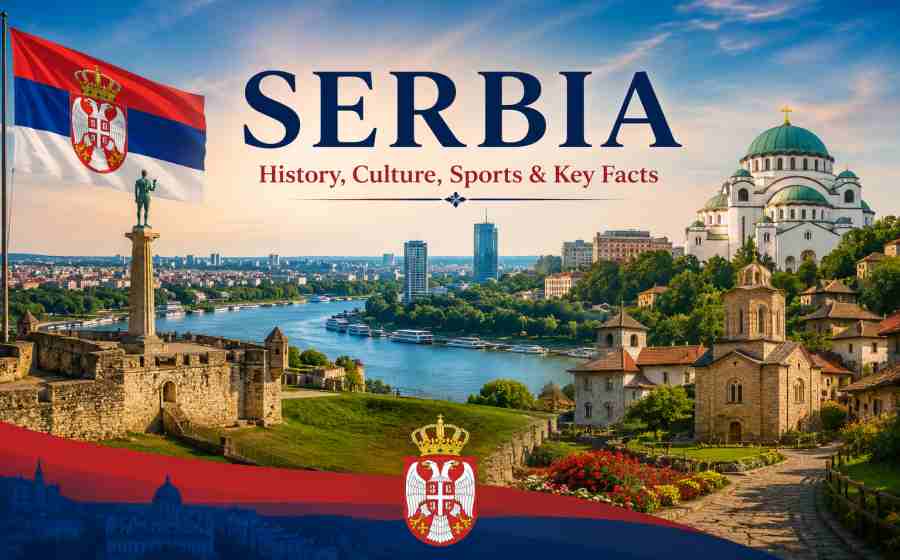
Serbia is a beautiful country located in Southeast Europe, at the crossroads of Central and the Balkan regions. Known for its rich history, vibrant traditions, medieval monasteries, delicious cuisine, and passionate sports culture, Serbia has played an important role in European history for centuries. Although it is a landlocked nation, Serbia attracts millions of visitors with its historic cities, scenic mountains, lively festivals, and warm hospitality.
The capital city, Belgrade, is one of the oldest continuously inhabited cities in Europe and serves as the country’s political, cultural, and economic center. Today, Serbia is a modern nation with a growing economy while preserving its deep-rooted cultural heritage.
Table of Contents
Geography of Serbia
Serbia covers an area of approximately 88,361 square kilometers, making it one of the medium-sized countries in Europe. It shares borders with Hungary, Romania, Bulgaria, North Macedonia, Croatia, Bosnia and Herzegovina, and Montenegro.
The country’s landscape is highly diverse. Northern Serbia consists mainly of fertile plains belonging to the Pannonian Basin, while central and southern Serbia are dominated by hills, valleys, rivers, and mountain ranges.
The Danube River, Europe’s second-longest river, flows through Serbia and plays a significant role in transportation, tourism, and agriculture.
Major Cities
- Belgrade (Capital)
- Novi Sad
- Niš
- Kragujevac
- Subotica
History of Serbia
Serbia has a history stretching back thousands of years. Ancient civilizations once inhabited the region before it became part of the Roman Empire.
During the Middle Ages, Serbia emerged as a powerful kingdom. The Serbian Empire reached its greatest extent under Stefan Dušan in the 14th century.
One of the most significant historical events was the Battle of Kosovo in 1389, which became a defining symbol of Serbian identity despite ending in Ottoman dominance.
For nearly five centuries, much of Serbia remained under Ottoman rule. During the 19th century, Serbian uprisings gradually restored independence. In 1878, Serbia gained international recognition as an independent state.
After World War I, Serbia became a key part of the Kingdom of Yugoslavia. Following World War II, it formed one of the republics of socialist Yugoslavia under Josip Broz Tito.
The breakup of Yugoslavia during the 1990s brought political instability and conflict. Since then, Serbia has focused on democratic reforms, economic development, and stronger international relations.
Culture of Serbia
Serbian culture reflects influences from both Eastern and Western civilizations. Religion, literature, music, and family traditions remain central to Serbian life.
The majority of the population follows Eastern Orthodox Christianity, and many centuries-old monasteries continue to serve as important religious and cultural landmarks.
Family gatherings, hospitality, and respect for elders are highly valued. Traditional customs are celebrated during religious festivals, weddings, and national holidays.
Language
The official language is Serbian, written in both the Cyrillic and Latin alphabets.
Traditional Clothing
Traditional Serbian costumes vary by region but often feature embroidered garments, colorful belts, woolen vests, and decorative headwear.
Serbian Cuisine
Serbian food is famous for its rich flavors and generous portions. Influences from Turkish, Hungarian, Austrian, and Mediterranean cuisines can be found across the country.
Popular dishes include:
- Ćevapi (grilled minced meat)
- Sarma (cabbage rolls)
- Pljeskavica (Serbian-style burger)
- Gibanica (cheese pastry)
- Ajvar (red pepper spread)
- Burek (filled pastry)
Fresh bread, dairy products, grilled meats, and seasonal vegetables are common parts of everyday meals.
Festivals and Celebrations
Serbia hosts numerous cultural festivals throughout the year.
Some of the most popular include:
- EXIT Music Festival in Novi Sad
- Guča Trumpet Festival
- Belgrade Beer Fest
- International Film Festival (FEST)
One unique Serbian tradition is Slava, a family celebration honoring a household’s patron saint. This custom is recognized as part of UNESCO’s Intangible Cultural Heritage.
Sports in Serbia
Sports are an essential part of Serbian national identity. Despite its relatively small population, Serbia has produced world-class athletes across multiple sports.
Tennis
Serbia gained global recognition in tennis through Novak Djokovic, one of the greatest tennis players in history. His achievements have inspired generations of young athletes.
Basketball
Basketball enjoys immense popularity. Serbia consistently ranks among the strongest basketball nations, producing many successful NBA and European League players.
Football
Football is the country’s most followed sport. Serbian clubs regularly compete in European competitions, while the national team has qualified for several FIFA World Cups.
Other Popular Sports
- Volleyball
- Water Polo
- Athletics
- Handball
- Wrestling
Serbia has won numerous Olympic, World Championship, and European Championship medals across these disciplines.
Economy
Serbia has a mixed economy based on manufacturing, agriculture, mining, information technology, and services.
Major industries include:
- Automobile manufacturing
- Information Technology
- Agriculture
- Food processing
- Energy
- Mining
The country exports machinery, agricultural products, electronics, and automotive components.
In recent years, Serbia has become an attractive destination for foreign investment due to its strategic location and skilled workforce.
Education
Education in Serbia is compulsory for children and follows European educational standards.
The country has several respected universities, including:
- University of Belgrade
- University of Novi Sad
- University of Niš
Higher education institutions attract both domestic and international students.
Tourism in Serbia
Tourism has steadily grown over the past decade.
Popular attractions include:
- Belgrade Fortress
- Kalemegdan Park
- Đerdap National Park
- Tara National Park
- Studenica Monastery
- Uvac Canyon
- Zlatibor Mountain
- Novi Sad’s Petrovaradin Fortress
Visitors also enjoy Serbia’s spas, skiing destinations, river cruises, and vibrant nightlife.
Government
Serbia is a parliamentary republic.
- Capital: Belgrade
- Official Language: Serbian
- Currency: Serbian Dinar (RSD)
- Time Zone: Central European Time (CET)
The President serves as the head of state, while the Prime Minister leads the government.
Interesting Facts About Serbia
- Belgrade is among Europe’s oldest continuously inhabited cities.
- The Danube River flows nearly 600 kilometers through Serbia.
- Serbia is famous for its medieval Orthodox monasteries.
- The world’s largest raspberry exporter has often included Serbia among the leading producers.
- Nikola Tesla was born in the region that was then part of the Austrian Empire, and Serbia proudly celebrates his scientific legacy.
- Serbia has numerous natural caves, mountains, and national parks.
- Coffee culture is an important part of everyday Serbian social life.
- The traditional family celebration “Slava” is unique to Serbian Orthodox culture.
- Serbian athletes have won medals in multiple Olympic sports.
- The country serves as a cultural bridge between Central and Southeast Europe.
Summary
Serbia is a nation where ancient history meets modern development. From its medieval kingdoms and historic landmarks to its lively festivals, delicious cuisine, and remarkable sporting achievements, Serbia offers a unique blend of tradition and progress. Its strategic location, cultural diversity, and welcoming people make it an important country in the Balkans and an increasingly attractive destination for travelers, students, and investors alike. Whether exploring Belgrade’s vibrant streets, admiring centuries-old monasteries, or cheering for world-class Serbian athletes, visitors gain a deeper appreciation for the country’s rich heritage and dynamic future.
Also Check: General Knowledge