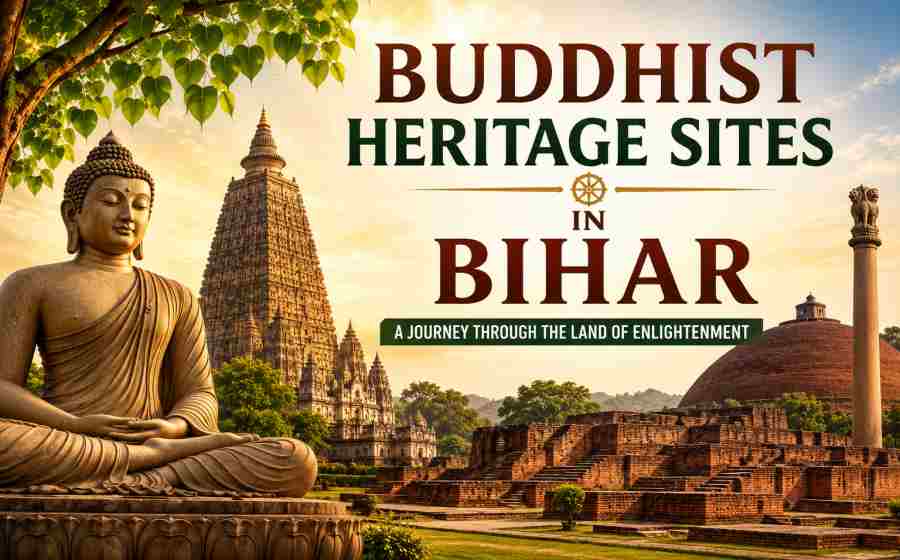
Buddhist Heritage Sites in Bihar – Sacred Land of Buddhism, Bodh Gaya and Nalanda
Explore the Buddhist Heritage Sites in Bihar including Bodh Gaya, Nalanda, Rajgir, Vaishali and Kesaria. Learn their history, importance and key facts.
Buddhist Heritage Sites in Bihar
Bihar holds a unique and respected place in the history of Buddhism. It is often called the birthplace of Buddhist enlightenment because it was here that Prince Siddhartha attained enlightenment and became Gautama Buddha. Many important events of Buddha’s life took place in Bihar, making it one of the most sacred destinations for Buddhists across the world.
Every year, thousands of pilgrims, historians, researchers, and tourists visit Bihar to explore its ancient monasteries, temples, stupas, and archaeological remains. These sites not only represent India’s rich cultural heritage but also spread the timeless message of peace, wisdom, and compassion taught by Lord Buddha.
Table of Contents
Why Bihar is Important in Buddhism
Bihar is closely associated with the life and teachings of Gautama Buddha. Several significant milestones of Buddhism occurred in this region:
- Buddha attained enlightenment at Bodh Gaya.
- He spent many years preaching in Rajgir and nearby regions.
- The first Buddhist Council was held in Rajgir.
- Nalanda became one of the world’s greatest centers of Buddhist learning.
- Vaishali was frequently visited by Buddha and played an important role in the spread of Buddhism.
Because of these historical events, Bihar is considered one of the holiest regions for Buddhists worldwide.
List of Buddhist Heritage Sites
1. Bodh Gaya
Bodh Gaya, located in Gaya district, is the most sacred Buddhist site in the world. It was here, under the famous Bodhi Tree, that Prince Siddhartha attained enlightenment after deep meditation and became the Buddha around the 6th century BCE.
The main attraction is the Mahabodhi Temple, an architectural masterpiece built near the place of enlightenment. The temple is recognized as a UNESCO World Heritage Site and attracts pilgrims from countries such as Sri Lanka, Thailand, Japan, China, Myanmar, Bhutan, and Nepal.
Important attractions include:
- Mahabodhi Temple
- Bodhi Tree
- Vajrasana (Diamond Throne)
- Great Buddha Statue
- International Buddhist monasteries
Bodh Gaya remains the spiritual center of global Buddhism.
2. Nalanda Mahavihara
Nalanda, situated near Rajgir, was one of the world’s earliest and greatest residential universities. Established during the Gupta period, it became a renowned center for Buddhist education and attracted scholars from across Asia.
Thousands of monks and students studied subjects such as:
- Buddhist philosophy
- Logic
- Medicine
- Astronomy
- Mathematics
- Literature
The Chinese scholar Xuanzang studied here for several years and described Nalanda’s greatness in his travel accounts.
Today, visitors can explore:
- Ancient monastery ruins
- Lecture halls
- Libraries
- Temples
- Sculptures
- Nalanda Archaeological Museum
The ruins of Nalanda are also recognized as a UNESCO World Heritage Site.
3. Rajgir
Rajgir, the ancient capital of the Magadha kingdom, is one of the most important Buddhist pilgrimage destinations.
Lord Buddha spent several years here preaching his teachings. After Buddha’s Mahaparinirvana, the First Buddhist Council was held in the Saptaparni Cave under the leadership of Mahakashyapa to preserve Buddha’s teachings.
Major Buddhist attractions include:
- Griddhakuta (Vulture Peak)
- Saptaparni Cave
- Japanese Peace Pagoda
- Ropeway to Ratnagiri Hill
- Ancient monastery remains
Rajgir beautifully combines history, spirituality, and natural beauty.
4. Vaishali
Vaishali is another significant Buddhist heritage site where Buddha visited several times during his lifetime.
Some important events associated with Vaishali include:
- Buddha delivered his last sermon here.
- He announced his approaching Mahaparinirvana.
- The Second Buddhist Council was held here approximately 100 years after Buddha’s death.
The famous Ashokan Pillar at Vaishali stands as a symbol of Emperor Ashoka’s devotion to Buddhism.
Other attractions include:
- Buddha Stupa
- Relic Stupa
- Archaeological remains
- Buddhist monasteries
Vaishali also has historical importance as one of the world’s earliest republics.
5. Kesaria Stupa
Located in East Champaran district, the Kesaria Stupa is one of the largest Buddhist stupas in the world. According to Buddhist tradition, Buddha gave his begging bowl to the people of Vaishali while passing through Kesaria on his final journey.
The massive brick structure reflects ancient architectural excellence and continues to be an important pilgrimage destination. Its impressive size and historical significance make it one of Bihar’s remarkable Buddhist monuments.
6. Vikramshila Mahavihara
Situated in Bhagalpur district, Vikramshila was another famous Buddhist university established by King Dharmapala of the Pala dynasty during the 8th century CE.
The university specialized in advanced Buddhist studies, particularly Vajrayana Buddhism.
Important features include:
- Large central monastery
- Meditation halls
- Stupas
- Ancient classrooms
- Excavated ruins
Along with Nalanda, Vikramshila greatly contributed to the spread of Buddhism throughout Asia.
7. Barabar Caves
Although originally associated with the Ajivika sect during Emperor Ashoka’s reign, the Barabar Caves later became important for Buddhist monks and travelers.
These rock-cut caves are among the oldest surviving caves in India and demonstrate remarkable engineering and craftsmanship.
Their polished interiors continue to amaze archaeologists and visitors alike.
Buddhist Pilgrimage Circuit in Bihar
Many tourists follow a Buddhist pilgrimage route covering major sacred sites in Bihar.
The common circuit includes:
- Bodh Gaya
- Rajgir
- Nalanda
- Vaishali
- Kesaria
- Vikramshila
This journey offers visitors a complete understanding of Buddha’s life, teachings, and the development of Buddhism in ancient India.
Contribution of Emperor Ashoka
Emperor Ashoka played a vital role in preserving and promoting Buddhism in Bihar.
His contributions include:
- Construction of stupas
- Building monasteries
- Erection of Ashokan pillars
- Promotion of Buddhist teachings across Asia
- Preservation of important pilgrimage sites
His efforts transformed Bihar into a global center of Buddhist culture.
Tourism and Cultural Importance
Buddhist heritage tourism significantly contributes to Bihar’s economy.
Visitors from Japan, Thailand, Myanmar, Sri Lanka, Vietnam, South Korea, Tibet, Bhutan, Nepal, and many other countries visit these sacred places every year.
The state government has also improved:
- Roads
- Hotels
- Tourist facilities
- International connectivity
- Cultural festivals
The annual Kagyu Monlam and Buddha Purnima celebrations attract thousands of international pilgrims.
Preservation Efforts
Several organizations work together to preserve Bihar’s Buddhist heritage.
These include:
- Archaeological Survey of India (ASI)
- UNESCO
- Government of Bihar
- International Buddhist organizations
Their efforts focus on conservation, archaeological research, infrastructure development, and sustainable tourism.
Interesting Facts
- Bodh Gaya is the place where Buddha attained enlightenment.
- The Mahabodhi Temple is a UNESCO World Heritage Site.
- Nalanda was among the world’s oldest residential universities.
- Rajgir hosted the First Buddhist Council.
- Vaishali hosted the Second Buddhist Council.
- Kesaria Stupa is one of the largest Buddhist stupas in the world.
- Emperor Ashoka built several monuments across Bihar to promote Buddhism.
Summary
The Buddhist Heritage Sites in Bihar are not only important religious destinations but also priceless treasures of world history and culture. From the sacred Bodhi Tree at Bodh Gaya to the ancient classrooms of Nalanda and the historic monasteries of Rajgir and Vaishali, each site reflects the remarkable journey of Buddhism and its enduring message of peace, wisdom, and compassion.
These heritage sites continue to inspire millions of visitors from around the world and highlight Bihar’s unmatched contribution to global civilization. Preserving and promoting these monuments ensures that future generations can continue to learn from this extraordinary legacy.
Also Check: Bihar GK