Slovakia – History, Culture, Sports and Key Facts about Europe’s Hidden Gem
Discover Slovakia through its history, culture, sports, geography, economy, famous landmarks, traditions and important facts in one complete overview.
Slovakia
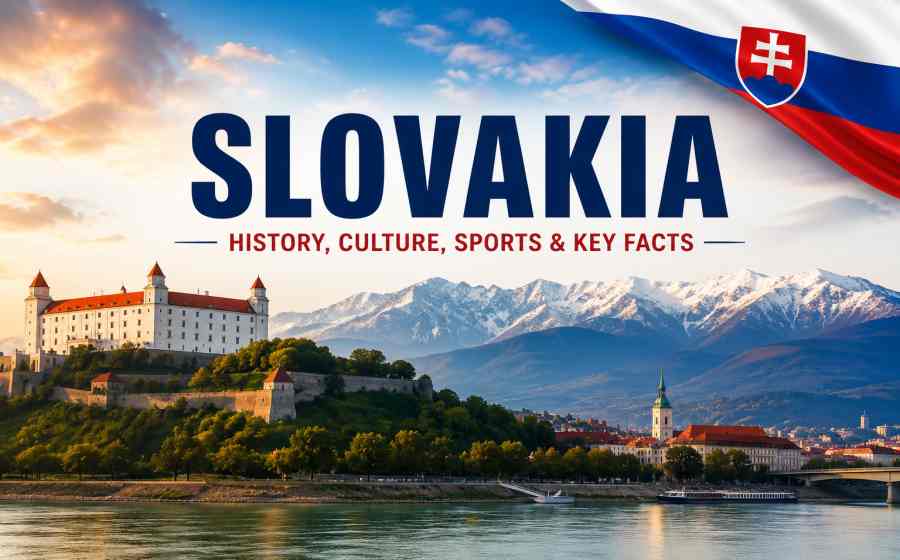
Slovakia is a beautiful landlocked country located in Central Europe. Known for its majestic mountains, medieval castles, colorful folk traditions, and rich cultural heritage, Slovakia is one of Europe’s most fascinating nations. Although it became an independent country only in 1993, its history stretches back over a thousand years. Today, Slovakia is recognized for its growing economy, stunning natural beauty, and strong traditions that attract visitors from around the world.
Table of Contents
Location and Geography
Slovakia lies in the heart of Europe and shares borders with Czech Republic, Austria, Hungary, Poland, and Ukraine. The country covers an area of about 49,000 square kilometers, making it one of Europe’s smaller nations.
The Carpathian Mountains dominate much of northern and central Slovakia, while fertile plains extend across the south. The country’s highest peak is Gerlachovský štít, standing at 2,655 meters in the High Tatras mountain range.
The Danube River, Europe’s second-longest river, flows through the southwestern part of Slovakia and passes its capital city.
Quick Facts
- Capital: Bratislava
- Largest City: Bratislava
- Official Language: Slovak
- Currency: Euro (€)
- Population: Around 5.4 million
- Continent: Europe
- Government: Parliamentary Republic
- Time Zone: Central European Time (CET)
History of Slovakia
The history of Slovakia dates back to ancient Celtic and Roman civilizations. During the 9th century, the region became part of the Great Moravian Empire, one of the earliest Slavic states.
Later, Slovakia remained under the Kingdom of Hungary for nearly one thousand years. Following World War I in 1918, Slovakia joined with the Czech lands to form Czechoslovakia.
During World War II, Slovakia briefly existed as an independent state under German influence. After the war, Czechoslovakia was re-established and later became a communist country under Soviet influence.
In 1989, the peaceful Velvet Revolution ended communist rule. On 1 January 1993, Czechoslovakia peacefully split into two countries—the Czech Republic and Slovakia. This event is popularly known as the Velvet Divorce.
Since then, Slovakia has joined major international organizations, including:
- European Union (2004)
- NATO (2004)
- Eurozone (2009)
- Schengen Area
Culture of Slovakia
Slovak culture reflects a blend of Slavic traditions, European influences, and local customs that have developed over centuries.
Traditional villages are famous for wooden churches, folk costumes, embroidery, music, and dance. Folk festivals are celebrated throughout the country, where people wear colorful traditional clothing and perform ancient dances.
Music plays an important role in Slovak culture. Folk songs are commonly accompanied by violins, flutes, and traditional instruments.
Slovakians also value family traditions, hospitality, and community celebrations. Christmas and Easter are celebrated with unique customs that have been preserved for generations.
Traditional Food
Slovak cuisine is hearty and flavorful. Some popular dishes include:
- Bryndzové Halušky (potato dumplings with sheep cheese)
- Potato pancakes
- Cabbage soup
- Roast pork with dumplings
- Smoked cheese
- Traditional pastries
- Honey cakes
Potatoes, dairy products, cabbage, mushrooms, and meat are common ingredients in Slovak cooking.
Economy
Slovakia has developed into one of Central Europe’s fastest-growing economies. The country is especially famous for automobile manufacturing. Several global car companies operate factories in Slovakia, making it one of the world’s largest car producers per capita.
Major industries include:
- Automobile manufacturing
- Engineering
- Electronics
- Machinery
- Information technology
- Tourism
- Agriculture
The country also exports machinery, vehicles, and electronic equipment worldwide.
Education
Education in Slovakia is compulsory for children and follows European educational standards. Higher education is offered through several universities, including the prestigious Comenius University in Bratislava, founded in 1919. Students from various countries also choose Slovakia for affordable higher education.
Sports in Slovakia
Sports are an important part of Slovak life.
The country’s most popular sports include:
- Ice Hockey
- Football (Soccer)
- Skiing
- Tennis
- Cycling
- Athletics
Ice Hockey
Ice hockey is considered Slovakia’s national sport. The Slovak national team has won medals in the Winter Olympics and the IIHF Ice Hockey World Championship, producing internationally famous players.
Football
Football enjoys massive popularity across Slovakia. Clubs compete in the Slovak First Football League, while the national team regularly participates in European competitions.
Winter Sports
Because of the High Tatras mountains, skiing and snowboarding attract thousands of visitors every winter.
Tourism
Slovakia offers numerous attractions for tourists.
Popular destinations include:
- Bratislava Castle
- High Tatras National Park
- Spiš Castle
- Slovak Paradise National Park
- Bojnice Castle
- Demänovská Cave System
The country is home to more than 180 castles and castle ruins, making it one of Europe’s richest countries in medieval architecture. Nature lovers enjoy hiking, skiing, mountain climbing, and cave exploration.
Government
Slovakia is a parliamentary democratic republic. The President serves as the head of state, while the Prime Minister leads the government.
The country has a multi-party political system and follows democratic principles established after independence.
Interesting Facts About Slovakia
- Slovakia became independent on 1 January 1993.
- Bratislava is the only capital city in the world that borders two countries (Austria and Hungary).
- Slovakia has more than 6,000 caves, although only a small number are open to visitors.
- The High Tatras are among Europe’s smallest alpine mountain ranges.
- The country has over 180 castles and fortresses.
- Slovakia uses the Euro despite not being one of the original Eurozone members.
- It is one of Europe’s safest countries for travelers.
- Traditional wooden churches of Slovakia are recognized as UNESCO World Heritage Sites.
- The country has a strong automotive industry with global importance.
- Folk music and dance remain an active part of Slovak culture.
Why Slovakia is Important
Slovakia serves as an important connection between Western and Eastern Europe. Its strategic location, modern industries, skilled workforce, and membership in the European Union make it an important European nation. Beyond its economic success, Slovakia preserves centuries-old traditions, stunning landscapes, and historical monuments that make it culturally unique.
Summary
Slovakia is a remarkable Central European country where history, natural beauty, and modern development exist side by side. From the breathtaking High Tatras and magnificent castles to its vibrant folk traditions and successful automobile industry, Slovakia offers much to learn and admire. Its peaceful history of independence, rich cultural heritage, and growing global presence make it an important topic for students and General Knowledge enthusiasts. Understanding Slovakia helps broaden our knowledge of Europe’s diverse cultures, geography, and historical development.
Also Check: General Knowledge