Burundi – History, Culture, Traditions, Sports and Fascinating Facts
Burundi is a culturally rich East African nation known for its royal drummers, ancient history, Lake Tanganyika, diverse traditions and resilient people.
Burundi
Burundi is a small but culturally rich country located in East Africa. Despite its modest size, Burundi has a long history, vibrant traditions, beautiful landscapes, and resilient people. It is one of Africa’s oldest kingdoms and is known for its unique drumming heritage, colorful cultural celebrations, and breathtaking natural scenery. Although the country has faced political and economic challenges over the years, it continues to preserve its traditions and work toward development.
Burundi is bordered by Rwanda to the north, Tanzania to the east and south, and the Democratic Republic of the Congo to the west. The country also shares the beautiful shoreline of Lake Tanganyika, one of the world’s deepest freshwater lakes. Agriculture forms the backbone of Burundi’s economy, while coffee and tea remain its major export products.
Table of Contents
History of Burundi
Burundi has one of Africa’s oldest continuous kingdoms. Long before European colonization, it was ruled by a monarchy known as the Kingdom of Burundi. The king, called the Mwami, governed the country with the support of traditional chiefs.
During the late 19th century, Burundi became part of German East Africa. After Germany’s defeat in World War I, the League of Nations placed Burundi under Belgian administration along with neighboring Rwanda. Belgian colonial policies created social divisions that later contributed to political conflicts.
Burundi gained independence on 1 July 1962. Initially, it remained a constitutional monarchy, but the monarchy was abolished in 1966, and the country became a republic.
The decades following independence witnessed ethnic tensions and civil conflict between the Hutu and Tutsi communities. The civil war, which lasted from 1993 to 2005, caused significant loss of life and displacement. Peace agreements eventually helped restore stability, although political and economic challenges continue. Today, Burundi is gradually focusing on national development, education, healthcare, and economic growth.
Geography of Burundi
Burundi covers approximately 27,834 square kilometers, making it one of Africa’s smaller countries. Important geographical features include:
- Capital: Gitega (Political Capital)
- Largest City: Bujumbura
- Highest Point: Mount Heha (2,684 meters)
- Major Lake: Lake Tanganyika
- Climate: Tropical highland climate with moderate temperatures
- Main Rivers: Ruvubu River and Ruzizi River
The country’s landscape mainly consists of hills, valleys, plateaus, and fertile farmland, earning Burundi the nickname “The Heart of Africa.”
Culture and Traditions
Burundian culture reflects centuries of tradition and community values. Music, dance, storytelling, and ceremonies remain important parts of daily life.
Traditional Drumming
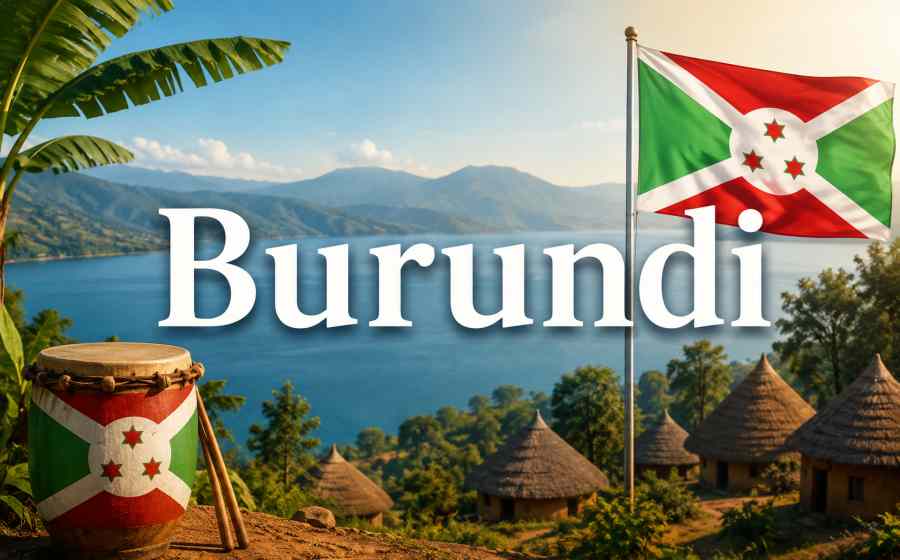
Burundi is internationally famous for its Royal Drummers, whose energetic performances feature massive traditional drums accompanied by dancing and singing. This drumming tradition has been recognized by UNESCO as an Intangible Cultural Heritage.
Languages
Burundi has three official languages:
- Kirundi
- French
- English
Kirundi is spoken by almost the entire population, making it one of the few African countries with a common native language.
Traditional Clothing
During cultural celebrations, colorful garments, woven fabrics, and handmade accessories are commonly worn. Modern clothing is also popular in urban areas.
Food
Common Burundian dishes include:
- Beans
- Cassava
- Sweet potatoes
- Plantains
- Maize
- Rice
- Fish from Lake Tanganyika
Tea and locally grown coffee are widely consumed throughout the country.
Economy of Burundi
Burundi remains one of the world’s least-developed economies, with agriculture serving as its primary economic activity.
Major agricultural products include:
- Coffee
- Tea
- Bananas
- Beans
- Cassava
- Cotton
- Maize
Coffee is Burundi’s most valuable export and provides income for many farming families.
The country is also working to improve:
- Infrastructure
- Education
- Tourism
- Renewable energy
- Small-scale industries
International partnerships continue to support Burundi’s development efforts.
Wildlife and Natural Attractions
Although Burundi is relatively small, it has diverse wildlife and natural beauty.
Popular attractions include:
Lake Tanganyika
One of the oldest and deepest freshwater lakes in the world, Lake Tanganyika supports numerous fish species and offers scenic beaches.
Kibira National Park
This rainforest is home to:
- Chimpanzees
- Monkeys
- Birds
- Butterflies
- Rich plant diversity
Ruvubu National Park
The country’s largest national park protects wildlife such as:
- Buffaloes
- Antelopes
- Hippos
- Crocodiles
- Numerous bird species
Nature lovers visit Burundi to experience its peaceful landscapes and biodiversity.
Sports in Burundi
Sports play an increasingly important role in Burundi, especially among young people.
Football
Football is the country’s most popular sport. The Burundi national football team competes in African tournaments and regional championships.
Athletics
Burundi has gained international recognition in middle-distance running. The nation’s greatest sporting achievement came through Venuste Niyongabo, who won the 5,000-meter gold medal at the 1996 Olympic Games. This remains Burundi’s first Olympic gold medal and a proud moment in the country’s sporting history.
Other Sports
People also participate in:
- Basketball
- Volleyball
- Cycling
- Martial arts
- Traditional games
Government initiatives continue to encourage youth participation in sports.
Education in Burundi
Education is considered essential for the country’s future development.
The government has expanded access to primary education and continues working to improve:
- School infrastructure
- Teacher training
- Literacy rates
- Technical education
- Higher education opportunities
Universities in Burundi offer programs in agriculture, engineering, medicine, business, and social sciences.
Government and Political System
Burundi is a presidential republic.
The government consists of:
- President
- Prime Minister
- National Assembly
- Senate
- Independent judiciary
The Constitution promotes democratic governance while encouraging national unity after years of conflict.
Interesting Facts About Burundi
- Burundi is one of Africa’s oldest kingdoms.
- The country became independent on 1 July 1962.
- Gitega is the political capital, while Bujumbura remains the economic center.
- Kirundi is spoken by nearly the entire population.
- Burundi’s Royal Drummers are famous worldwide.
- Lake Tanganyika is among the deepest lakes on Earth.
- Coffee is the country’s leading export.
- Burundi won its first Olympic gold medal in athletics in 1996.
- Much of the country’s landscape consists of rolling green hills.
- Agriculture employs the majority of the population.
Why Burundi Matters
Burundi may be small in size, but it has a rich cultural heritage, remarkable history, and resilient people. Its ancient monarchy, traditional drumming, fertile landscapes, and world-class athletes highlight the country’s unique identity. While Burundi continues to face economic and developmental challenges, ongoing efforts in education, agriculture, infrastructure, and peacebuilding offer hope for a brighter future. Learning about Burundi provides valuable insight into the diversity, traditions, and enduring spirit of East Africa.
Summary
Burundi is a small East African country with a rich historical legacy, vibrant cultural traditions, and scenic natural landscapes. Known for its ancient kingdom, UNESCO-recognized Royal Drummers, and the beauty of Lake Tanganyika, the nation reflects a unique blend of heritage and resilience. Agriculture, especially coffee and tea production, plays a vital role in its economy, while football and athletics are among the most popular sports. Despite past political and economic challenges, Burundi continues to make progress in education, development, and national unity, making it an important country to study in the context of African history and culture.
Also Check: General Knowledge