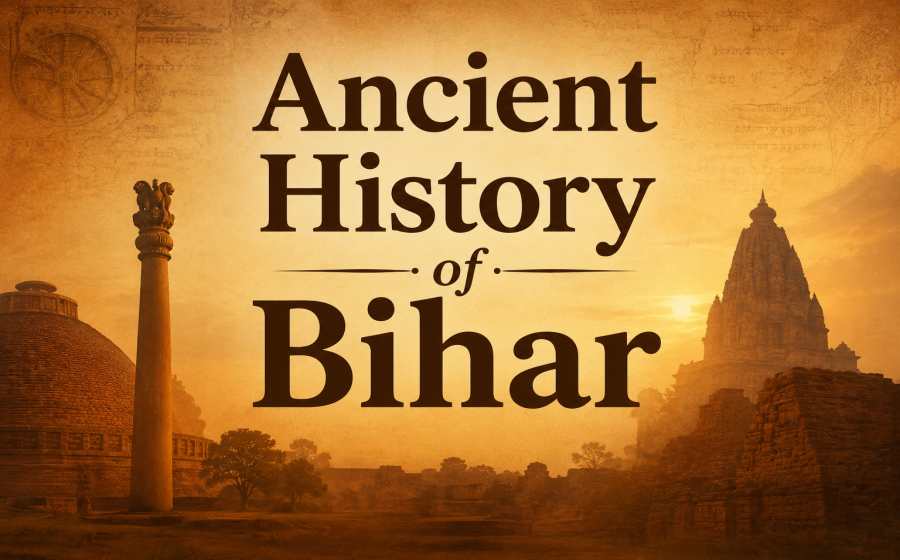
Ancient History of Bihar – The Complete Journey from Magadha to Modern Times
Explore the ancient history of Bihar from the rise of Magadha and powerful empires to its cultural, religious and historical legacy that shaped modern India.
Ancient History of Bihar
Bihar is one of the oldest continuously inhabited regions in the world and holds a unique place in the history of India. Known as the cradle of ancient Indian civilization, Bihar has been the center of powerful kingdoms, great universities, religious movements, and remarkable rulers. The land gave birth to influential ideas in politics, philosophy, education, and spirituality that continue to inspire the world today.
From the rise of the mighty Kingdom of Magadha to becoming the birthplace of Buddhism and Jainism, Bihar’s ancient history is rich and fascinating. The state’s historical journey eventually shaped its identity in medieval and modern India.
Table of Contents
Early Settlements in Bihar
Human settlements in Bihar date back thousands of years. Archaeological discoveries suggest that the region was inhabited during the Neolithic period. Fertile plains created by the Ganga and its tributaries supported agriculture, trade, and the growth of early civilizations.
During the Vedic period (around 1500–600 BCE), several powerful kingdoms known as Mahajanapadas emerged across northern India. Among them, Magadha became the strongest and most influential.
Rise of the Kingdom of Magadha
Magadha was located in present-day southern Bihar, with its early capital at Rajgir (ancient Rajagriha). The kingdom enjoyed several geographical advantages:
- Fertile agricultural land
- Rich iron ore deposits
- Dense forests providing timber
- Easy river transport through the Ganga
These advantages helped Magadha become economically prosperous and militarily powerful.
Bimbisara (558–491 BCE)
King Bimbisara of the Haryanka Dynasty expanded Magadha through diplomacy, military strength, and strategic marriages. He established friendly relations with neighboring kingdoms while strengthening internal administration. He is remembered as one of the first great rulers of ancient Bihar.
Ajatashatru
Ajatashatru succeeded Bimbisara and further expanded Magadha. He built strong fortifications, introduced advanced military weapons, and shifted the kingdom toward becoming the dominant power in northern India. His reign witnessed conflicts with neighboring kingdoms and growing urban development.
Pataliputra – The Great Capital
One of the most significant developments in Bihar’s history was the establishment of Pataliputra, today’s Patna.
Due to its strategic location near the confluence of major rivers, Pataliputra became:
- Administrative headquarters
- Commercial center
- Military base
- Cultural capital
For nearly one thousand years, Pataliputra remained one of the world’s greatest cities.
The Nanda Dynasty
After the Haryanka and Shishunaga dynasties, the Nanda Dynasty emerged around the 4th century BCE.
The Nandas built one of the largest armies of ancient India with thousands of soldiers, elephants, cavalry, and chariots. Their immense wealth earned Magadha great prestige throughout the Indian subcontinent.
However, their rule eventually ended with the rise of one of India’s greatest empires.
The Maurya Empire
The Maurya Empire began in Bihar and transformed Indian history forever.
Chandragupta Maurya
With the guidance of the brilliant scholar Chanakya (Kautilya), Chandragupta Maurya defeated the Nanda rulers and established the Maurya Empire around 322 BCE.
The empire soon expanded across most of the Indian subcontinent, making it one of the largest empires in Indian history.
Chanakya’s Contribution
Chanakya, believed to have studied and taught at Takshashila, played a major role in statecraft and governance.
His famous work, the Arthashastra, remains an important text on:
- Politics
- Economics
- Diplomacy
- Military strategy
- Public administration
Emperor Ashoka and Bihar
The greatest Mauryan ruler was Emperor Ashoka.
Initially known for military conquests, Ashoka changed after witnessing the destruction caused by the Kalinga War. He embraced Buddhism and dedicated his life to peace, justice, and welfare.
From Bihar, Ashoka promoted Buddhism across Asia by:
- Building stupas
- Constructing pillars
- Sending missionaries abroad
- Encouraging moral governance
Many Ashokan pillars and inscriptions still survive today.
Bihar and Buddhism
Bihar occupies a sacred place in Buddhist history. It was in Bodh Gaya that Prince Siddhartha attained enlightenment under the Bodhi Tree and became Gautama Buddha.
After enlightenment, Buddha spent several years travelling through Bihar, teaching his philosophy of:
- Compassion
- Non-violence
- Wisdom
- The Middle Path
Important Buddhist sites in Bihar include:
- Bodh Gaya
- Rajgir
- Nalanda
- Vaishali
These places continue to attract pilgrims from around the world.
Bihar and Jainism
Bihar is equally significant in the history of Jainism. Lord Mahavira, the 24th Tirthankara, spent much of his life preaching in Bihar. He attained enlightenment and spread the principles of:
- Truth
- Non-violence
- Simplicity
- Self-discipline
Vaishali is regarded as one of the important centers of Jain heritage.
Nalanda University
One of Bihar’s greatest achievements was the establishment of Nalanda University around the 5th century CE.
Nalanda became one of the world’s earliest residential universities.
It attracted students from:
- China
- Korea
- Tibet
- Japan
- Sri Lanka
- Southeast Asia
Subjects taught included:
- Philosophy
- Mathematics
- Medicine
- Astronomy
- Grammar
- Logic
- Literature
The university possessed an enormous library containing thousands of manuscripts and became an international center of learning.
Vikramshila University
Another renowned educational institution in Bihar was Vikramshila University, established during the Pala Dynasty.
It specialized in Buddhist studies and attracted scholars from many countries. Together, Nalanda and Vikramshila made Bihar the educational capital of ancient Asia.
Gupta Period
During the Gupta Empire (4th–6th century CE), Bihar continued to flourish. Often called the Golden Age of India, this period witnessed remarkable progress in:
- Literature
- Science
- Mathematics
- Art
- Architecture
- Astronomy
Trade and education prospered, while Bihar remained an important political and cultural center.
Medieval Changes
Beginning in the 12th century, repeated invasions altered Bihar’s political landscape. In 1193 CE, Nalanda University suffered destruction during military invasions, leading to the decline of one of the world’s greatest centers of education.
Over time, Bihar came under the rule of the Delhi Sultanate, followed by the Mughal Empire. Although political control changed, Bihar continued contributing to agriculture, trade, and religious life.
Bihar in Modern India
During British rule, Bihar became an important center of India’s freedom movement.
Several notable leaders emerged from Bihar, including:
- Dr. Rajendra Prasad, the first President of independent India
- Jayaprakash Narayan, a prominent social and political leader
- Babu Kunwar Singh, a hero of the Revolt of 1857
On 22 March 1912, Bihar became a separate province after being carved out of the Bengal Presidency. After India’s independence in 1947, Bihar became one of the country’s major states. In 2000, the state of Jharkhand was formed from its southern districts.
Historical Importance of Bihar
The history of Bihar has influenced not only India but also much of Asia. The region contributed to:
- The rise of powerful empires
- Development of democratic traditions in ancient republics like Vaishali
- Birth and spread of Buddhism and Jainism
- Establishment of world-famous universities
- Advancement of governance through Chanakya’s Arthashastra
- Growth of art, education, and philosophy
These achievements continue to make Bihar one of India’s most historically significant states.
Summary
The ancient history of Bihar is a story of remarkable achievements in governance, education, religion, and culture. From the mighty Kingdom of Magadha to the Maurya Empire, from the teachings of Buddha and Mahavira to the glory of Nalanda University, Bihar has shaped the course of Indian and world history. Even in modern times, its historical legacy remains a source of pride and inspiration. Understanding Bihar’s past helps us appreciate its enduring contribution to civilization and its lasting influence on the cultural heritage of India.
Also Check: Bihar GK