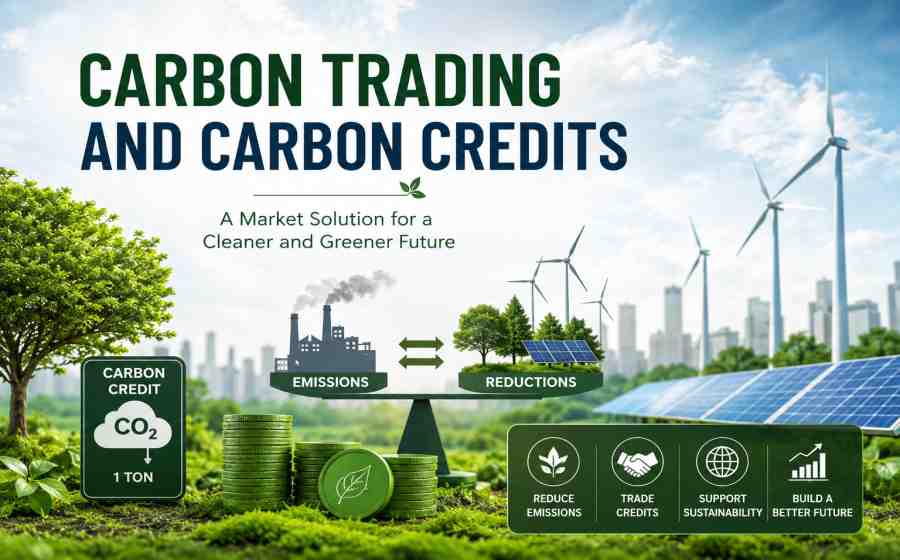
Carbon Trading and Carbon Credits – How They Work to Fight Climate Change
Learn about Carbon Trading and Carbon Credits, how they work, their benefits, challenges and their role in reducing global carbon emissions.
Carbon Trading and Carbon Credits
Climate change has become one of the biggest global challenges of the 21st century. Rising temperatures, melting glaciers, unpredictable weather, and increasing pollution levels are affecting both nature and human life. To reduce greenhouse gas emissions and control global warming, governments and organizations around the world have introduced several environmental strategies. One of the most important among them is Carbon Trading and Carbon Credits.
These concepts aim to encourage industries and countries to reduce carbon emissions while promoting cleaner and greener technologies. Carbon trading has now become a major part of global environmental policies and sustainable development goals.
Table of Contents
What is Carbon Trading?
Carbon trading is a market-based system designed to reduce the emission of greenhouse gases, especially carbon dioxide (CO₂). Under this system, companies or countries are given a specific limit for carbon emissions. If they emit less than the allowed limit, they can sell their unused emission allowance to others. On the other hand, those who exceed their limits must buy extra allowances.
This system creates a financial incentive for industries to reduce pollution. Companies that adopt cleaner technologies can earn profits by selling excess credits, while polluting industries face higher costs.
Carbon trading is often called the “cap-and-trade” system because governments place a cap on total emissions and allow trading within that limit.
What are Carbon Credits?
A carbon credit is a permit or certificate that represents the reduction or removal of one metric ton of carbon dioxide or equivalent greenhouse gases from the atmosphere.
Carbon credits are generated through activities that reduce emissions, such as:
- Planting trees and forest conservation
- Renewable energy projects like solar and wind power
- Energy-efficient technologies
- Waste management and recycling projects
- Methane capture systems
Organizations or individuals who reduce emissions can earn carbon credits and sell them in the carbon market.
How Does Carbon Trading Work?
The carbon trading process works in several steps:
1. Setting Emission Limits
Governments or international organizations fix a limit on total greenhouse gas emissions for industries or countries.
2. Allocation of Carbon Allowances
Companies receive carbon allowances or permits based on their operations and emission levels.
3. Monitoring Emissions
Industries regularly measure and report the amount of carbon they emit.
4. Buying and Selling Credits
- Companies emitting less than their limit can sell unused credits.
- Companies exceeding their limits must purchase additional credits.
5. Encouraging Green Practices
This system motivates industries to use renewable energy and cleaner technologies to reduce costs.
Types of Carbon Markets
There are mainly two types of carbon markets:
1. Compliance Market
This market is regulated by governments and international agreements. Companies must follow legal emission limits. The European Union Emissions Trading System (EU ETS) is a well-known example.
2. Voluntary Carbon Market
In this market, companies and individuals voluntarily buy carbon credits to offset their emissions and improve environmental responsibility.
For example, an airline company may buy carbon credits to compensate for the pollution caused by flights.
Importance of Carbon Trading and Carbon Credits
1. Reduces Greenhouse Gas Emissions
Carbon trading encourages industries to cut emissions and adopt eco-friendly methods.
2. Promotes Renewable Energy
Solar, wind, and hydroelectric projects receive financial support through carbon credit systems.
3. Encourages Innovation
Companies invest in cleaner technologies and energy-efficient systems to reduce operational costs.
4. Supports Sustainable Development
Carbon markets help balance economic growth with environmental protection.
5. Global Cooperation
Countries work together under international agreements like the Paris Climate Agreement to reduce global warming.
Advantages of Carbon Trading
Cost-Effective Solution
Companies can reduce emissions in the most economical way possible.
Economic Opportunities
Carbon markets create new business opportunities in renewable energy and environmental projects.
Environmental Protection
Reduced emissions improve air quality and slow climate change.
Encourages Corporate Responsibility
Businesses become more environmentally conscious and sustainable.
Challenges of Carbon Trading
Despite its benefits, carbon trading also faces several challenges.
1. Difficulty in Monitoring
Accurate measurement of carbon emissions can be complex.
2. Risk of Fraud
Fake carbon credits and incorrect reporting can weaken the system.
3. Unequal Benefits
Developed countries and large corporations may gain more advantages compared to poorer nations.
4. High Initial Costs
Installing clean technologies can be expensive for industries.
5. Limited Impact Without Strong Rules
If governments do not enforce strict emission caps, carbon trading may not significantly reduce pollution.
Carbon Trading in India
India is actively participating in climate action and renewable energy development. The country has promoted:
- Solar energy projects
- Wind energy expansion
- Afforestation programs
- Energy-efficient industries
India is also developing a domestic carbon market to support industries in reducing emissions. The government aims to achieve net-zero emissions by 2070 and increase the use of clean energy.
Indian companies are increasingly investing in carbon credit projects because they provide both environmental and financial benefits.
Carbon Credits and Climate Change
Carbon credits play an important role in controlling climate change. By placing a monetary value on carbon emissions, they encourage businesses and governments to reduce pollution. However, experts believe carbon credits should not replace direct emission reduction efforts.
Industries must focus on reducing pollution at the source rather than depending entirely on purchased credits. A balanced approach combining renewable energy, energy efficiency, sustainable transport, and carbon markets is necessary for long-term environmental protection.
Future of Carbon Trading
The future of carbon trading looks promising as more countries commit to reducing greenhouse gas emissions. Global awareness about sustainability is increasing, and businesses are under pressure to adopt eco-friendly practices.
Technological advancements such as artificial intelligence, blockchain, and advanced monitoring systems may improve transparency and efficiency in carbon markets. As climate policies become stricter, carbon trading is expected to play a larger role in achieving global climate goals.
Summary
Carbon Trading and Carbon Credits are important tools in the global fight against climate change. They encourage industries and countries to reduce emissions while supporting renewable energy and sustainable development. Although the system faces challenges like monitoring issues and market inequalities, it remains one of the most practical approaches for controlling greenhouse gas emissions.
With stronger regulations, better transparency, and global cooperation, carbon trading can significantly contribute to a cleaner and greener future. Protecting the environment is now a shared responsibility, and carbon markets provide an innovative way to combine economic growth with environmental sustainability.
Also Check: Environment